
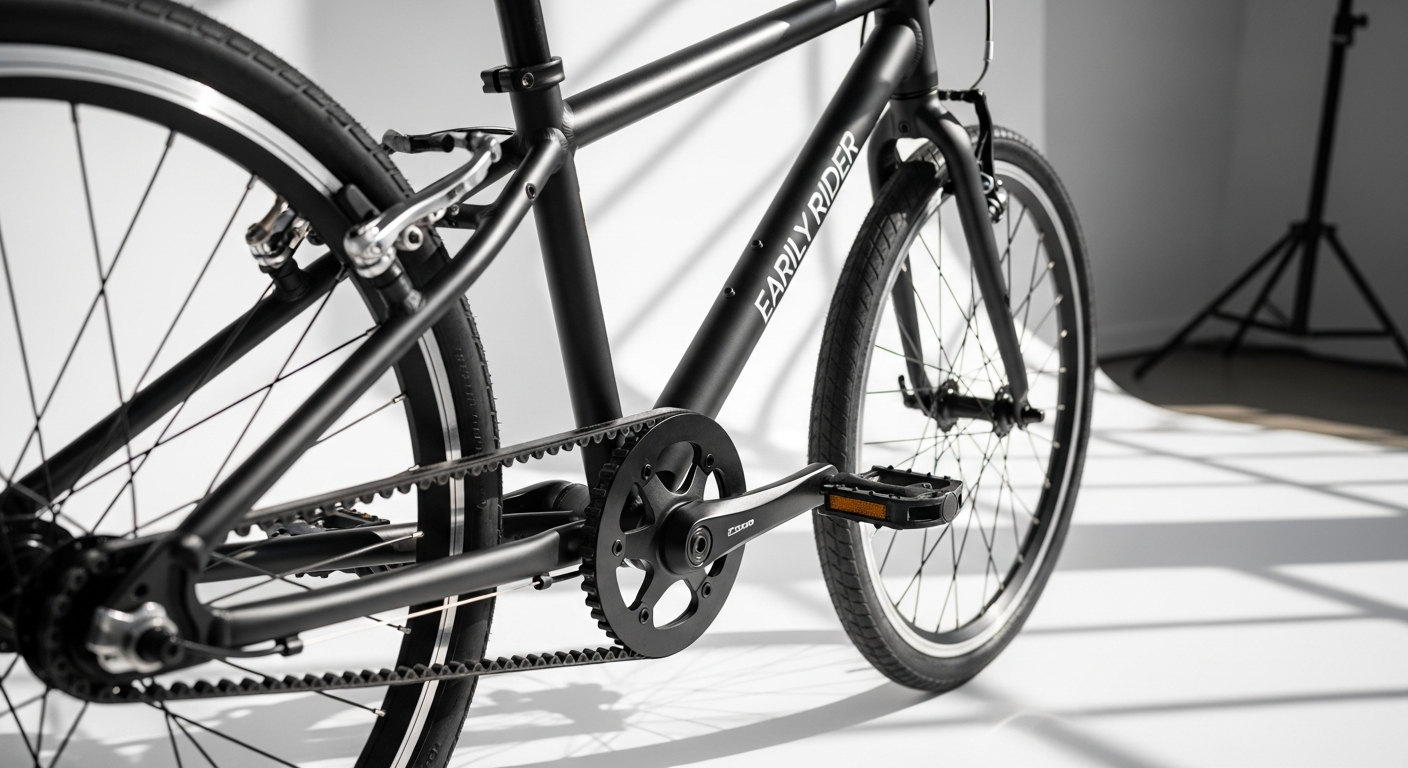
Discover why the Early Rider Belter 16 is the premium choice for young riders aged 4-6. Learn about its Gates belt drive, lightweight aluminum frame, and why parents invest in this award-winning 16-inch kids bike.
When you strap your child into a traditional chain-driven bike, you’re accepting a set of compromises that Early Rider simply refused to make. The Gates belt drive system represents a fundamental rethinking of children’s bicycle mechanics, replacing the century-old chain design with a clean, sealed carbon-reinforced belt that delivers performance without the mess.
Traditional chains demand constant attention—lubrication cycles, rust prevention, adjustment checks. They pinch fingers, snag clothing, and transfer grease onto your child’s legs and clothes. For young riders still developing coordination and awareness, these hazards translate to real safety concerns. The Gates system eliminates every one of these issues.
How the Gates Belt Drive Eliminates Traditional Chain Problems
The belt drive operates on a completely different principle than chains. Rather than relying on exposed links and teeth that require regular maintenance, the Gates system uses a closed-loop design that shields the drivetrain entirely. Your child can wear flowing pants, loose shoelaces, or dangling jacket hems without any risk of entanglement. The design speaks to serious engineering: it’s what engineers specify for cargo bikes, electric bikes, and premium adult bicycles.
Maintenance Advantages: Zero Lubrication, No Rust
Here’s what ownership actually looks like with the Belter 16: you don’t oil the drivetrain. You don’t adjust tension. You don’t scrape rust or check for wear patterns. The belt operates silently in its sealed system, and when rain comes, it shrugs off moisture that would accelerate corrosion on a traditional chain. This isn’t a luxury feature—it’s a fundamental simplification that means more time riding and less time troubleshooting.
Safety Benefits for Small Hands and Loose Clothing
Young riders haven’t yet internalized the spatial awareness that keeps clothing clear of moving parts. The Gates system eliminates this concern entirely. No pinch points. No catch hazards. No sudden grabs or pulls when a pant leg drifts toward the chainring. This freedom allows children to focus on learning pedaling technique and balance rather than worrying about dangerous contact points.
Durability and Longevity of Belt Systems
Chains stretch, wear, and eventually demand replacement—typically every 1,000-2,000 miles depending on maintenance and conditions. Gates belts run for 3,000+ miles with virtually no wear, and when they do eventually require replacement, the investment is minimal. This durability directly supports the Belter 16’s legendary resale value and multi-child hand-down potential.
Quieter Ride Experience That Encourages Longer Sessions
Chain noise is constant—a rhythmic clicking or grinding that becomes background static for experienced cyclists but can be fatiguing for young riders building endurance. The belt drive operates almost silently, creating an experience that feels more refined and encouraging. Longer rides become possible without the auditory fatigue that wears down young cyclists.
Environmental and Hygiene Advantages
Grease stains don’t come out easily. They accumulate on clothing, skin, and eventually your home. The belt system eliminates this environmental friction entirely. Your child arrives home clean. The bike stays clean. This matters more than it initially seems—it removes a practical barrier that prevents some families from encouraging regular cycling.
Discover the Early Rider Belter 16 and experience the belt drive advantage for yourself.
Feather-Light Performance: How 5.6kg Makes a Difference for Young Riders
A child’s strength develops gradually. The difference between a 7 kg bike and a 5.6 kg bike represents roughly 20% of a young rider’s body weight—a proportion that dramatically affects how they experience cycling. The Belter 16’s hand-brushed aluminum frame tips the scales at just 5.6-6.1 kg (12.3-13.5 pounds), a specification that transforms fundamental riding dynamics.
Weight Specifications and Why This Matters for Children’s Development
When a bike weighs less relative to a child’s body mass, acceleration happens faster, hills feel climbable, and confidence compounds. A heavier bike creates fatigue that discourages practice. A lighter bike invites longer sessions and more experimentation. This isn’t abstract—it’s the difference between a child who rides enthusiastically and one who treats cycling as an obligation.
Impact of Lightweight Construction on Acceleration, Hill Climbing, and Maneuverability
Physics doesn’t negotiate. Less mass requires less force to move, less energy to accelerate, and less strength to maintain momentum. A child pedaling a 5.6 kg bike experiences immediate feedback—their effort produces results. On inclines, lightweight construction becomes genuinely significant. Hills that would require dismounting and walking on heavier bikes remain rideable on the Belter 16.
Hand-Brushed Aluminum Frame Benefits
The aluminum construction provides durability without bulk. Aluminum resists corrosion naturally, shrugs off rust, and maintains structural integrity through years of use. The hand-brushed finish isn’t purely aesthetic—it reflects Early Rider’s commitment to quality at every detail level. You’re buying a bike that will look respectable when you eventually pass it to the next child or sell it.
Confidence Building: How Easier Handling Translates to Skill Development
Responsive handling builds confidence. When a child steers and the bike responds immediately, they develop intuitive understanding of balance and control. When a bike feels heavy and sluggish, they develop compensatory habits—over-steering, jerky movements, tension. The Belter 16’s lightweight construction allows natural development of proper technique because the bike rewards good form with responsive performance.
Comparison with Heavier Competitor Bikes
Most children’s bikes in the 16-inch category weigh 6.5-7.5 kg. That 1-1.5 kg difference represents a 15-20% weight penalty that compounds across every ride. Competitors achieve lower prices by using heavier steel frames or inferior component choices. The Belter 16 achieves its weight through aluminum engineering and premium design—you’re paying for sophisticated manufacturing, not cost-cutting.
Carrying and Transport Advantages for Parents
Parents quickly discover that lightweight bikes become family assets in unexpected ways. Loading into car trunks, carrying up stairs, assisting with mounting—the physical experience of managing the bike becomes noticeably easier. On family cycling trips, a lighter bike means less fatigue and frustration when transporting equipment.
Premium Component Breakdown: What You’re Actually Paying For
The Belter 16’s price point sits at £449-$479 USD, placing it firmly in premium territory. Understanding the component composition reveals exactly where this investment concentrates and why the engineering justifies the cost.
Dual Tektro Handbrakes with Short, Easy-Pull Levers
The braking system represents a critical interface between rider and bike. Young hands lack the strength that adult riders take for granted. The Tektro dual brakes feature short pull levers specifically designed for small hands, allowing effective braking without requiring significant hand strength. This engineering detail matters directly for safety and confidence—children can stop reliably without struggling against brake resistance.
Ritchey Stem and Handlebars: Professional-Grade Components
Ritchey manufactures components for professional-level adult bikes. These aren’t commodity parts selected primarily for cost efficiency. Ritchey components offer precise fit, responsive handling characteristics, and longevity that persists through multiple children’s growth phases. The stem and bars work together to create the handling geometry that makes the Belter 16 feel responsive and precise.
2-Inch Tire Options and Stability
The Vee Speedster and Schwalbe Billy Bonkers tires represent thoughtful selections for the target use case. The 2-inch width provides stability and traction on paved surfaces where most young riders spend their time, while the tire geometry supports confident cornering and braking. The frame’s design accommodates wider tire options, meaning you can transition to more aggressive tread patterns if your child develops interest in rough terrain riding.
Corrosion-Resistant Hardware
Early Rider specifies hardware that resists corrosion throughout the bike. Stainless steel fasteners, protective coatings, and material selections that prevent rust accumulation. This attention to detail ensures that the bike maintains its appearance and function year after year, supporting the resale value that makes premium bikes economically sensible for families.
Frame Geometry Engineered for Comfort, Control, and Efficiency
The frame geometry doesn’t simply scale down an adult design. The chainstay length, seat tube angle, and handlebar reach exist specifically to support a young rider’s proportions and developing technique. This geometry supports proper pedaling mechanics, encourages correct posture, and creates a responsive platform for skill development.
Tire Versatility: Future Off-Road Exploration
As your child’s confidence grows, the ability to accommodate wider, more aggressive tires becomes significant. The frame design allows for future customization without requiring a complete bike replacement. This versatility extends the useful lifespan and supports skill progression from pavement to varied terrain.
Award-Winning Design: The Eurobike Gold Standard
The Early Rider Belter 16 won the Gold Eurobike Award, an accolade that carries significant weight in cycling engineering circles. This recognition validates the design philosophy and engineering approach that defines the bike.
Recognition That Validates Engineering Excellence
Eurobike judges evaluate entries based on innovation, design quality, functionality, and market relevance. A Gold Award in the children’s category represents genuine recognition from industry experts that the Belter 16 represents excellence in its category. This isn’t marketing hyperbole—it’s third-party validation from engineers and designers who evaluate hundreds of products annually.
How the Belter 16 Mirrors High-End Adult Bike Principles
Early Rider didn’t simplify adult bike principles to create a children’s bike. Instead, they applied the same rigorous engineering standards that define premium adult bicycles. Premium materials, thoughtful component selection, geometry optimization, and attention to detail. The result feels premium because it follows premium design principles rather than cost-reduction imperatives.
Industry Reputation Within the Premium Children’s Bike Market
Within cycling communities, the Belter 16 carries aspirational status. Parents actively seek this specific model. The used market for Belter 16s remains remarkably strong because demand consistently exceeds supply. This reputation concentrates value and supports resale economics that make the premium price more financially sensible.
Longevity and Resale Value Driven by Sought-After Status
Parents report recovering 60-75% of their Belter 16 investment when selling to the next owner. This resale strength stems directly from reputation, durability, and sustained demand. The bike doesn’t become obsolete—it becomes a valued hand-me-down or resale item that maintains economic value throughout its useful life.
What Winning Design Means for Your Child’s Riding Experience
Award recognition translates practically into a bike that feels competent and responsive. Geometry that supports confident handling. Components that perform reliably. Materials that endure. The psychological effect shouldn’t be underestimated—your child is riding a bike that reflects genuine quality rather than a scaled-down toy alternative.
The Investment Reality: Understanding Premium Pricing
At £449-$479 USD, the Belter 16 represents a substantial investment for a bike that your child will outgrow in 2-3 years. Understanding the economics reveals why this premium positioning makes sense for many families.
Price Range Context and Market Positioning
The Belter 16 sits at the premium extreme of the 16-inch children’s bike market. Budget alternatives start around £150-200 USD. Mid-range options occupy the £250-350 range. The Belter 16’s premium positioning reflects its material choices, component specifications, and engineering sophistication. You’re paying for aluminum instead of steel, Gates belt drives instead of chains, and Tektro brakes instead of commodity alternatives.
Cost-Per-Use Analysis: Durability and Resale Offset Investment
A family purchasing the Belter 16 for £449 and selling it eighteen months later for £300 has actually paid £149 for eighteen months of regular riding. Divide that across 50+ riding days per season, and the daily cost becomes remarkably reasonable. Compare this to a £200 bike that requires replacement within two years, and the economics favor the premium option.
Comparison to Budget Alternatives and What You Gain
Budget bikes deliver transportation functionality. The Belter 16 delivers a carefully engineered riding platform that encourages skill development and longer sessions. Components on budget bikes wear faster, requiring earlier replacement. Heavier frames create fatigue that discourages use. The comparison isn’t purely financial—it’s about the riding experience that motivates children to ride more frequently and develop genuine enthusiasm for cycling.
Resale Market Strength: Recovering 60-75% of Investment
The Belter 16 maintains value in ways that most children’s bikes don’t. Strong secondary market demand, reputation within cycling communities, and genuine durability combine to create resale economics that are almost unique in the children’s bike category. Serious buyers actively seek Belter 16s specifically, not as default options but as preferred choices.
When the Premium Price Makes Sense for Your Family
The premium pricing makes strongest sense when you have clear riding plans beyond a single season. If your child is genuinely interested in cycling as an activity, not a passing phase. If you’re planning to use the bike for multiple children through hand-down scenarios. If you’re willing to use resale markets to recover a significant portion of the investment. For families meeting these criteria, the premium price becomes defensible rather than extravagant.
Financing and Value Retention Strategies
Some families split the investment by purchasing used Belter 16s from the strong secondary market, reducing initial outlay while still accessing the premium engineering. Others pursue multi-child strategies where the bike serves three or four children across ten years, making the annual cost minimal. Planning for eventual resale from the purchase date—keeping the bike well-maintained, documenting condition, photographing details—supports stronger secondary market performance.
Honest Limitations: What You Should Know Before Buying
No product achieves excellence uniformly across all dimensions. The Belter 16 has recognized limitations worth considering before committing to the investment.
Stock Pedal Grip Concerns in Older Models
Early user reviews of initial Belter 16 production runs noted that stock pedals could feel slippery, particularly in wet conditions or when wearing smooth-soled shoes. Later production runs appear to have addressed this concern with improved pedal designs, but if you’re purchasing used or from older inventory, pedal performance is worth verifying. Replacement pedals are readily available and represent a minor expense if needed.
Limited Reach Adjustment Options
The stem and handlebar configuration offers less adjustability than some competitors. Some taller riders within the intended age range report that reach feels slightly extended, while shorter riders experience minor fit challenges. The bike works well for children matching the designed proportions (approximately 44.5 cm inside leg measurement), but falls slightly outside optimal fit for children at the extremes of the size spectrum.
Price Barrier for Families on Tighter Budgets
For families where £449-$479 USD represents a significant financial commitment, the premium pricing creates a genuine barrier. Budget constraints make the premium investment emotionally difficult, even when long-term economics support the decision. This limitation isn’t a product deficiency—it’s a market reality that affects access to premium engineering for some families.
Availability and Lead Time Considerations
The Belter 16’s popularity sometimes creates inventory constraints. Waiting lists, extended lead times, or limited availability in certain regions represent practical challenges. If you need a bike urgently, availability might force you toward alternatives. Planning ahead and checking current stock status becomes necessary.
Sizing Specificity: The 44.5cm Inside Leg Measurement
The Belter 16 targets a specific developmental stage and inseam measurement. Children significantly outside this range might experience fit challenges. Measuring your child’s inside leg inseam before purchase becomes essential—ordering without verifying fit creates unnecessary risk.
Customization Limitations Compared to Adult Bikes
The Belter 16 exists as a complete system rather than a customizable platform. You can upgrade pedals or tires, but the fundamental geometry and component ecosystem remain fixed. Adult premium bikes offer more extensive customization options. The Belter 16’s approach trades flexibility for optimized design coherence—a trade-off that makes sense for the product category but represents a legitimate limitation worth acknowledging.
Ideal Rider Profile: Is the Belter 16 Right for Your Child?
The Belter 16 serves a specific user profile effectively. Understanding whether your child matches this profile clarifies whether the premium investment makes sense.
Age Range and Developmental Readiness
The Belter 16 targets children aged approximately 4-6 years with inside leg measurements near 44.5 cm. This represents the developmental stage where confident pedalers transition from balance bikes into serious pedaling mechanics. Your child should demonstrate clear comfort with pedaling technique and steering before the premium investment becomes fully justified. Children still mastering basic balance might experience frustration with the bike’s responsive handling characteristics.
Skill Level Requirements
The Belter 16 rewards confident pedaling technique. Children who remain hesitant on bikes, who lack balance confidence, or who treat cycling as incidental activity might not develop sufficient skill to justify the premium engineering. The bike shines for children ready to embrace cycling genuinely, not as a casual activity but as an actual recreational interest.
Family Cycling Ambitions and Long-Term Riding Plans
Families with genuine cycling ambitions—weekend rides, touring, cycling as family activity—get maximum value from the Belter 16. The bike supports skill development that extends naturally into adult cycling. For families where the bike represents a temporary accommodation before the child shifts to other activities, the premium investment becomes harder to justify economically.
Maintenance Expectations and Parent Involvement
The Gates belt drive largely eliminates maintenance requirements, which actually reduces parent burden relative to chain-driven alternatives. However, some component care—tire pressure, brake adjustment—remains necessary. Parents comfortable with basic bike maintenance and willing to manage this responsibility will experience satisfaction with the bike’s low-maintenance character.
Budget Capacity and Investment Philosophy
Families approaching children’s equipment as investments in skill development and long-term use will view the premium price as sensible. Families seeking lowest-cost functional alternatives will find the pricing difficult to justify. Your investment philosophy regarding children’s gear significantly affects whether the Belter 16 resonates.
Resale Intentions and Multi-Child Hand-Down Scenarios
The resale value proposition becomes most compelling in multi-child households. The bike transforms from a one-time expense to an asset that cycles through multiple children, with resale value recovery funding subsequent children’s bikes. Single-child households should still value resale strength as a hedge against financial commitment, but the multi-child scenario maximizes value extraction.
Building Confidence Through Quality Engineering
The Belter 16’s most intangible value emerges in how children relate to the bike emotionally and physically. Quality engineering creates positive reinforcement cycles that extend far beyond mechanical performance.
How Lightweight Construction Reduces Frustration
A heavy bike frustrates young riders. Acceleration feels sluggish. Steering requires excessive effort. Hills demand walking. These frustrations accumulate, creating negative associations with cycling. The Belter 16’s lightweight construction reverses this dynamic. Effort produces results. Pedaling accelerates the bike. Hills remain climbable. Success reinforces engagement.
Responsive Handling That Rewards Skill Development
The geometry and component integration create a responsive platform where improved technique translates immediately into better performance. Smoother pedaling strokes, refined steering input, and balanced weight distribution all create perceptible improvements. This responsiveness motivates continued practice and skill refinement in ways that sluggish bikes cannot match.
Comfortable Geometry That Supports Correct Posture
The Belter 16’s frame geometry positions the rider in posture that supports efficient pedaling mechanics and healthy spinal alignment. Children riding in proper position develop muscle memory and motor patterns that persist into adult cycling. Poor geometry creates compensatory habits that persist. The engineering investment pays dividends in physical development.
Brake Performance That Builds Safe Stopping Habits
The Tektro brake system provides reliable stopping power without requiring excessive hand strength. Children develop confidence in their ability to stop reliably and controllably. This confidence extends to faster riding and more adventurous route exploration—positive developments when built on solid braking fundamentals.
The Psychological Impact of Owning a Real Bike
Children sense quality intuitively. The Belter 16 feels premium. The aluminum finish, component quality, and overall presentation communicate that this is a real bike, not a toy. This perception affects how children relate to the bike and what behaviors they associate with cycling. A real bike deserves proper technique, thoughtful handling, and genuine engagement. The bike reinforces these associations through its quality signals.
Long-Term Cycling Interest Development
Children who experience cycling as enjoyable and confidence-building during these formative years develop genuine enthusiasm for the activity. Early positive experiences predict later cycling adoption. The Belter 16’s engineering excellence creates positive experiences that extend far beyond the specific years of use, planting seeds for lifelong cycling engagement.
The Premium Choice for Serious Young Cyclists
The Early Rider Belter 16 isn’t just another children’s bike—it’s a carefully engineered tool designed to transform how young riders experience cycling. The Gates belt drive eliminates frustrations that plague traditional chain systems, the feather-light aluminum frame makes every ride more enjoyable, and premium components ensure flawless performance for years. Yes, the investment is substantial at £449-$479 USD, but parents consistently report that confidence boost, skill development, and resale value justify every penny. If your child is a confident 4-6 year old ready to embrace serious pedaling, or if you’re planning to pass this bike through multiple children, the Belter 16 represents exceptional long-term value. The limited reach adjustment and potential pedal concerns are worth considering, but they rarely overshadow the overall engineering excellence. This is the bike you buy when you’re ready to stop replacing bikes every season and start investing in genuine quality. Research your child’s inside leg measurement, check current availability, and consider whether the premium investment aligns with your riding plans—for families who make this choice, the Belter 16 consistently delivers the experience and performance that justify the decision.
Start your child’s cycling journey with the Early Rider Belter 16 today.