
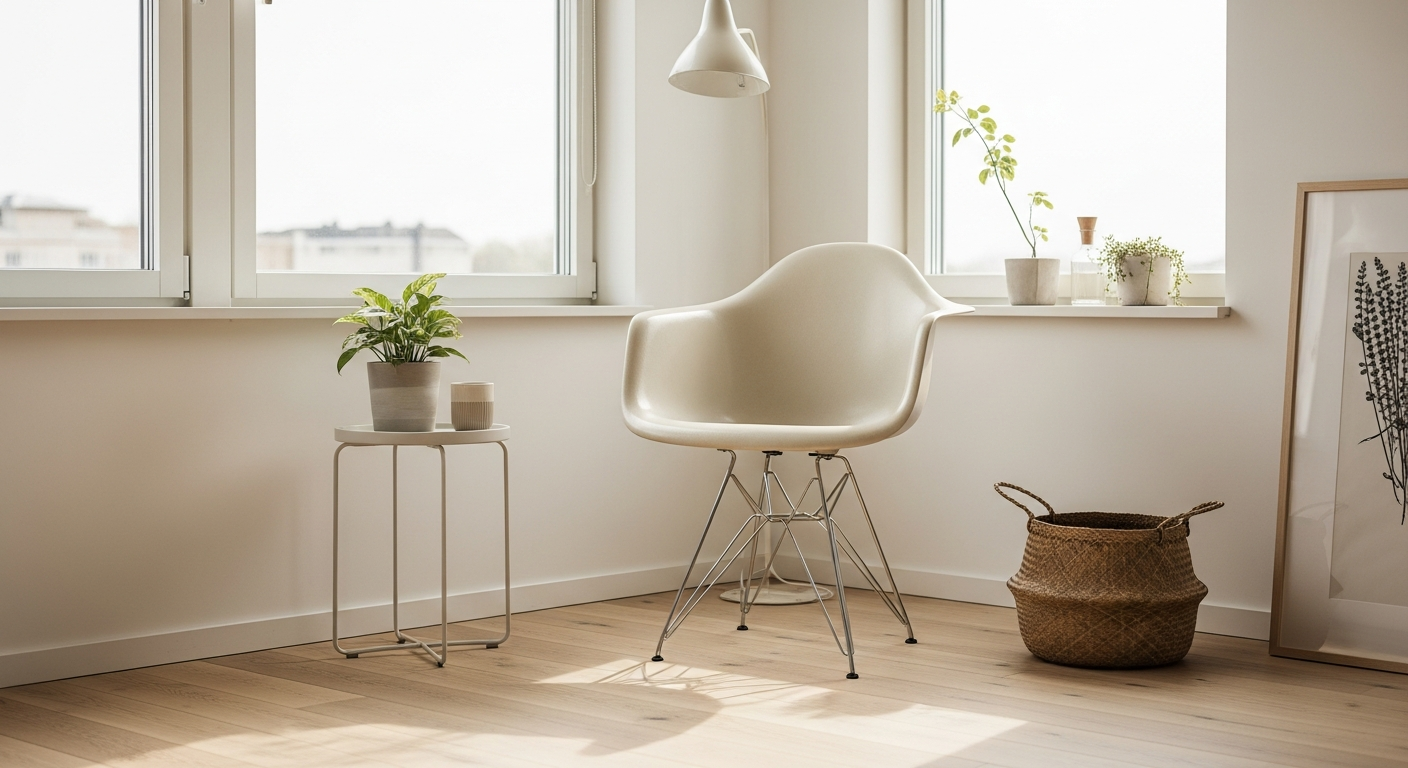
Discover why the Vitra Eames Plastic Side Chair DSW (RE version) is the sustainable furniture choice for eco-conscious Swiss homes. Learn about its recycled materials, timeless design, and lasting value.
Over 70 years after its original design, the Eames Plastic Side Chair continues to dominate modern interiors worldwide. The newer RE version—crafted entirely from recycled plastic—proves that legendary design doesn’t require virgin materials to remain exceptional. When Charles and Ray Eames created this chair in 1950, they couldn’t have imagined how their revolutionary approach to materials and manufacturing would echo through the decades.
The Vitra Eames Plastic Side Chair DSW represents something rare in furniture: a design that satisfies both aesthetic purists and sustainability advocates. This iconic chair has transcended its mid-century origins to become a staple in contemporary homes, offices, and creative spaces across Switzerland and beyond. What began as an experimental approach to plastic molding evolved into a design masterpiece that collectors and everyday users equally cherish.
Discover the Vitra Eames Plastic Side Chair DSW at Bruno Wickart CH today.
The Original 1950 Vision and Mid-Century Modernism
Charles and Ray Eames approached furniture design with scientific rigor and artistic vision. Their 1950 plastic chair emerged from a desire to democratize good design—creating beauty that could be manufactured affordably without sacrificing integrity. The mid-century modernist movement embraced this philosophy: form and function as inseparable partners, materials chosen for their honest expression rather than mere ornamentation.
The DSW variant distinguishes itself through its specific base configuration—the “W” stands for the warm wooden four-legged frame with cross struts, differentiating it from the metal-based versions like the DAW or DAX. This wooden foundation became the defining feature that elevated the design from purely industrial to invitingly residential.
The Sculptural Seat Shell and Ergonomic Advantages
The organically shaped seat shell remains the chair’s most memorable element. Rather than imposing geometric constraints, Eames observed human anatomy and created curves that cradle the body naturally. The shell flows from a slightly elevated back to a gently scooped seat, supporting the spine while distributing weight evenly across the surface. This organic approach to ergonomics predates contemporary wellness design by decades, yet feels entirely modern.
The plastic shell’s thinness contributes to the chair’s visual lightness—it appears almost to float above the wooden base. This transparency of design, where every element serves a purpose, became a hallmark of Eames methodology. There’s no decorative flourish, no structural excess. The chair achieves presence through purity.
Why Virtually Unchanged for Over Seven Decades
Perfection requires no revision. The Eames Plastic Side Chair’s design has remained virtually identical since 1950 because its proportions, curves, and construction already achieved optimal balance. Vitra’s custodianship of this design involved rigorous protection rather than “improvement.” Contemporary versions benefit from refined manufacturing techniques and material innovations, yet the essential form that captured hearts in 1950 remains unchanged.
This consistency itself has become part of the chair’s mystique. In an era of constantly shifting aesthetics, owning an Eames chair means owning something that resisted trend cycles. Museums worldwide have incorporated it into permanent collections—the Museum of Modern Art in New York, the Design Museum in London, and countless others recognize it as essential to design history.
Understanding the RE Version: Recycled Plastic Innovation
The RE designation marks a significant evolution in sustainable luxury. Rather than abandoning the original design formula, Vitra responded to contemporary environmental concerns by reimagining the material supply chain. The RE version maintains every visual and functional characteristic of the standard plastic chair while substituting virgin petroleum-based plastic with post-consumer recycled material.
The Sourcing and Processing of Recycled Plastic
Post-consumer recycled plastic comes from products already in circulation—beverage bottles, packaging, discarded household items. Collecting and sorting this material requires significant infrastructure. Once aggregated, the plastic undergoes shredding, washing, and processing to remove contaminants and restore polymer chain integrity. This processed material then enters Vitra’s manufacturing facilities, where it’s melted and molded using identical techniques to virgin plastic production.
The sourcing involves partnerships with recycling facilities across Europe, ensuring material traceability and quality standards. Vitra doesn’t simply source the cheapest recycled plastic; they maintain rigorous specifications ensuring the recycled material performs identically to virgin alternatives in durability, color consistency, and structural integrity.
Environmental Impact Reduction and Circular Economy Principles
Producing virgin plastic requires crude oil extraction, refining, and polymerization—energy-intensive processes generating substantial carbon emissions. Recycled plastic production bypasses the extraction phase entirely, consuming approximately 40–50% less energy. When multiplied across thousands of chairs sold annually, this difference represents meaningful environmental impact reduction.
Beyond energy savings, choosing recycled material diverts waste from landfills and incinerators. Each kilogram of post-consumer plastic transformed into an Eames chair is material no longer degrading in ecosystems for centuries. Vitra’s commitment to circular economy principles means designing products for longevity (reducing replacement cycles) while ensuring end-of-life recyclability.
Quality Assurance for Recycled Plastic Components
Skepticism about recycled materials often stems from legitimate concerns about durability and performance degradation. Vitra addresses this through comprehensive testing protocols. The recycled plastic undergoes identical stress testing, UV exposure evaluation, and color-fastness assessment as virgin material alternatives. Multiple production runs are sampled and tested independently before full manufacturing commences.
The resulting RE chairs meet or exceed all durability standards associated with standard versions. Real-world use across thousands of customers has confirmed that recycled plastic performance matches virgin alternatives across decades of use.
Experience the durability of the Vitra Eames Plastic Side Chair RE at Bruno Wickart CH.
Comfort, Functionality, and Real-World Performance
The plastic shell’s comfort level surprises many first-time users. Without cushioning, it provides moderate support—adequate for casual dining or brief office use. The organic curves prevent pressure points that plague flat plastic chairs, and the slightly yielding material absorbs some body weight rather than creating rigidity.
Seat Height and Proportions
At approximately 42 centimeters in seat height, the DSW suits standard dining tables (around 75 centimeters) and typical desk heights. These proportions align with ergonomic standards developed over decades of seating research. Your feet rest naturally on the floor without dangling, and your thighs remain parallel to the ground—the foundational seating position that minimizes spinal stress.
Natural Comfort and the Cushion Consideration
Extended sitting sessions—working at desks for eight hours or lingering over long dinners—benefit from additional cushioning. Adding a simple foam pad (available separately) transforms the chair for marathon work sessions without compromising the aesthetic. Many users maintain multiple Eames chairs: some with cushions for office spaces, others bare for dining rooms where seating duration remains brief.
This flexibility represents intelligent design thinking. Rather than overbuilding the chair to address every possible use case, Eames created a foundation that works competently alone while accommodating personalization.
Stackability and Space-Saving Benefits
Swiss living spaces, particularly in urban centers like Zurich and Basel, value compact furniture. The Eames Plastic Side Chair’s stackability becomes a practical advantage—four chairs occupy minimal vertical space when stored. This feature makes the design particularly suited to small apartments, studios, and flexible living arrangements where dining tables must accommodate varying guest counts.
Durability of Wooden Base and Long-Term Wear
The wooden base constructed from solid beech (typically) or similar hardwoods resists decades of daily use. Cross struts prevent lateral wobbling, and the four-point weight distribution eliminates stress concentration. After 20, 30, or even 40 years of use, well-maintained examples function structurally identically to newly manufactured versions.
Wood does age visibly—developing patina, subtle color changes, and minor surface variations that add character rather than detract from appeal. Many long-time owners view this aging process as enhancement, proof of the chair’s history and authenticity.
Maintenance and Cleaning
Both components require minimal maintenance. The plastic shell wipes clean with a damp cloth—resistant to staining and unaffected by spilled beverages or food residue. The wooden base benefits from occasional dusting and, annually, a light oil treatment to maintain finish and protect against drying.
This simplicity stands in stark contrast to upholstered furniture requiring specialized cleaning or cushions needing regular fluffing. The Eames chair’s low-maintenance nature appeals to busy households and commercial settings alike.
Weight Capacity and Structural Integrity
The chair’s design accommodates diverse body types comfortably. Its weight capacity exceeds 120 kilograms, reflecting the robustness of its engineering. The plastic shell distributes pressure across a broad surface area, while the wooden base provides reliable support without any sense of instability even under dynamic movement.
Temperature Considerations
Plastic responds to temperature fluctuations—contracting slightly in cold and expanding marginally in heat. Swiss seasonal variations (winters reaching 0°C or below, summers occasionally exceeding 25°C) represent manageable ranges where the Eames chair performs without issue. The material doesn’t become brittle in cold or excessively soft in heat. Wooden bases similarly withstand these ranges without warping when properly maintained.
Styling Versatility Across Interior Aesthetics
The Eames Plastic Side Chair’s design neutrality enables seamless integration into virtually any interior language. Its success across Scandinavian minimalism, contemporary eclecticism, industrial loft aesthetics, and traditional settings demonstrates genuine versatility rather than bland compromise.
Scandinavian and Minimalist Harmony
Swiss design sensibilities naturally align with Scandinavian principles: clean lines, functional elegance, and honest materials. The chair’s form embodies these values precisely. In minimalist interiors, a single well-chosen Eames chair often serves as the spatial anchor—a statement piece that requires no companion furniture for impact.
Contemporary Dining Table Integration
Pairing the chair with modern dining tables creates effortless sophistication. Wood-topped tables complement the warm base, while glass or marble surfaces create subtle contrast. The chair’s profile remains visually lighter than bulky upholstered alternatives, preventing dining areas from feeling heavy or over-furnished.
Maximalist and Eclectic Arrangements
Counterintuitively, the chair thrives in visually complex environments. Its structural clarity provides grounding amidst patterned textiles, artwork, and varied color palettes. Using multiple chairs in different shell colors—charcoal, white, ochre—adds layered interest without introducing additional furniture pieces.
Office and Workspace Applications
Beyond dining rooms, the chair functions excellently in home offices, creative studios, and professional settings. Its compact footprint doesn’t dominate small spaces, while its iconic design elevates workspace aesthetics beyond typical office furniture. Companies from startups to established design firms specify Eames chairs for reception areas and collaborative spaces.
Color Options and Décor Coordination
Vitra offers the Eames Plastic Side Chair in an extensive palette: classic white and black, warm neutrals like sand and ochre, and seasonal colors. These options enable coordination with existing interiors rather than requiring design compromises. Some customers purchase chairs matching dominant room colors; others deliberately choose contrasting hues for visual drama.
Mixing and Matching for Visual Interest
Creating seating groups with multiple chairs in complementary colors generates visual rhythm. A dining set of four featuring two white and two charcoal chairs, for instance, establishes sophisticated balance. This approach extends beyond matching sets—an approach that feels increasingly relevant in contemporary interiors valuing curated individuality.
Complementary Accent Pieces
The chair pairs beautifully with simple wooden side tables, metal-framed shelving, or minimalist pendant lighting. Its visual clarity means accessories need not compete for attention. The focus remains on the chair’s form and the negative space surrounding it—very much the design philosophy that created the chair originally.
Evolving Rooms Across Time
Furniture purchases ideally outlast interior trends. The Eames chair’s timelessness means a chair purchased for a dining room might migrate to an office, then a bedroom sitting area, accumulating years of stories without aesthetic discord. This adaptability makes it remarkably economical across decades of ownership.
Investment Value and Price Justification
The CHF 350–450 price point represents a significant investment compared to mass-produced alternatives available for CHF 50–100. Understanding this premium requires examining quality metrics, longevity calculations, and the intangible value of owning recognized design.
What Factors Into Designer Furniture Pricing
Several elements contribute to the premium:
Material quality: Genuine hardwood bases and virgin or recycled plastic meeting strict specifications cost substantially more than cheap alternatives.
Manufacturing precision: Each chair involves multiple production steps with quality checkpoints. Vitra’s European manufacturing maintains higher labor standards and stricter tolerances than factories in regions with minimal oversight.
Design heritage: You’re not simply purchasing a chair; you’re acquiring a piece whose design has been refined and celebrated for over 70 years. This intellectual property, licensing, and protection infrastructure factors into pricing.
Longevity: Designer furniture assumes decades of use, contrasting with mass-market pieces anticipated to fail within 3–5 years. This fundamentally different manufacturing philosophy increases upfront costs.
Mass-Produced Alternatives and Why Quality Commands Premium
Knockoff Eames-style chairs flood online marketplaces at fraction of official prices. These often employ thinner plastic shells (structurally weaker), unstable base joinery, and painted rather than solid wood. While visually similar at first glance, they fail rapidly—developing cracks within months, wobbling with normal use, and requiring replacement.
Purchasing authentic Vitra products through authorized retailers like Bruno Wickart CH ensures genuine materials and manufacturing standards. This protection against counterfeits, while sometimes invisible, significantly justifies pricing differences.
Longevity Calculations and Cost-Per-Year
A mass-produced chair purchased for CHF 80 lasting three years costs CHF 26.67 annually. An Eames chair at CHF 400 lasting 30 years costs CHF 13.33 annually—while delivering superior comfort, undeniable aesthetic value, and likely appreciating in collector desirability.
When viewed across decades, authentic design proves economical compared to repetitive replacement cycles of inferior furniture.
Resale Value and Collector’s Appeal
Vintage Eames chairs from the 1950s–1970s command significant prices at design auctions, often exceeding CHF 500–800 depending on condition and originality. Contemporary examples retain approximately 60–70% of original value, maintaining desirability on secondary markets.
This resale potential means your investment isn’t locked into furniture depreciation typical of most purchases. Should you relocate or redesign, selling remains feasible without substantial loss.
Warranty Coverage and After-Sales Support
Vitra stands behind its products with comprehensive warranties protecting against manufacturing defects. Bruno Wickart CH provides responsive customer service and can source replacement components (cushions, bases, shells) should damage occur.
Mass-market furniture typically offers minimal warranty protection, and replacement parts remain unavailable after a few years as manufacturers discontinue older models.
Promotional Pricing and Seasonal Discounts
Bruno Wickart CH periodically offers promotional pricing on Eames chairs. Monitoring their website or subscribing to newsletters reveals seasonal sales—opportunities to acquire chairs at reduced rates (occasionally reaching CHF 350 from regular CHF 445 pricing).
Patience can yield substantial savings without compromising authenticity or quality.
Financing Options for Larger Purchases
Many retailers offer payment plans for furniture purchases exceeding certain thresholds. Rather than a single substantial payment, spreading costs across months makes high-quality furniture more accessible.
ROI Perspective and Home Aesthetic Value
Design investments return value through elevated living experiences and home aesthetics. A thoughtfully furnished room brings daily joy—quantifying this benefit extends beyond financial calculations into quality-of-life territory.
Properties featuring curated, authentic furniture also command premium rental or resale values. The Eames chair, as a universally recognized design icon, subtly signals taste and intentionality to visitors and potential buyers alike.
Sustainability and Environmental Responsibility
The recycled plastic RE version represents conscious design consumption without compromise. Environmental considerations have shifted from peripheral to central in furniture purchasing decisions, particularly among Swiss consumers valuing ecological stewardship.
Carbon Footprint Reduction Through Recycled Materials
Manufacturing virgin plastic requires crude oil extraction, refining, and polymerization—energy-intensive processes. Recycled plastic production bypasses extraction entirely, reducing energy consumption by 40–50%.
For context: producing a standard plastic shell requires approximately 8–10 kilowatt-hours of energy; the recycled version requires roughly 4–5 kilowatt-hours. Multiplied across thousands of chairs annually, this reduction equals substantial carbon savings.
European Manufacturing Standards
Vitra’s commitment to European production means compliance with stringent environmental regulations, worker protections, and quality standards. Unlike manufacturing in regions with minimal environmental oversight, European facilities employ advanced pollution control, waste minimization, and resource efficiency protocols.
This geographic choice increases manufacturing costs but ensures genuine environmental responsibility throughout production processes.
Modularity and Extended Lifespan
The chair’s modular construction means replacement without complete disposal. A damaged plastic shell can be replaced independently; a worn wooden base can be refinished or exchanged. This design approach extends product lifespan and reduces waste generation compared to furniture requiring complete replacement when single components fail.
End-of-Life Recyclability
Both plastic shells and wooden bases remain recyclable at end-of-life. The plastic shell can enter new production cycles; the wood can be chipped for particleboard, mulch, or biomass energy. Unlike composite materials or chemically treated furnishings, Eames chairs decompose into constituent materials without environmental toxicity.
Vitra’s Broader Sustainability Commitment
Vitra extends sustainability thinking beyond individual products. The company publishes environmental reports detailing manufacturing impacts, sets science-based reduction targets, and continuously innovates toward circular economy principles. Choosing Vitra represents aligning with a manufacturer genuinely committed to ecological responsibility rather than superficial “green” marketing.
Certifications and Environmental Assessments
The RE chair meets certifications including FSC wood sourcing standards (for the base), recycled content verification, and compliance with European chemical safety regulations. Third-party assessments validate environmental claims rather than relying solely on manufacturer assertions.
Supporting Circular Economy Initiatives
Purchasing recycled-content furniture actively supports circular economy development. Demand drives investment in recycling infrastructure, material processing facilities, and innovation in sustainable manufacturing. Each Eames RE purchase represents a vote for systemic change toward material circularity.
Comparison Against Fast Furniture
The fast furniture industry—characterized by rapid design turnover, minimal durability, and disposal after brief use—represents the environmental inverse of the Eames chair philosophy. A single Eames chair lasting 30 years prevents approximately 15–20 inferior chairs from entering landfills. This preventive environmental impact cannot be overstated.
The Enduring Case for Choosing Authentic Design
The Vitra Eames Plastic Side Chair DSW isn’t simply a piece of furniture—it’s a statement about your values regarding design, sustainability, and quality. At CHF 350–450, this investment might feel substantial compared to mass-produced alternatives. Yet when you calculate the cost across decades of reliable use, factor in its timeless aesthetic that won’t feel dated in five years, and consider the positive environmental impact of choosing recycled materials, the value becomes undeniable.
Whether you’re furnishing a Swiss apartment, outfitting a creative workspace, or seeking that one iconic piece to anchor your dining area, the Eames Plastic Side Chair DSW delivers authenticity that contemporary knockoffs simply cannot replicate. The chair’s 70+ year history represents continuous validation from designers, architects, collectors, and everyday users who recognized something essential in its form and function.
Investing in authentic design reflects a longer view of consumption—recognizing that true luxury lies not in accumulating numerous disposable items but in curating meaningful possessions that age gracefully while delivering consistent value. The Eames chair exemplifies this philosophy perfectly.
Visit Bruno Wickart CH and experience the Vitra Eames Plastic Side Chair DSW firsthand today.