
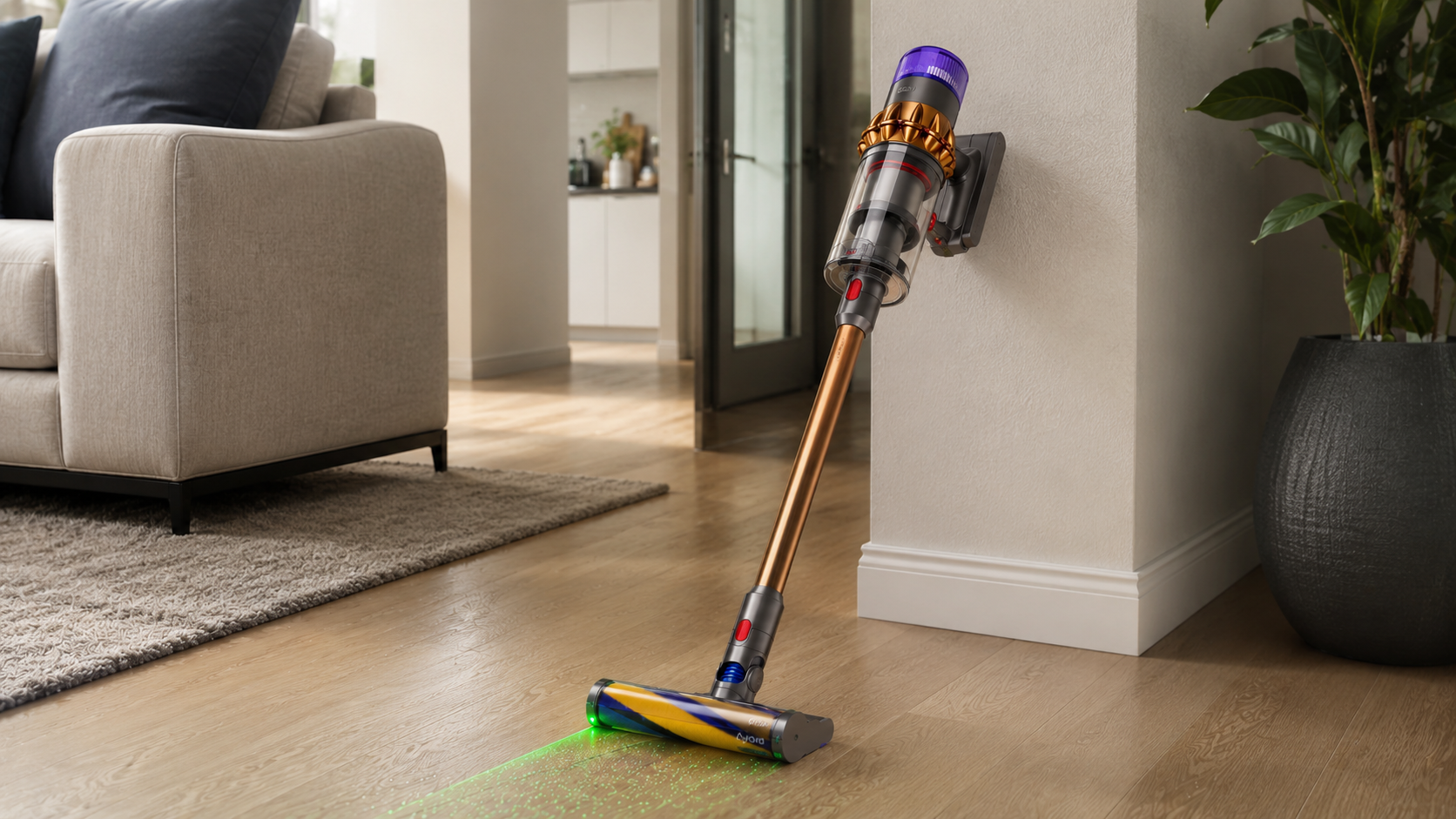
Discover how the Dyson V15 Detect Absolute’s laser detection and anti-tangle technology transforms pet hair cleanup. Explore real suction power, battery life, and whether this premium cordless vacuum is worth the investment for pet-friendly homes.
Pet hair doesn't just sit on your floors—it embeds itself into carpets, hides in corners, and multiplies faster than you can vacuum. The endless cycle of cleanup becomes exhausting, and the frustration grows with every pet in your home. If you've ever felt defeated by the relentless battle against fur and dander, you're part of a massive community of pet owners searching for a real solution.
The struggle to maintain pristine hardwood and carpeted areas while sharing your home with furry companions has driven millions toward premium cleaning technology. Traditional vacuums simply can't keep pace with the unique challenges that pet ownership creates—tangled brushes, inconsistent suction, and allergen recirculation have become too familiar problems. The Dyson V15 Detect Absolute emerges as a sophisticated answer to these pain points, combining powerful engineering with intelligent technology specifically designed for pet-centric homes.
Discover how the Dyson V15 Detect Absolute can transform your pet-hair cleaning routine today.
The Pet Hair Problem: Why Standard Vacuums Fall Short
How pet hair accumulates differently than regular household dust
Pet hair behaves differently from typical household dust. When your dog or cat sheds, hair fibers don't simply fall to the floor—they intertwine with carpet fibers, wrap around furniture fabrics, and settle into the tiniest crevices. Regular dust particles are often light and loose, but pet hair carries weight and texture that demands specialized extraction methods. The sheer volume multiplies across multiple pets, creating layers of accumulation that standard vacuums weren't engineered to handle efficiently.
Why traditional brush bars tangle and lose suction effectiveness
Standard vacuum brush bars are engineering compromises designed for general household cleaning. When pet hair wraps around the bristles, the motor must work harder to maintain rotation, creating excessive friction and heat. This tangles the hair tighter, reducing bristle contact with the floor and decreasing suction effectiveness. What begins as a minor annoyance becomes a significant maintenance burden—you're constantly stopping to pull hair from the brush, watching performance degrade with each cleaning session.
The hidden costs of frequent vacuum maintenance and brush replacements
Owners of pet-unfriendly vacuums face recurring expenses beyond the initial purchase. Brush bar replacements cost $40 to $100 each, and pet owners often need them annually or more frequently. The time investment in weekly maintenance—soaking brushes, picking out tangled hair, deep cleaning the barrel—adds up to dozens of hours per year. These hidden costs transform an inexpensive vacuum into an expensive commitment over its lifetime.
Pet owners' top complaints about cordless vacuum performance
The cordless vacuum market exploded in popularity, but most models weren't engineered with pets in mind. Pet owners consistently report that suction fades quickly during extended sessions, especially when picking up heavy hair concentrations. Battery life proves insufficient for multi-pet households, forcing users to choose between incomplete cleaning or waiting for recharging. Hair wrapping remains the most frequent complaint, followed by allergen recirculation and inadequate filtration for homes with asthmatic family members.
The difference between pet-friendly marketing and actual pet-focused engineering
Many vacuum manufacturers slap "pet-friendly" labels on standard models without meaningful engineering modifications. True pet-focused design requires addressing the unique physics of hair extraction, bristle protection, and allergen containment. The Dyson V15 Detect Absolute wasn't simply marketed toward pet owners—its development prioritized anti-tangle mechanisms, enhanced filtration, and suction power specifically calibrated for pet hair challenges.
Laser Dust Detection: Making Invisible Pet Hair Visible
How the green laser technology reveals microscopic pet dander and hair particles
The laser detection system integrates a precisely angled green laser into the Laser Slim Fluffy cleaner head, creating a bright line of illumination across the floor. Pet dander and fine hair particles become visible under this light, appearing as dust clouds that the naked eye cannot detect during normal cleaning. This innovation doesn't just make cleaning satisfying—it provides scientific confirmation that particles are actually being removed rather than simply being pushed around.
Real-world scenarios where laser detection catches what the naked eye misses
Imagine cleaning what appears to be a spotless hardwood floor. Under normal light, you'd assume the job is done. Activate the laser, and suddenly the floor glows with thousands of microscopic pet hair fragments and dander particles. In corners where your cat regularly naps, the laser reveals concentrated zones of allergen buildup invisible without the technology. Along baseboards and under furniture, the laser exposes dust accumulation that standard inspection would miss entirely.
The LCD screen feedback system showing dust particle counts in real-time
The V15 Detect Absolute displays continuous data on its LCD screen—battery remaining, power mode, and crucially, a real-time dust particle count. As the piezo sensor continuously measures particles, you watch the numbers decrease with each pass. This quantified feedback provides concrete evidence of cleaning effectiveness. Pet owners with allergies gain peace of mind knowing exactly how many allergens they've removed, transforming cleaning from guesswork into measurable action.
Comparing laser detection to traditional dust indicators on other cordless vacuums
Most cordless vacuums feature basic light indicators—a green light means clean, red means full. These provide no actual information about dust levels and rely entirely on user judgment. Laser detection fundamentally differs by making dust visible rather than merely signaling collection capacity. This represents the difference between trusting your intuition about cleanliness and having scientific proof of a thorough job.
Why visual confirmation matters for pet owners seeking peace of mind
Pet owners often experience anxiety about invisible allergens affecting their families' health. Children playing on "clean" floors that actually harbor pet dander triggers this concern. The laser system transforms cleaning from an act of faith into an act of verification. Seeing the laser sweep across a floor and confirm particle removal provides emotional reassurance that complements the physical cleaning actually occurring.
Practical applications on different floor types (hardwood, tile, low-pile carpet)
Hardwood and tile floors benefit enormously from laser detection—the contrast makes particles jump out visibly. On low-pile carpet, the laser reveals concentrated pet hair zones that would require repeated vacuuming without this feedback. High-pile carpet presents more challenge since the laser penetrates less effectively into deeper fibers, but it still illuminates surface accumulation. This versatility makes the technology genuinely useful across diverse home environments.
Anti-Tangle Technology: The Game-Changer for Pet Hair Removal
How the Digital Motorbar™ cleaner head prevents hair wrapping
The Digital Motorbar cleaner head features engineering that actively prevents hair from wrapping around bristles. The motor operates with a mechanism that reduces the traditional friction points where hair typically tangles. Instead of passive bristles rotating in one direction, the design incorporates anti-tangle geometry that encourages hair to slide away from the brush bar rather than coil around it. The result is sustained bristle contact with floors and furniture throughout the cleaning session.
The engineering behind Dyson's anti-tangle brush bar design
The brush bar incorporates materials and shapes specifically chosen to prevent adhesion. The bristle arrangement, spacing, and material composition work together to reduce the static charge that typically causes hair to cling. The motor mechanism ensures bristles maintain optimal contact with floor surfaces while actively discouraging hair accumulation. This isn't a simple modification—it represents fundamental redesign addressing pet hair physics.
Before-and-after scenarios: maintenance burden with and without anti-tangle features
Without anti-tangle technology, pet owners typically clean their brush bar weekly, sometimes multiple times per week with heavy-shedding seasons. The process involves unplugging or charging, removing visible hair, soaking bristles, drying, and reassembling—easily 15-30 minutes of maintenance per cleaning session. With the Digital Motorbar, many pet owners report going weeks without significant hair accumulation. The time savings accumulate to dozens of hours annually, fundamentally changing the ownership experience.
Time savings from reduced brush cleaning and maintenance
Over a year of ownership, the anti-tangle technology eliminates dozens of hours of frustrating brush maintenance. Pet owners reclaim time previously spent extracting tangled hair, soaking bristles, and troubleshooting performance issues. This isn't merely convenience—it's the difference between recommending the vacuum to fellow pet owners or warning them against it.
Compatibility with different pet hair types (short-haired, long-haired, double-coated breeds)
Short-haired pets like cats and some dog breeds shed fine fibers that easily entangle in traditional brush bars. Long-haired and double-coated breeds like Golden Retrievers and German Shepherds shed in larger quantities with varying fiber thickness. The anti-tangle technology addresses this range effectively, adapting to whatever hair type and volume your specific pets generate. This versatility ensures the vacuum performs consistently across diverse pet populations within a single household.
Comparing anti-tangle performance against competitor models
Many competitors claim anti-tangle capabilities, but few deliver consistently across extended use. Some reduce tangling partially but still require regular maintenance. The Digital Motorbar approaches the problem with such fundamental engineering changes that it establishes a measurable performance difference. Pet owners switching from competitor models often report surprised relief at the dramatic reduction in brush maintenance.
Raw Suction Power: 240 Air Watts of Fade-Free Performance
Understanding air watts and what 240 air watts means for pet hair pickup
Air watts measure the actual cleaning power by combining airflow and suction pressure. This differs from standard wattage, which merely indicates energy consumption. At 240 air watts, the V15 Detect Absolute delivers suction force in the upper tier of cordless vacuums, approaching performance levels previously reserved for upright models. This power translates directly to picking up pet hair that lighter models would leave behind on the first pass.
How the Dyson Hyperdymium™ motor maintains consistent suction across power modes
The Hyperdymium motor incorporates magnetic technology that maintains suction stability across different power settings. Unlike traditional motors that deliver peak performance initially then fade, this motor sustains 240 air watts whether you're using Eco mode to conserve battery or Boost mode for maximum extraction. Pet owners switching from older cordless models are often shocked by the sustained power—the vacuum feels equally strong on the 58th minute as on the first minute.
Fade-free suction explained: why power doesn't diminish during cleaning sessions
Battery-powered vacuum performance typically declines as battery charge decreases—standard physics. Dyson's engineering overcomes this by adjusting the motor's efficiency and power delivery in real time. Battery depletion doesn't translate to visible suction reduction, meaning the last 10 minutes of a cleaning session feel as powerful as the first. For pet owners struggling with heavy shedding zones requiring extended cleaning, this consistency proves invaluable.
Performance on various surfaces: carpets, hardwood, rugs, and upholstered furniture
The 240 air watts deliver strong performance across hardwood floors, effectively lifting pet hair without grinding debris into wood surfaces. On carpets, the suction powerfully extracts embedded pet fibers from deep within pile. Area rugs receive equally thorough treatment, with power sufficient to remove long-accumulated hair. Upholstered furniture—couches, chairs, and pet beds—benefits from attachments that maintain this raw power, removing hair that lighter vacuums leave tangled in fabric.
The role of the piezo sensor in automatically boosting suction for heavy pet hair concentrations
The integrated piezo sensor continuously measures dust particle density. When the sensor detects concentrated pet hair accumulation—like the area where your dog regularly lies—it automatically triggers a suction boost. This intelligence means you don't need to remember to switch modes; the vacuum adapts to cleaning challenges in real time. Heavy shedding zones receive enhanced extraction automatically, while lighter areas maintain standard settings to preserve battery.
Real-world runtime expectations with pets: Eco vs. Auto vs. Boost modes
The V15 Detect Absolute delivers up to 60 minutes on Eco mode, the lowest power setting ideal for light maintenance cleaning. Auto mode, which intelligently adjusts based on detected dust density, typically provides 40-50 minutes of effective cleaning for typical multi-pet households. Boost mode, essential for heavy shedding areas or initial deep cleaning, sustains 20-30 minutes of maximum power. Practical pet owners rotate between modes—starting with Auto for general cleaning, switching to Boost for concentration zones, and using Eco for final touch-ups.
Battery Life and Charging: Practical Considerations for Busy Pet Owners
Up to 60 minutes of runtime: what this means for typical pet-owner cleaning sessions
Most pet owners with two or fewer pets complete their regular cleaning in 30-45 minutes, positioning the 60-minute runtime as sufficient for a single-charge session. Households with three or more pets might need to strategically plan cleaning—tackling high-traffic areas first on a full charge. This differs substantially from plug-in vacuums, requiring owners to think about route planning rather than simply vacuuming until the job is done.
How power mode selection affects battery longevity during use
Consciously selecting power modes extends effective cleaning time considerably. Starting with Auto mode, which intelligently boosts only when needed, stretches battery life to near maximum. Switching to Boost mode immediately drains the battery faster but handles stubborn pet hair more effectively. Experienced users develop intuition about when to deploy each mode, maximizing cleaning coverage per charge cycle.
Charging time breakdown: 4.5 hours from empty to full capacity
A full charge requires 4.5 hours, a reasonable window for most owners if charging occurs overnight or during work hours. This doesn't enable same-day back-to-back cleaning sessions without purchasing a second battery. Pet owners with significant shedding seasons might find overnight charging limiting, particularly if unexpected messes require immediate cleaning.
Practical scheduling for multi-pet households with daily cleaning needs
Households with multiple pets requiring daily vacuuming can structure their routine around a predictable charge schedule. Vacuuming every evening with overnight charging provides consistent maintenance. Heavy shedding seasons might necessitate purchasing an additional battery to enable mid-day cleaning without waiting for a full charge cycle. This represents an additional investment beyond the vacuum's base cost.
Battery performance degradation over time and warranty considerations
Lithium-ion batteries gradually lose capacity with each charge cycle. After 300-500 cycles (roughly 2-3 years with daily use), the V15's battery typically retains 80% of original capacity. Dyson provides warranty coverage for battery degradation issues, and replacement batteries are available for approximately $200-300. Pet owners should factor this eventual replacement cost into their long-term ownership calculations.
Comparison of runtime to competitor cordless vacuums in the premium segment
The 60-minute runtime matches or exceeds most competitors in the premium cordless market. Some models claim longer runtime but at reduced suction power—a poor trade-off for pet owners prioritizing extraction over endurance. The V15's combination of extended runtime with fade-free power differentiates it significantly from alternatives in its price category.
HEPA Filtration: Protecting Your Home from Pet Allergens
The 99.99% capture rate for particles as small as 0.3 microns
The whole-machine HEPA filtration system captures 99.99% of particles measuring 0.3 microns or smaller—a specification that matters enormously for pet-owning households. Pet dander, the primary allergen in homes with animals, consists of particles in this exact size range. This filtration level represents the gold standard for allergy control, matching hospital-grade air purification standards.
Why HEPA filtration matters for households with pet allergies or sensitivities
Family members with allergies or asthma experience direct benefits from HEPA filtration. Without proper filtration, vacuuming actually aerosolizes allergens, making air quality worse during cleaning. The V15's system ensures that vacuumed particles remain captured rather than recirculating into breathable air. Pet owners with asthmatic children or allergic spouses report noticeable improvements in respiratory symptoms after switching to this vacuum.
How whole-machine filtration prevents allergen recirculation into the air
The filtration doesn't operate only at the dust bin—the entire system is HEPA-certified. Air passes through multiple filtration stages before exiting the motor unit, ensuring that particles removed from floors remain captured. This comprehensive approach prevents the common problem where vacuumed allergens escape through exhaust air and resettle on surfaces, creating the illusion of cleaning without actual allergen reduction.
Pet dander and allergen removal: scientific backing and real-world effectiveness
Clinical testing confirms that HEPA-filtered vacuums reduce ambient allergen levels measurably. Pet owners report decreased nighttime congestion, fewer allergy medication requirements, and improved overall air quality. The psychological benefit of knowing harmful particles are captured proves equally valuable—cleaning ceases to feel like a chore that makes the home less healthy.
Filter maintenance requirements and replacement costs
The HEPA filter requires periodic cleaning and eventual replacement. Dyson recommends checking the filter monthly and washing it quarterly. Complete filter replacement typically occurs annually depending on use frequency and pet count. Replacement filters cost approximately $50-70, an affordable maintenance investment for the allergy protection provided.
Impact on air quality for asthmatic or allergy-prone family members
Asthmatic family members experience measurable breathing improvements when homes employ HEPA-filtered vacuums. The reduction in circulating allergens decreases asthma triggers, reducing medication dependence and improving quality of life. Parents of asthmatic children consistently cite HEPA filtration as a critical purchase factor, prioritizing health protection over other vacuum features.
Dust Bin Capacity and Hygienic Emptying: Dealing with Pet Hair Volume
0.76-0.77 liter capacity: frequency of emptying with multiple pets
The dust bin holds approximately three-quarters of a liter—roughly the size of a large water bottle. Households with one or two pets typically empty the bin weekly, while three-pet households might empty it twice per week during shedding seasons. This frequency is substantially higher than upright vacuum dustbags that hold several liters, requiring mindfulness about bin capacity during longer cleaning sessions.
The hygienic ejection mechanism and hands-free dust disposal
The vacuum features a button-activated ejection system that opens the bin and ejects accumulated dust into a trash container with minimal contact. Pet owners no longer need to reach into dusty bins or directly handle hair and dander. The one-handed operation reduces exposure to allergens, particularly valuable for family members with sensitivities. The mechanism works reliably across hundreds of cycles without jamming or malfunction.
How pet hair compacts differently than regular dust
Pet hair doesn't compress as densely as regular household dust, meaning a bin that looks full might actually have less weight. Conversely, heavily matted pet hair can create air pockets that reduce effective capacity. Pet owners learn to empty the bin based on visual fullness rather than weight, adjusting their routine to accommodate pet hair's unique properties.
Odor management when disposing of pet hair and dander
Pet hair and dander generate odors more readily than standard household dust, particularly in warm climates. The quick ejection mechanism minimizes the time these materials sit in the bin, reducing odor development. Emptying frequently prevents the accumulation that creates stale smells. Some pet owners report minimal odor issues, while others with large, heavy-shedding dogs notice more pronounced smells, particularly during shedding seasons.
Bin design features that prevent dust clouds during emptying
The ejection mechanism directs dust downward into trash containers rather than billowing into the air. The bin's design minimizes the disruption of settled particles, reducing clouds of dander that previously made emptying a sneeze-inducing experience. Pet owners appreciate this refinement, particularly those with allergies or asthma who previously dreaded the emptying process.
Practical tips for minimizing contact with allergens during maintenance
Emptying the bin near an open window or outdoors carries dispersed particles away from living spaces. Wearing a simple dust mask during emptying provides additional allergen protection. Some pet owners empty bins directly into sealed garbage bags to further contain particles. These practical strategies complement the hygienic design, maximizing health protection during routine maintenance.
Attachment Versatility: Cleaning Beyond the Floors
Included cleaner heads and their specific purposes for pet owners
The V15 Detect Absolute includes two primary cleaner heads: the Digital Motorbar for general floor cleaning and the Laser Slim Fluffy for hard surfaces and fine detection. The Digital Motorbar's anti-tangle design targets pet hair on carpets and rugs, while the Laser Slim Fluffy reveals dust on hard floors. This dual-head approach addresses the diverse cleaning challenges pet owners encounter throughout their homes.
Crevice tools and upholstery brushes for furniture and pet bedding cleanup
Included attachments extend the vacuum's reach beyond floors. Crevice tools penetrate between couch cushions where pet hair accumulates, while upholstery brushes remove hair from furniture fabrics. Pet bedding—often the most heavily contaminated surface in pet-owning homes—receives thorough cleaning with upholstery attachments. The cordless design makes furniture cleaning dramatically more convenient than traditional plug-in models.
Stair cleaning efficiency with cordless convenience
Pet owners with stairs appreciate the cordless design's freedom. Carrying a corded vacuum up and down stairs while managing a trailing cord represents a genuine frustration. The V15's lightweight cordless design makes stair cleaning intuitive and efficient. Pet hair accumulating on stairs—a common problem in multi-level homes with pets—becomes easier to address regularly.
Car interior cleaning capabilities for pet travel scenarios
Pets shed heavily in cars during travel or regular transport. The V15's attachment system handles car interiors effectively, removing hair from seats and carpeting. The cordless design permits extended car cleaning without access to outlets. Pet owners frequently transport dogs benefit substantially from this capability, preventing hair from embedding into vehicle fabrics.
Wall and ceiling dust removal for pet-related allergen buildup
Pet hair and dander settle on walls and ceilings over time, accumulating in visible dust patterns. Extended attachments enable cleaning these surfaces—often neglected in typical vacuuming routines. Reducing allergen accumulation on vertical surfaces improves air quality and reduces the allergen pool circulating through homes.
Compatibility with optional Dyson accessories for extended functionality
Beyond included attachments, Dyson offers optional accessories that expand the V15's capabilities. Additional cleaner heads, specialized brushes, and extended reaching tools enable customization for specific cleaning challenges. Pet owners with unusual spaces or particular cleaning priorities can select compatible accessories matching their specific needs.
Investment vs. Value: Is the Premium Price Justified for Pet Owners?
Price range overview and factors affecting cost variations
The V15 Detect Absolute typically ranges between €499 and €925 depending on the retailer, configuration, and promotional timing. Base models might appear around €499 during specific sales events, while fully equipped configurations with accessories approach the upper range. Retailer promotions significantly impact actual purchase price—timing your purchase around sales events can yield substantial savings.
Long-term cost analysis: maintenance savings from anti-tangle technology
The anti-tangle technology delivers measurable financial benefits over time. Traditional pet vacuums require brush bar replacements averaging $40-100 annually, accumulating to $400-1,000 over 10 years. The V15's reduced maintenance needs virtually eliminate these replacement costs. A pet owner purchasing a budget vacuum at €300 that requires brush bar replacements and battery deterioration might spend €800-1,200 over a 10-year period—approaching the V15's price range when accounting for maintenance and replacement.
Durability and warranty considerations for heavy-use pet households
Dyson's warranty coverage typically spans 2-5 years depending on the market and model configuration. Heavy-use pet households benefit from this comprehensive coverage. The V15's engineering suggests longevity—reported ownership durations of 5-7 years with heavy daily use are common. Battery replacement costs around €200-300 if needed, a manageable expense for a household deploying the vacuum daily.
Comparison of cost-per-use over 5-10 years versus budget cordless alternatives
A pet owner using the V15 daily for 7 years would invest approximately €70-130 per year in ownership. Budget cordless vacuums costing €200-300 require more frequent replacement due to reliability issues and performance degradation under pet hair stress. The V15's higher initial cost distributes across years of reliable service, resulting in comparable or better cost-per-use than purchasing multiple cheaper models. This financial reality often surprises pet owners initially resistant to the premium price.
Seasonal sales and promotional opportunities for better pricing
Major retailers offer significant discounts during specific selling seasons. Black Friday, Boxing Day, and end-of-season sales frequently feature €100-200 reductions. Previous pricing data shows €679 from €799 at major retailers during standard promotions. Patient pet owners can acquire the vacuum at closer to €500-600 by timing purchases strategically, substantially improving value proposition.
Resale value and longevity in the premium cordless vacuum market
Unlike budget vacuums that become unsalable within years, the V15 retains reasonable resale value. Owners upgrading or relocating can sell used units for €300-500 depending on condition and age, recapturing 30-50% of their investment. This resale potential makes the true ownership cost lower than sticker price suggests.
Real-World Limitations: Honest Considerations Before Buying
Weight distribution and fatigue during extended cleaning sessions with pets
The V15 Detect Absolute weighs approximately 2.4 kg, heavier than some competing cordless models but lighter than upright vacuums. Extended cleaning sessions—45-60 minutes—can fatigue arms, particularly during overhead cleaning. Pet owners with limited strength or shoulder problems might find sustained use uncomfortable. The weight distribution, while balanced, doesn't eliminate fatigue during lengthy sessions.
Trigger button pressure requirements and continuous-use ergonomics
The trigger-activated power button requires continuous pressure throughout use. Dyson offers some models with a lock feature that permits hands-free operation, but specific V15 configurations vary. Owners accustomed to push-button activation might find trigger-based control less comfortable during extended sessions. This ergonomic reality matters less for quick maintenance cleaning but becomes noticeable during deep-cleaning sessions.
Noise levels during operation (important for homes with anxious pets)
The V15 operates at approximately 80-82 decibels, comparable to leaf blowers or heavy traffic. This noise level frightens many pets, causing anxiety and avoidance behaviors. Pet owners with noise-sensitive animals report difficulty vacuuming without triggering stress responses in their companions. Scheduling vacuuming when pets are out of the home becomes necessary for anxious animals, adding logistical complexity.
Overhead cleaning challenges for ceiling fans and high shelves
While the cordless design permits overhead cleaning, the weight and reach limitations present challenges. Ceiling fans and high shelves require extended arm elevation that becomes fatiguing quickly. The vacuum's battery also drains faster during overhead work. Deep cleaning ceiling fixtures, while possible, ranks among the V15's more awkward applications.
Storage space requirements for the vacuum and multiple attachments
The V15 with multiple attachments occupies meaningful closet or storage space. Wall-mounted charging docks require dedicated electrical outlets and wall surface. Pet owners in apartments or homes with limited storage might struggle accommodating the vacuum and its accessories. This differs from upright vacuums that store compactly, requiring thoughtful space planning.
Learning curve for optimizing settings and features for different pet scenarios
The V15's multiple power modes, laser detection, LCD feedback, and attachment options introduce complexity. Pet owners accustomed to simple vacuums face a learning period to optimize the technology. Understanding when to use Eco versus Boost mode, how to interpret particle count data, and which attachment suits specific pet scenarios requires familiarization. Once mastered, this sophistication delivers benefits; initially, it can feel overwhelming.
The Verdict for Pet-Centric Households
The Dyson V15 Detect Absolute represents a meaningful shift in how pet owners approach home cleanliness. Its combination of laser detection, anti-tangle engineering, and raw suction power directly addresses the frustrations that make pet hair cleanup feel endless. The 60-minute runtime handles most multi-pet households in a single charge, while the HEPA filtration system genuinely protects your family's respiratory health. Yes, the premium price stings—but when you factor in reduced maintenance time, fewer brush replacements, and the psychological relief of actually seeing the dust you're removing, the investment begins to make sense.
The laser technology transforms cleaning from an act of faith into scientific verification. Pet owners tired of wondering whether they've truly removed allergens gain concrete evidence with each cleaning session. The anti-tangle brush bar eliminates the frustrating weekly maintenance that plagued previous pet vacuum ownership. The piezo sensor's intelligent suction adjustment means you're not manually adjusting settings—the vacuum adapts to your pet's shedding patterns in real time.
Real limitations exist: the weight, trigger ergonomics, storage requirements, and noise levels that frighten anxious pets merit honest consideration. Overhead cleaning remains awkward, and the 4.5-hour charging window requires scheduling consciousness. These factors disqualify the V15 for some households despite its exceptional capabilities.
For pet owners who've grown tired of compromise, who've experienced the recurring maintenance burden of traditional cordless vacuums, or whose family members suffer from pet-related allergies, this vacuum delivers the performance justifying its position at the top of the cordless market. The investment recycles through years of reliable performance, reduced maintenance costs, and genuinely improved home cleanliness and air quality. It's a premium solution for a genuine pet-ownership problem.
Make the upgrade to the Dyson V15 Detect Absolute and reclaim your home from pet hair today.