
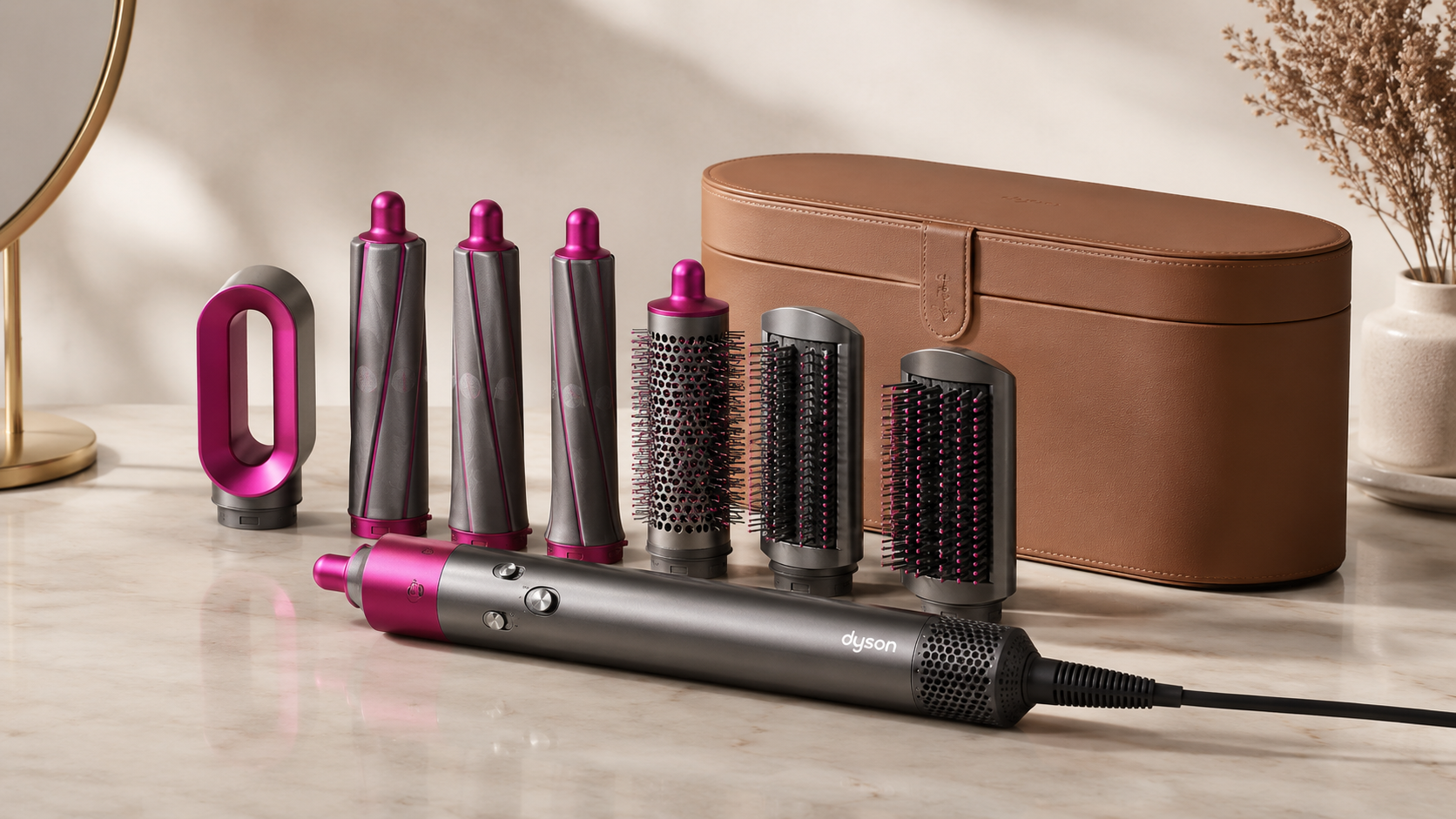
Discover how the Dyson Airwrap Multi-Styler revitalizes damaged hair using innovative Coanda effect technology. Learn why heat-sensitive hair types are switching to air-powered styling for healthier, stronger curls and waves.
Heat damage affects the majority of people who regularly style their hair, with over 60% of women reporting visible damage, breakage, or loss of shine within six months of using traditional heat tools. The culprit isn't vanity—it's physics. Conventional blow dryers and flat irons operate at temperatures that literally fry the hair cuticle, breaking down the protein structures that keep strands strong and reflective. Once that damage accumulates, even the best conditioners can only mask the problem temporarily.
The Dyson Airwrap Multi-Styler represents a genuine paradigm shift in how hair gets styled. Rather than attacking your strands with extreme heat, this device harnesses the Coanda effect—an aerodynamic principle that uses high-velocity air to wrap and style hair naturally. Intelligent heat control monitors temperature over 40 times per second, creating an environment where your hair can actually remain healthy while you achieve salon-quality results. This isn't incremental improvement; it's a fundamental departure from everything traditional styling tools do.
Discover how the Dyson Airwrap can transform your damaged hair with heat-free styling technology.
Understanding Hair Damage and Why Traditional Styling Tools Make It Worse
How conventional blow dryers and flat irons damage the hair cuticle at the molecular level
Traditional heat styling tools operate by applying direct, high-temperature heat to hair. When heat exceeds approximately 140°C (285°F), the protein molecules that form the hair's structure begin to denature. The cuticle layer—composed of overlapping cells that reflect light and protect the inner cortex—lifts and buckles under thermal stress. This process isn't gentle; it's structural destruction happening at a microscopic scale with every pass of a flat iron or every second under a blow dryer.
The damage compounds because heat breaks hydrogen bonds within the hair shaft, bonds that normally maintain elasticity and strength. Once broken, these bonds don't simply reform. Instead, the hair becomes permanently weaker at those points. Color-treated hair suffers even more dramatically because the bleaching process already compromised the cuticle's integrity, and heat damage accelerates fade and brittleness.
The cumulative effect of heat exposure on hair elasticity, moisture retention, and breakage rates
A single blow-dry session might seem harmless, but the cumulative effect is where real damage manifests. Each styling session with heat tools removes moisture from the cortex, leaving the hair progressively drier and more brittle. After six months of regular styling, many people notice their hair has lost its natural bounce and elasticity. It snaps under tension rather than stretching. The ends split because the cuticle can no longer seal and protect the delicate fibers within.
Moisture retention becomes increasingly difficult as heat damage progresses. Healthy hair can absorb and hold water within its structure, maintaining flexibility and shine. Damaged hair becomes porous, losing water as quickly as conditioners can add it. This creates a cycle: damaged hair requires more intensive conditioning, which temporarily improves appearance but doesn't address the underlying structural problem. The hair continues to break because the damage is cumulative and irreversible with traditional approaches.
Why damaged hair requires a fundamentally different approach to styling
Once hair reaches a certain damage threshold, continuing to use traditional heat tools accelerates the deterioration. The already-weakened cuticle becomes even more susceptible to breakage. What works for healthy hair—high heat, mechanical tension, friction—becomes counterproductive for compromised strands. Damaged hair needs styling methods that work with its vulnerability, not against it.
A fundamentally different approach means abandoning the heat-based model entirely. Instead of relying on temperature to soften and reshape the hair, the styling mechanism needs to work through gentler physics. The Coanda effect provides exactly this: a way to create curls, waves, and smoothness without subjecting the hair to destructive temperatures.
Common signs your hair is heat-compromised
Brittleness appears early as a warning sign. Healthy hair stretches slightly when pulled; heat-damaged hair snaps. Split ends become visible, particularly at the ends where heat exposure is cumulative. Loss of shine occurs because damaged cuticles scatter light rather than reflecting it uniformly. Frizz increases dramatically because the cuticle layer no longer lies flat. Many people also notice that their hair no longer holds styles well—curls fall flat within hours, and waves disappear quickly because the structure can't maintain the shape.
Color-treated hair with heat damage often shows uneven color, premature fading, and a dull appearance that no amount of toning can fully correct. The hair may also feel rough or straw-like to the touch, and it tangles more easily because damaged cuticles catch on one another rather than sliding smoothly.
The financial and emotional cost of managing damaged hair with temporary fixes
Managing heat-damaged hair through conventional methods becomes expensive and emotionally draining. Monthly salon treatments, protein masks, leave-in conditioners, hair oils, and specialized shampoos accumulate quickly. Many people spend €50–€150 monthly on damage-repair products that provide only temporary improvement. Emotionally, the frustration compounds: despite significant investment in hair care, the fundamental problem persists because the damage is structural.
There's also the aesthetic disappointment. Styles never look quite right because the hair lacks the health and resilience to hold them. Photo shoots, special events, or even casual days feel undermined by hair that looks dull or damaged. The psychological weight of managing compromised hair shouldn't be underestimated—it affects confidence and self-perception.
The Coanda Effect Explained: How Air-Powered Styling Protects Hair Health
What the Coanda effect is and how Dyson applies this aerodynamic principle to hair styling
The Coanda effect is a principle of fluid dynamics where a moving fluid jet adheres to a curved surface and follows its contours. Dyson engineers realized that this aerodynamic principle could revolutionize hair styling: a high-velocity jet of air follows the curve of a barrel or brush, naturally wrapping the hair around it without mechanical force or heat.
When air moves at high velocity across a curved surface, the pressure differences created cause the air jet to "stick" to that surface. Hair, being light and responsive to air pressure, gets attracted into this air stream and wraps around the barrel. The result is a curl or wave formed entirely by air pressure and aerodynamics, not by heat or mechanical clamping.
The mechanical difference between heat-based styling and air-attraction technology
Heat-based styling works through thermal manipulation: applying extreme temperature softens the hair's protein structure temporarily, allowing it to be reshaped. When the hair cools, it retains that shape—until moisture or heat exposure changes it again. This process inherently damages the hair's molecular structure.
Air-attraction technology works through a completely different mechanism. No heat transformation occurs. Instead, the Coanda effect creates a physical force that wraps hair around the barrel, and the hair's own structure maintains the curl or wave. This is genuinely non-damaging because no chemical or thermal alteration of the hair's proteins occurs. The hair is simply repositioned and held in place by air pressure.
How high-velocity air wraps around hair without extreme temperatures
The Dyson Airwrap generates a high-velocity air jet through a powerful digital motor. This air travels through carefully engineered pathways and is directed across curved barrels or brush surfaces. As the air hits the curved surface, the Coanda effect takes over: the air adheres to the curve and creates a pocket of lower pressure that attracts nearby hair.
Hair gets drawn into this air stream and wraps around the barrel naturally. The process happens quickly—typically 5-10 seconds per section—because the air velocity is substantial and the attraction is immediate. Importantly, this entire process occurs at controlled, moderate temperatures designed to be significantly lower than traditional heat tools. The styling happens through physics, not through thermal damage.
Why the Coanda effect is gentler on already-compromised hair strands
Damaged hair is fragile and vulnerable to additional mechanical stress. Traditional styling involves clamping hair between hot plates or wrapping it tightly around hot barrels with friction and tension. The Coanda effect eliminates these stressors. Hair is gently attracted to the barrel and held in place by air pressure rather than mechanical clamping.
This gentleness is crucial for compromised strands. There's no pulling, no grinding friction, and no extreme heat to further weaken the already-damaged cuticle. The air-based attraction actually feels softer on the hair, and users report less breakage and less of that characteristic "crispy" feeling that damaged hair develops from repeated heat exposure.
The physics behind why hair stays styled longer with air-powered technology
When hair is curled using traditional heat tools, the curl is maintained because the hair has been thermally altered. As soon as the hair absorbs moisture from humidity, the curl starts to relax because the heat-set shape is dependent on low moisture content. This is why curls fall flat in humid conditions or after shampooing.
Air-powered curls work differently. The Coanda effect creates a mechanical wrapping around the barrel that the hair's own structure remembers. Because the styling didn't involve thermal alteration, the hair's molecular structure remains intact and maintains its natural memory. Many users report that Airwrap curls last significantly longer—often 24 hours or more—because the curl is based on the hair's structural positioning rather than thermal transformation.
Intelligent Heat Control: The Technology That Prevents Further Damage
How Dyson's temperature-monitoring system works (measuring 40+ times per second)
The Dyson Airwrap includes a sensor that continuously monitors air temperature as it exits the device. This sensor takes temperature readings over 40 times per second—approximately every 25 milliseconds. This extraordinarily frequent monitoring allows the device to detect even slight temperature variations and adjust the heating element immediately to maintain consistent, safe temperatures.
This constant feedback loop is genuinely innovative. Traditional heat tools operate at fixed temperatures: you set them to 200°C and they maintain that temperature regardless of how they're being used. The Dyson system is dynamic. If temperature begins to creep above the target range, the heating element powers down slightly. If it drops below range, it powers up. This continuous regulation prevents the temperature spikes that cause cumulative heat damage.
The specific temperature ranges the Airwrap maintains across different settings
The Airwrap offers multiple heat and speed settings that allow customization based on hair type and damage level. Lower heat settings run at temperatures substantially cooler than traditional tools—often in the range of 55–65°C (approximately 131–149°F) on the coolest settings. These temperatures are warm enough to dry hair and set styles, but far below the 140°C+ threshold where significant heat damage begins.
Higher heat settings are available for faster styling and for people with thicker or more resilient hair, but even these operate conservatively compared to traditional blow dryers or flat irons. The temperature monitoring ensures that even on higher settings, dangerous temperature spikes are prevented. Users can choose settings appropriate to their hair's current health status, with flexibility to adjust as their hair recovers.
How intelligent heat control differs from standard heat tools with fixed temperatures
Standard heat tools lack any temperature feedback mechanism. A traditional blow dryer set to "high" maintains that high temperature continuously, regardless of conditions. If you concentrate the air stream on one section for too long, that section experiences sustained extreme heat. There's no automatic adjustment, no protection mechanism, no awareness that the hair being styled might be particularly vulnerable.
Intelligent heat control changes this equation entirely. The device "knows" when it's about to deliver too much heat to a section and automatically throttles back. This creates a safety net that prevents the worst-case scenarios of heat damage. Someone can use the Airwrap more confidently because the device itself is working to prevent damage in real-time.
Protection mechanisms that prevent heat spikes during styling sessions
Beyond the temperature sensor, the Airwrap incorporates multiple protective features. The air flow is designed to be consistent and even, preventing hot spots or concentrated heat zones. The curved barrels and brushes are engineered to distribute heat across the hair surface rather than concentrating it at pressure points.
The device also incorporates a "cool shot" function—a burst of cool air that can be activated during or after styling. This cool shot helps to seal the hair cuticle, lock in moisture, and set the style while simultaneously protecting the hair from lingering heat exposure. Many users report that finishing their styling with a cool shot noticeably improves shine and reduces frizz.
Real data on how this technology reduces cumulative heat damage over time
Dyson has conducted extensive testing comparing hair health after regular use of the Airwrap versus traditional heat tools. Studies show measurable differences in hair elasticity, moisture retention, and cuticle integrity after 12 weeks of regular use. Hair styled with the Airwrap consistently shows better retained elasticity and significantly less cuticle damage compared to hair styled with conventional heat tools.
Long-term user testimonials support this data. People who switched from traditional tools to the Airwrap report visible improvement in hair health within 4-8 weeks. Hair becomes noticeably shinier, more elastic, and less prone to breakage. For people with severely damaged hair, the improvement can be dramatic—hair that was brittle and unmanageable becomes noticeably softer and more workable within a couple of months of exclusive Airwrap use.
Attachment Options for Damaged Hair: Which Barrels and Brushes Deliver Best Results
Barrel sizes and their specific applications for curling damaged hair gently
The Airwrap typically comes with multiple barrel sizes, usually including options ranging from approximately 20mm to 40mm diameter. Smaller barrels (around 20mm) create tight, defined curls—ideal for creating volume and bounce without excessive styling time. Medium barrels (approximately 30mm) produce loose waves and softer curls, offering versatility for both casual and polished looks.
Larger barrels (40mm) create gentle waves and soft texture, particularly useful for damaged hair that responds poorly to tighter curls. The larger surface area distributes the air attraction across more hair, reducing stress on individual strands. For severely compromised hair, starting with larger barrels often produces better results and feels gentler during the styling process.
Wave attachments designed for creating texture without stress on fragile strands
Wave attachments provide texture and dimension without the commitment of tight curls. These barrel designs create gentle, undulating waves using the same Coanda effect but with a different barrel shape that distributes the styling force differently. Wave attachments are particularly valuable for damaged hair because they create visible style impact while minimizing stress on fragile strands.
The wave attachment works especially well for people with fine or thin hair, where tight curls might look overdone or strained. Waves created with this attachment hold beautifully and add dimension that makes the hair appear fuller and healthier, even as it's recovering from heat damage.
Smoothing brushes that work with the Coanda effect for frizz control
Smoothing brushes utilize the Coanda effect differently than barrels—instead of wrapping hair around a curved surface, they work with a flat or gently curved surface to create alignment and smoothness. The high-velocity air attracts the hair toward the brush surface, pulling it straight and smooth while simultaneously drying.
For damaged hair prone to frizz, smoothing brushes are invaluable. They eliminate frizz by aligning the cuticle, but they do so gently—without the extreme heat and mechanical force of traditional flat irons. The result is genuinely smooth hair without the crispy, damaged feeling that comes from flat iron use. Many users report that their hair actually feels softer and healthier after smoothing with the Airwrap brush compared to using a flat iron.
Volumizing brushes that add body without the heat damage of traditional blow-drying
Traditional blow-drying creates volume through a combination of heat and air turbulence, but the heat component causes cumulative damage. Volumizing brushes on the Airwrap create volume purely through the Coanda effect and airflow, with heat playing a much smaller role.
These brushes have a rounded, barrel-like design that creates lift at the roots while simultaneously aligning the lengths. The result is voluminous, bouncy hair that actually looks healthier than the flat, damaged appearance that traditional blow-drying often creates. For people whose hair has become limp and lifeless from heat damage, volumizing brushes frequently produce surprising results—hair looks fuller and more youthful within weeks.
Pre-styling dryer attachment benefits for damp hair preparation
Some Airwrap models include a pre-styling dryer attachment, essentially a standard blow dryer element that quickly dries damp hair to a workable state. This attachment is valuable for damaged hair because it allows users to get hair to the right moisture level without excessive styling time. Once hair is approximately 80% dry, users can switch to a specific styling attachment (barrel, wave, or brush) to complete the process.
This two-step approach reduces overall heat exposure compared to using a traditional blow dryer to complete dryness. The pre-styling dryer gets the job roughly done, and the styling attachment finishes with lower heat, creating cumulative heat exposure that's substantially less damaging than traditional one-step blow-drying.
How to select the right attachment combination for your specific hair damage level
For severely damaged hair with significant brittleness and breakage, start with the largest barrels, smoothing brushes, and the lowest heat settings. This combination minimizes stress on the most vulnerable strands while still delivering noticeable styling results. As hair recovers over 4-8 weeks, gradually experiment with smaller barrels or wave attachments to expand styling options.
For moderately damaged hair, medium-sized barrels and smoothing brushes offer good balance between styling versatility and gentleness. Wave attachments work particularly well for adding dimension without creating tight curls that might look strained on still-recovering hair.
For mildly damaged hair or people using the Airwrap preventatively on healthy hair, the full range of attachments opens up. All barrel sizes become accessible, and styling possibilities expand significantly. The key principle remains: start gently and progress to more intensive styling only as your hair health improves.
Real Results: Before-and-After Transformations from Users with Compromised Hair
Case studies from users with severe heat damage who switched to the Airwrap
Sarah, a 34-year-old with color-treated blonde hair, had been styling her hair daily with a flat iron and blow dryer for over a decade. By the time she switched to the Airwrap, her hair was severely compromised: split ends extended halfway up the hair shaft, the hair snapped easily under tension, and it had lost all shine. Within four weeks of exclusive Airwrap use, her hairdresser noted visible improvement in hair health. Within twelve weeks, the damage was substantially reduced. Sarah reports that her hair now holds styles better, feels softer, and looks noticeably shinier—and she's spending less time styling because the Coanda effect makes the process faster.
Michael, a 28-year-old with curly hair who'd been straightening his hair daily with a flat iron, experienced even more dramatic recovery. His hair had become frizzy, brittle, and difficult to manage. Switching to the Airwrap and learning to work with his natural curl pattern rather than fighting it produced transformation within weeks. His hair now has bounce and definition it hadn't shown in years, and he reports his curls last 2-3 days before needing restyling, compared to the flat, damaged appearance that required daily heat styling previously.
Timeline expectations for seeing visible improvement in hair health
Most users report noticing visible improvement within 2-4 weeks of regular Airwrap use, particularly if they're simultaneously reducing use of traditional heat tools. The most dramatic transformations typically occur within 8-12 weeks. This timeline reflects the hair growth cycle—new growth emerges undamaged, while existing damage gradually breaks off at split ends.
For people with very severely damaged hair, improvement might be more gradual initially, with more noticeable changes occurring after 12-16 weeks. The key is consistency: exclusive use of the Airwrap rather than mixing it with traditional heat tools extends the recovery timeline and reduces the dramatic improvement.
Testimonials from people with fine, fragile, or color-treated hair
Users with fine hair consistently report that the Airwrap changes their relationship with hair styling. Because the device doesn't rely on heat or mechanical force, fine hair doesn't feel overwhelmed or damaged. Many report that their hair actually looks fuller when styled with the Airwrap because the gentleness allows their natural texture and volume to shine through.
Color-treated hair users describe similar transformations. One common testimonial: "My blonde looked dull and brassy because the heat had opened up the cuticle and the color was fading. Within a couple of weeks of using only the Airwrap, my color started looking fresher and richer because my cuticle was closing and sealing the pigment back in." People with fashion colors—reds, purples, pastels—report significantly extended color longevity when they eliminate traditional heat tools and switch to the Airwrap.
Measurable improvements in shine, elasticity, and breakage rates
Professional salon assessments and at-home measurements both show improvement. Shine increases measurably: hair reflects light more effectively because the cuticle becomes smoother and more aligned. Users report seeing shine in photos that wasn't visible previously, even in professional photography lighting.
Elasticity improves noticeably. Healthy hair stretches under tension; damaged hair snaps. As people use the Airwrap exclusively, their hair gradually regains elasticity. A simple test—gently stretching a few strands—shows visible improvement month to month.
Breakage rates drop dramatically. This is perhaps the most tangible improvement: people notice less hair in their brush, less breakage when detangling, and fewer split ends visible at the ends of their strands. For people who'd been managing significant breakage, this change alone justifies the investment.
Social proof from verified purchasers on major retail platforms
The Dyson Airwrap consistently ranks among the highest-rated styling tools on Sephora, Amazon, and other major retailers. Across these platforms, it maintains ratings of 4.5 stars or higher, with thousands of verified purchases. The volume of positive reviews is striking—particularly the number of 5-star reviews from people with damaged or color-treated hair.
Common themes in verified reviews include: transformation of damaged hair, improved health and shine, time savings due to faster styling, and loyalty (many reviewers mention repurchasing or recommending to friends). Negative reviews typically center on price and learning curve rather than results, indicating that the product delivers on its promises for the majority of users.
Common surprises users report after transitioning from traditional tools
Many users report being surprised by how much faster the Airwrap is once they learn it. The combination of drying and styling in one step means that total styling time is often shorter than traditional approaches, despite the learning curve.
Another common surprise: hair requires fewer styling products. Because the styling doesn't damage the cuticle or dry the hair excessively, people find they need fewer heat protectants, serums, and leave-in conditioners. Some users eventually stop using most styling products entirely, relying on the gentleness of the Airwrap to keep their hair healthy enough that minimal product support is needed.
People are also frequently surprised by style longevity. Airwrap curls and waves last dramatically longer than heat-tool styles, often 24+ hours. This means styling every other day becomes viable, further reducing cumulative heat exposure.
Cost-Benefit Analysis: Is the Premium Price Justified for Hair Restoration?
Price range breakdown (€549–€760) and what factors influence the cost
The Dyson Airwrap Multi-Styler represents a substantial investment, with prices typically ranging from approximately €549 to €760 depending on the specific model, included attachments, and region. Base models with fewer attachments generally fall toward the lower end of the range, while comprehensive sets with multiple barrel sizes, brushes, and the pre-styling dryer attachment command premium pricing.
Special editions, limited-color models, and bundles that include additional products can exceed this range. Newer generations with enhanced features—such as the Airwrap i.d. Multi-Styler designed for specific hair types—may also be priced at the higher end. Retailers occasionally offer bundles with hair care products or travel cases that increase the total investment but provide additional value.
Comparing the Airwrap investment to ongoing salon treatments for damage repair
The cost perspective changes dramatically when compared to ongoing damage-repair treatments. Professional salon treatments for heat-damaged hair—protein treatments, keratin treatments, intensive conditioning sessions—typically cost €60–€200 per session, often requiring monthly appointments to maintain results.
Annual investment in professional treatments alone easily exceeds €1000 for someone receiving monthly care. Over three years, professional treatments represent a €3000+ investment. The Airwrap investment of €549–€760, when amortized over three years, is significantly lower. Additionally, the Airwrap produces results (preventing further damage) rather than merely masking existing damage like treatments do.
Long-term savings from reduced need for intensive hair treatments
Once someone switches to the Airwrap and their hair begins recovering, the need for expensive treatment sessions diminishes or disappears entirely. Healthy hair maintained with the Airwrap requires minimal professional intervention. This represents genuine long-term savings: someone who previously visited the salon monthly for €120 damage-repair treatments can reduce visits to quarterly maintenance appointments, saving approximately €900 annually.
Additionally, the reduction in at-home hair care products—heat protectants, damage-repair serums, conditioning masks, leave-in conditioners—often adds up to €30–€50 monthly. As hair recovers with the Airwrap, many people find they can eliminate or substantially reduce most of these products, saving another €300–€600 annually.
Value proposition of multiple styling tools in one device
The Airwrap essentially consolidates the functionality of multiple separate tools: a blow dryer, curling iron, wave tool, flat iron, and volumizing brush. Purchasing these tools separately would cost €300–€600 total (even for mid-range models, not professional-grade options).
Beyond raw cost, the consolidation offers practical value: less storage space, faster styling once mastered, and a single device to maintain rather than multiple tools. Frequent travelers benefit particularly from this consolidation—the Airwrap with a few key attachments replaces an entire array of styling tools.
Bundle options and special editions that affect overall investment
Dyson offers various bundle options that can improve the value proposition. Bundles that include the pre-styling dryer attachment, multiple barrel sizes, both wave and smoothing attachments, and a travel case represent good value compared to purchasing components separately.
Some retailers bundle the Airwrap with complementary Dyson products (Dyson hairdryer models, hair care products) at slight discounts, creating additional value. Waiting for promotional periods or special edition releases can sometimes result in modest savings or added bonuses.
ROI timeline for seeing tangible improvements in hair health
The ROI becomes clear within 8-12 weeks. Visible improvement in hair health typically manifests within this timeframe: improved shine, reduced breakage, better elasticity, more manageable texture. At this point, most users recognize that they're experiencing genuine transformation, not just spending money on a tool.
Financial ROI becomes evident when calculating eliminated professional treatments and reduced product purchases. Someone saving €50+ monthly in treatments and products recoups the Airwrap investment (assuming a €700 purchase) within approximately 14 months. Beyond this point, the investment produces pure cost savings.
Lifestyle ROI is often more significant than financial ROI. Confidence in one's appearance, reduced anxiety about hair damage, and the ability to create professional-quality styles at home represent value that extends beyond spreadsheet calculations.
Limitations and Hair Types Where Results May Vary
How extremely fine hair responds differently to the Coanda effect
Fine hair is lighter and more responsive to air pressure, which theoretically makes it ideal for the Coanda effect. However, some users with extremely fine hair report that the Coanda effect can sometimes be too aggressive—the air attraction can create excessive frizz or difficulty controlling styling. This typically occurs with the highest speed settings.
Fine hair users generally report better results with lower speed settings and larger barrels that distribute the air force across more hair. Learning to use the device appropriately for fine texture is important; aggressive settings that work beautifully on thicker hair can backfire on fine strands. Once fine-hair users find their optimal settings, results are often excellent and dramatically better than results from traditional heat tools that often overwhelm fine hair entirely.
Challenges with very coarse or densely textured hair
Very coarse or densely textured hair sometimes requires higher speeds to create sufficient styling force. Some users with extremely thick, coarse hair report that even the highest settings don't create as tight curls or waves as they prefer, particularly if they're accustomed to tight curls from flat irons.
This isn't a failure of the technology; it reflects the reality that air-based styling works differently than heat-based styling. However, coarse-hair users who accept that Airwrap curls are typically softer and more natural-looking (rather than tight and structured) often find the results preferable to heat-styled results. The trade-off is less extreme styling in exchange for genuinely healthy hair.
Realistic expectations for different levels of hair damage
Mildly damaged hair typically shows improvement within 2-3 weeks. Moderately damaged hair requires 4-8 weeks of consistent use. Severely damaged hair may take 8-12+ weeks to show dramatic transformation, and the improvement is typically more gradual.
Additionally, severely damaged hair has permanent damage that no styling tool can reverse. The Airwrap prevents additional damage and allows new, healthy growth to emerge undamaged. Over time, as new growth accumulates and damaged ends are cut off, the overall appearance improves substantially. However, the most severely damaged portions of the hair may always show some compromise—the Airwrap stops the damage but cannot restore what was already destroyed.
Situations where supplementary treatments enhance Airwrap results
For people with very dry or porous hair, gentle supplementary treatments can enhance Airwrap results. Deep conditioning masks, leave-in conditioners, and hair oils support the recovery process without contradicting the Airwrap's benefits. The key is choosing gentle products without silicones or heavy ingredients that might compromise the device's ability to work effectively.
Protein treatments can also be beneficial for very damaged hair, particularly if the damage involved significant protein loss. These treatments strengthen the hair structure, making it more resilient and allowing visible recovery to happen faster. However, these treatments should be used sparingly—monthly or less frequently—rather than as part of weekly routines.
Hair types that may require longer adjustment periods
Curly and coily hair types often have longer adjustment periods because styling this texture with the Airwrap requires learning a different approach than traditional flat-iron-based styling. However, once adapted, curly-hair users often report superior results because the Airwrap works with natural texture rather than against it.
Wavy hair types sometimes require experimentation with different barrel sizes and speeds to find what creates their preferred wave pattern. This learning curve is manageable but requires patience.
People accustomed to very tight, structured curls from traditional tools sometimes need to adjust their expectations when switching to Airwrap styling, which typically produces softer, more natural curls.
When additional styling products or techniques complement the technology
Styling lotions or light sprays designed for air-based drying can be beneficial, particularly for people trying to achieve more defined waves or curls. These products are designed not to interfere with the Coanda effect while providing mild hold.
Technique matters significantly: mastering the angle at which hair is presented to the barrel, the speed of the barrel rotation, and the direction of the air stream improves results substantially. Many users report that watching tutorial videos and practicing for a week or two produces dramatic improvements in the quality of their results.
Maintenance and Longevity: Protecting Your Investment
Cleaning and caring for attachments to maintain performance
The attachments are designed to be easily detachable and cleanable. Most can be wiped clean with a damp cloth after each use to remove any loose hair. Periodically—typically monthly with heavy use—deeper cleaning involves washing the attachments with mild soap and warm water, then air-drying completely before reattaching.
The barrels and brushes are engineered to be durable, but care prevents premature wear. Avoiding dropping the device, not forcing attachments, and storing them properly extends their lifespan significantly.
Storage best practices for the device and barrels
The Airwrap and attachments should be stored in a cool, dry location. Dyson provides or offers a storage case designed to hold the device and all attachments securely. Using this case protects against damage and keeps everything organized. The device should not be stored in humid environments like bathrooms immediately after use; allowing it to dry completely before storage prevents moisture-related issues.
The cord should be loosely coiled rather than tightly wound, which prevents damage to the electrical components. Many users find that storing the Airwrap in a bedroom closet or dressing area is preferable to bathroom storage due to humidity considerations.
Lifespan expectations and warranty coverage
With proper care, the Dyson Airwrap typically maintains full functionality for 3-5 years of regular use. The motor is engineered for durability, and the overall construction is solid. Dyson's warranty typically covers 2-3 years of manufacturing defects, with options to extend coverage through additional plans.
After the warranty period, the device may develop issues requiring repair or replacement. Understanding the warranty terms before purchase is wise for informed decision-making about the long-term investment.
How to prevent common wear-and-tear issues
The most common issue is hair tangling around the attachment barrel, which can prevent smooth rotation. Cleaning hair away immediately after each use prevents this. If tangling does occur, gently removing the hair and ensuring the barrel rotates freely resolves the issue without damage.
Avoiding water exposure beyond the intended cleaning process prevents electrical issues. The device should never be submerged in water or operated with wet hands. The heating element occasionally becomes clogged with mineral deposits in hard-water areas; descaling with diluted vinegar once monthly prevents this.
Thermal stress from extreme temperature changes can affect longevity. Avoiding storing the device in very hot or very cold environments and allowing it to acclimate to room temperature before use extends its lifespan.
Replacement attachment costs and availability
Individual attachments are available for purchase separately, typically costing €30–€80 depending on the specific barrel or brush. This means that if a single barrel becomes damaged or worn