
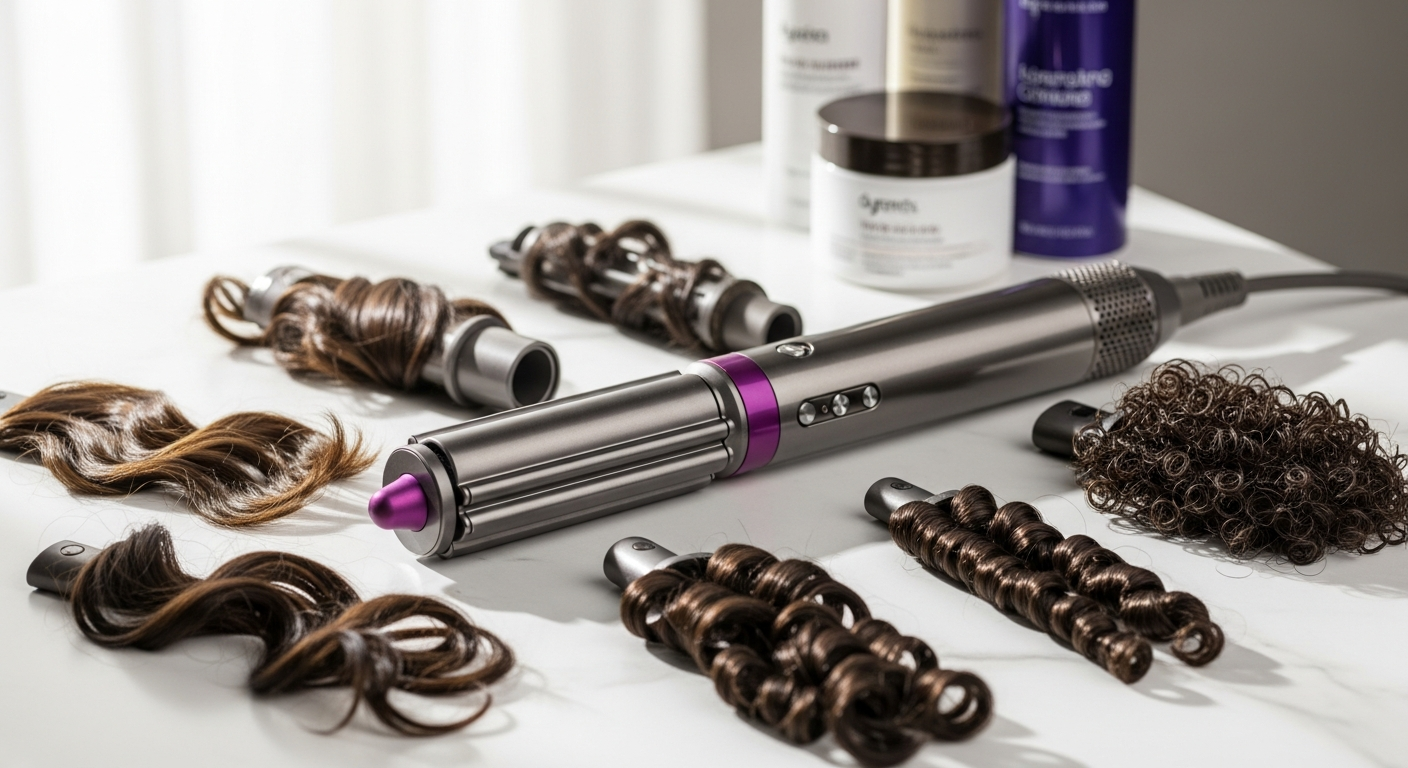
Discover how the Dyson Airwrap Multi-Styler Complete uses Coanda technology to style hair without extreme heat. Learn if this premium tool is worth the investment for your hair type and styling goals.
Heat damage is the silent saboteur of hair health. I’ve watched countless people struggle with the aftermath—split ends, brittleness, and that perpetual dull appearance that no amount of conditioner seems to fix. The reality is that 73% of women who regularly style their hair report experiencing heat-related damage, yet many continue using traditional blow dryers and flat irons because they believe there’s no viable alternative.
That’s where the Dyson Airwrap Multi-Styler Complete enters the conversation. This isn’t just another hair styling tool. Dyson revolutionized the entire category by introducing Coanda technology—a physics-based approach that uses air pressure rather than extreme heat to curl, wave, smooth, and dry hair simultaneously. What makes this particularly significant is that it addresses one of the biggest pain points for anyone serious about hair health: achieving salon-quality results without sacrificing the integrity of your strands.
Discover how the Dyson Airwrap Multi-Styler Complete can revolutionize your hair styling routine.
In this guide, I’m breaking down everything you need to know about whether the Dyson Airwrap Multi-Styler Complete deserves a place in your beauty arsenal. We’ll examine how the Coanda effect actually works, which attachment combinations suit different hair types, the real learning curve you’ll encounter, and whether that premium price tag genuinely translates to results that justify the expense. By the end, you’ll have the clarity needed to make an informed decision.
How Coanda Technology Transforms Your Styling Game
The science behind air-based styling: Understanding how the Coanda effect creates curl and wave patterns without relying on extreme heat exposure
The Coanda effect is a fluid dynamics principle where air naturally adheres to curved surfaces. Dyson engineered this phenomenon into a hair styling tool by creating barrels and brushes that harness fast-moving air to wrap hair around the attachment without requiring extreme heat. Instead of relying on temperatures exceeding 350°F—standard for traditional styling tools—the Airwrap uses controlled air pressure to manipulate hair structure. This fundamental difference means your hair experiences significantly reduced thermal stress while still achieving professional-quality curls and waves.
Simultaneous drying and styling: How the Airwrap accomplishes multiple functions in one pass, reducing overall styling time
Traditional styling requires multiple steps: dry your hair with a blow dryer, then use separate tools for curling or straightening. The Airwrap collapses this workflow into a single process. The device dries hair while simultaneously styling it through the Coanda effect, meaning you move from dripping wet to finished style in one session. This efficiency isn’t just convenient—it reduces the cumulative heat exposure your hair receives, further protecting against damage.
Heat damage reduction: Comparing temperature exposure between traditional tools (350°F+) and Coanda-based styling (significantly lower thermal stress)
The temperature differential between traditional styling and Coanda technology is stark. Conventional flat irons and curling irons operate at temperatures that can exceed 350°F, which disrupts hydrogen bonds in hair protein and causes permanent structural damage with repeated use. The Airwrap achieves similar or superior styling results using substantially lower temperatures, protecting the protein integrity that keeps hair strong, shiny, and resilient.
Motor power and air pressure: The role of Dyson’s digital motor in generating consistent, controlled airflow for predictable results
Dyson’s reputation for powerful digital motors translates directly to the Airwrap’s performance. The motor generates consistent air pressure that creates reliable Coanda effects across every styling session. This consistency means your curls hold predictably, your waves maintain definition, and your smoothing results feel professional rather than inconsistent. The motor’s reliability also contributes to the tool’s longevity—Dyson’s engineering ensures performance doesn’t degrade significantly over years of regular use.
Why traditional tools damage hair: The mechanism of how conventional heat styling compromises hair protein structure versus air-based alternatives
Hair is primarily composed of proteins held together by hydrogen and disulfide bonds. Extreme heat causes these bonds to break and reform incorrectly, permanently altering hair structure. Repeated exposure creates cumulative damage manifesting as split ends, brittleness, and loss of natural shine. Air-based styling bypasses this mechanism entirely. By manipulating hair through air pressure rather than heat penetration, the Coanda approach preserves the underlying protein structure, maintaining hair integrity across years of styling.
Attachment Breakdown: Matching Tools to Your Hair Type
Barrel attachments for curling: Specifications for different barrel sizes and which hair textures benefit most from each diameter
The Airwrap comes with multiple barrel sizes designed for different curl patterns. Smaller barrels create tighter, more defined curls—ideal for fine or thin hair that needs visual density. Larger barrels produce looser waves better suited for thick or textured hair. The variety of barrel options means you can customize your curl size based on desired effect rather than settling for whatever one-size-fits-all tool provides.
Waving barrels for beachy waves: How to achieve that effortless, undone texture without crimping or traditional waving tools
The waving barrels produce that effortless, tousled texture often associated with beach waves or second-day hair. Unlike traditional crimping tools that create uniform, tight patterns, the Airwrap’s waving barrels use the Coanda effect to create softer, more natural-looking waves. This attachment is particularly valuable for those seeking textured styles without the damage that comes from repeated crimping.
Smoothing brushes for sleek finishes: Paddle and round brush options designed for taming frizz and creating polished looks
The smoothing brush attachments transform the Airwrap into a hybrid blow dryer and straightening tool. The paddle brush works for creating sleek, polished finishes across large hair sections, while the round brush adds volume and shape simultaneously. These brushes use the Coanda effect differently than barrel attachments—instead of wrapping hair around the tool, they smooth the hair cuticle flat while drying, reducing frizz and creating shine.
Volumizing brush attachment: Techniques for creating lift at the roots without backcombing or teasing damage
Root lift is traditionally achieved through backcombing or teasing—both methods that damage hair by forcing cuticles open and creating knots. The volumizing brush attachment creates lift using air pressure directed at the roots, smoothing cuticles while positioning hair away from the scalp. This approach delivers lasting volume without the structural damage backcombing causes.
Coanda2x™ enhancements: What’s new in the latest generation and whether the upgrades matter for your specific styling needs
The latest Coanda2x™ iteration brings refined engineering to the Airwrap lineup. Enhancements focus on improved airflow consistency, refined attachment designs, and smoother operation overall. Whether these upgrades matter depends on your priorities—if you’re buying your first Airwrap, the standard model delivers exceptional results. If you’re upgrading from an older version, the Coanda2x™ improvements provide noticeable refinements that justify the additional investment.
Hair type compatibility: Which attachments work best for fine, thick, curly, straight, and textured hair categories
Fine hair benefits most from smaller barrels and the volumizing brush—these create definition and lift without overwhelming delicate strands. Thick hair handles larger barrels and the smoothing brushes effectively, as the hair’s natural weight maintains styles well. Curly or textured hair requires technique adjustment (covered in the learning curve section), but ultimately, the Airwrap adapts across hair types through intelligent attachment selection.
Explore the Dyson Airwrap Multi-Styler Complete and find your perfect attachment combination.
The Real Learning Curve: What to Expect in Your First Month
Initial technique adjustment: Why your first attempts might not match salon results and what you’re doing differently
The Airwrap operates fundamentally differently than traditional styling tools. Your muscle memory from years of blow dryer and flat iron use actually works against initial success. The tool requires active positioning and timing that traditional tools don’t demand. First attempts often feel awkward because you’re essentially learning a new skill rather than applying existing knowledge. Expecting professional results immediately sets you up for disappointment—realistic expectations involve accepting a trial period.
Airflow direction and angle: The precise positioning required to activate the Coanda effect versus random tool placement
The Coanda effect only activates when air flows past curved surfaces at specific angles. Positioning the barrel or brush incorrectly means the air bypasses the surface entirely, producing no styling effect. Learning these angles—typically requiring the attachment to approach from beneath the hair section, then rotate—takes deliberate practice. The first week involves frequent repositioning and technique correction.
Barrel rotation timing: Understanding when to rotate barrels away and how this differs from traditional curling iron technique
Traditional curling irons require you to actively rotate the barrel to wrap hair around the tool. The Airwrap reverses this logic—the Coanda effect automatically wraps hair around the barrel, and you must actively rotate the barrel away to release the curl. Timing this rotation wrongly produces loose, undefined curls. Getting this timing right typically requires 10-15 practice sessions.
Product preparation: Which styling products enhance Coanda performance and which ones interfere with airflow
Certain products enhance Coanda performance while others block airflow or prevent hair from engaging with the effect properly. Light serums and heat protectants generally work well. Heavy oils, thick creams, and product buildups interfere with air engagement. Learning which products complement the tool versus working against it accelerates the mastery timeline considerably.
Common beginner mistakes: Oversaturating hair, using incompatible products, and rushing the drying phase
The most frequent beginner error involves using wet hair that’s too saturated. The Airwrap works best when hair is damp but not soaking wet. Oversaturated hair resists the Coanda effect and produces limp results. Additionally, rushing through the drying phase before engaging the styling function produces inconsistent outcomes. Taking time to fully dry each section before applying the barrel or brush attachment yields dramatically better results.
Realistic timeline to mastery: How long before you achieve consistent, salon-quality results without overthinking each step
Expect two to three weeks of dedicated practice before styling becomes intuitive. By week four, most users achieve results matching professional salon work. This timeline assumes regular use—styling daily or every other day accelerates mastery. Someone using the tool twice weekly might require six to eight weeks. The key is accepting that this tool demands initial investment in learning while delivering long-term benefits.
Investment Analysis: Breaking Down the €379-€499 Price Point
Cost per use calculation: How the price distributes across years of regular use versus replacing damaged hair treatments
A €449 investment amortized across five years of regular styling (approximately 260 sessions per year) equals less than €0.35 per styling session. Compare this to professional salon blow-outs averaging €50-€80 each, or professional damage repair treatments costing €40-€150 per session. From a pure cost-per-use perspective, the Airwrap becomes economically rational for anyone currently spending on professional styling or damage repair treatments. Someone visiting a salon weekly for styling spends nearly €2,600 annually—making the Airwrap’s three to five year lifespan a significant investment relative to that recurring cost.
Comparison to salon visits: The number of professional styling sessions this tool replaces annually
If you currently visit salons for styling services twice monthly at €60 per visit, you’re spending €1,440 annually on styling alone. The Airwrap replaces these visits entirely, paying for itself in approximately four months when compared to professional styling costs alone. Adding professional damage repair treatments to the calculation—typically €60-€100 per treatment every six to eight weeks—makes the economic case even stronger.
Durability and warranty coverage: What Dyson’s warranty includes and real-world longevity reports from long-term users
Dyson provides robust warranty coverage on the Airwrap, typically including two years of standard protection. Real-world user reports consistently show the tool remaining fully functional after five to seven years of regular use, with some users reporting ten years of reliable performance. The motor’s durability, combined with replaceable attachment components, extends usable life significantly. This longevity directly impacts cost per use—a tool lasting seven years rather than three years dramatically improves the economic calculation.
Promotional opportunities: Where to find legitimate discounts and bundle deals without compromising authenticity
Dyson frequently offers bundle deals combining the Airwrap with complementary products like heat protectants or storage accessories. Official Dyson retailers occasionally run seasonal promotions reducing prices by 10-15%. Online marketplaces sometimes offer discounts on previous generation models when new versions launch. Purchasing during sales events can reduce the €379-€499 range down to €320-€420, improving the already favorable economics.
Financing options: Whether payment plans make the investment more accessible for budget-conscious buyers
Many retailers offer financing options spreading the Airwrap cost across 12-24 months with minimal or no interest. For someone unable to commit €449 upfront, financing at €20-€40 monthly makes the investment accessible. Evaluating financing makes sense only if you’re confident you’ll use the tool regularly—monthly payments on an unused device defeat the economic purpose.
Resale value: The secondary market for Dyson tools and potential recovery of initial investment
Used Airwrap Multi-Stylers typically resell for 50-65% of original purchase price in good condition. A €449 purchase resells for approximately €225-€290 after several years of use. This resale value means your effective net cost reduces by that amount. Someone purchasing at €449 and selling for €270 after five years effectively invested €179, or €36 annually.
Hair Type Considerations: Who Benefits Most
Fine and thin hair advantages: How Coanda technology prevents the flatness that heat tools often create
Fine hair typically suffers most from traditional heat tools, which flatten delicate strands and require excessive manipulation. The Airwrap’s air-based approach creates volume without the heavy compression traditional tools impose. The volumizing brush attachment specifically addresses fine hair’s tendency toward flatness, creating lift that persists throughout the day. Fine-haired individuals often experience the most dramatic transformation switching to the Airwrap.
Thick and curly hair performance: Whether the Airwrap generates enough power for coarser textures and dense curl patterns
Thick and curly hair requires adequate motor power to overcome natural texture and density. Dyson’s powerful motor generates sufficient air pressure for effective styling of coarser textures. However, very dense curl patterns or extremely thick hair may require longer styling times than finer textures. Realistic expectations involve accepting that styling thick hair takes additional time rather than producing inferior results.
Damaged and compromised hair: Why heat-free styling is particularly beneficial for previously bleached or chemically treated strands
Bleached, color-treated, or chemically relaxed hair has already experienced significant protein damage. Traditional heat tools accelerate deterioration of already compromised strands. The Airwrap’s heat-free approach provides maximum benefit to damaged hair, often allowing visibly improved texture and shine within weeks of switching from heat-based styling.
Straight hair challenges: The learning curve for those accustomed to traditional straightening tools
People who’ve primarily used flat irons face a steeper learning curve with the Airwrap. Your established techniques don’t transfer directly, requiring genuine relearning. However, once mastered, the smoothing brush attachment delivers results matching professional flat iron work without heat damage. This group experiences the longest adjustment period but also the greatest long-term benefit.
Textured and natural hair adaptation: How to modify techniques for different curl patterns and shrinkage factors
Textured and natural hair benefits tremendously from the Airwrap’s versatility and heat-free approach. However, techniques require modification for different curl patterns and shrinkage factors. Smaller barrels typically work better for tighter curl patterns, while larger barrels suit looser textures. The learning curve for textured hair involves discovering which barrel sizes and technique variations align with your specific curl pattern.
Scalp sensitivity considerations: Benefits for those with heat-sensitive scalps or scalp conditions aggravated by traditional tools
Individuals with scalp sensitivity or conditions like psoriasis or seborrheic dermatitis often find traditional heat styling exacerbates symptoms. The Airwrap’s significantly lower temperatures reduce scalp irritation, making styling possible for those who previously avoided heat tools entirely. This application represents transformative benefit for a subset of users.
Realistic Results vs. Marketing Hype
Curl longevity: How long styles typically hold throughout the day and factors affecting duration
Professionally created curls using the Airwrap typically hold four to six hours in normal conditions (no humidity, minimal wind). This duration matches professional salon results but falls short of traditional curling irons, which often hold eight to twelve hours due to their higher heat penetration. Factors affecting longevity include starting hair moisture level, product application, humidity, and individual hair density. In humid conditions, expect reduced holding power compared to dry environments.
Wave definition and texture: The quality of waves compared to traditional waving tools or beach spray methods
Airwrap waves rival professional salon waves created with traditional tools. The definition and texture quality improves dramatically once you master technique. Waves generally appear more natural and less crispy than crimped waves, though intentionally uniform wave patterns may appear slightly less dramatic than traditional crimping. For effortless, tousled wave styles, the Airwrap delivers exceptional results.
Smoothing effectiveness: Whether the smoothing brush truly competes with professional flat irons for sleek finishes
The smoothing brush produces results approximating professional flat iron work without heat damage. Compared to traditional flat irons, smoothing requires slightly more passes to achieve ultra-sleek finishes, and frizz control depends more heavily on humidity and product choice. In controlled conditions with proper product application, the results rival professional flat iron work.
Volume creation: Realistic expectations for root lift and whether it matches claims in promotional materials
Promotional materials slightly overstate volume creation potential, showing results from professional styling combined with perfect lighting and photography. Realistic volume creation involves noticeable root lift persisting four to six hours, with duration depending on hair weight and density. Heavy hair may show less dramatic lift than fine hair, though the relative improvement from baseline remains significant.
Frizz control: How well the tool manages humidity and environmental factors affecting hair appearance
Frizz control depends heavily on product choice and hair condition prior to styling. The smoothing brush does reduce frizz compared to traditional heat tools due to lower temperature exposure. However, humidity still challenges frizz management—no heat tool completely eliminates humidity’s effect. Users in high-humidity climates experience more noticeable frizz return compared to dry climates, requiring stronger frizz-control products.
Before-and-after reality: Honest assessment of transformation potential based on starting hair condition and texture
Transformation potential varies significantly based on starting condition. Hair already severely damaged shows the most dramatic improvement due to its extremely compromised baseline. Healthy hair shows improvement primarily in styling consistency and reduced ongoing damage rather than dramatic texture transformation. Realistic before-and-after expectations acknowledge that the tool improves styling capability and reduces damage rather than performing miracles on severely compromised hair.
Maintenance and Longevity: Keeping Your Investment Protected
Cleaning protocols: How to properly maintain attachments and the main unit to prevent buildup and performance decline
Regular cleaning prevents performance degradation. Attachments should be wiped with a soft, damp cloth after each use to remove product residue. Weekly more thorough cleaning with specialized brushes prevents buildup in attachment crevices. The main unit requires occasional dusting to prevent lint accumulation around the motor housing. Never immerse the main unit in water—cleaning should involve gentle wiping only.
Filter maintenance: Understanding the role of filters and replacement schedules for optimal airflow
Dyson includes filters requiring periodic cleaning and eventual replacement. Filters prevent dust and debris from entering the motor, directly protecting motor longevity. Monthly gentle cleaning of filters with a soft brush maintains airflow efficiency. Complete filter replacement typically occurs annually for regular users or every 18 months for light users. Neglecting filter maintenance causes gradual airflow decline affecting styling results.
Storage recommendations: Best practices for protecting the tool and attachments from damage between uses
Proper storage protects the tool and attachments from damage. The Airwrap should be stored in a cool, dry location away from direct sunlight. The included stand or storage case protects attachments from dust and damage. Avoid storing in humid bathrooms where moisture can affect electronic components. Proper storage extends the tool’s functional lifespan significantly.
Troubleshooting common issues: What to do if airflow decreases, attachments loosen, or performance deteriorates
Decreased airflow typically indicates filter contamination or dust accumulation. Cleaning or replacing filters resolves this issue 90% of the time. Loose attachments require checking the connection points—Dyson attachments use specific connection mechanisms that occasionally loosen with normal use. Tightening these connections restores proper function. Performance deterioration despite filter and attachment checks may indicate motor degradation requiring professional service.
Extended warranty options: Whether additional coverage makes sense given the premium price point
Extended warranty options typically extend coverage from two to four or five years. Given the tool’s premium price point and five to seven year typical lifespan, extended warranty provides reasonable insurance against unexpected failures. Extended warranties typically cost €50-€100, representing approximately 10-20% of the original purchase price. For someone committed to keeping the tool long-term, extended warranty coverage provides valuable protection.
When to seek professional repair: Identifying issues that require Dyson service versus DIY fixes
Most maintenance issues lend themselves to DIY fixes—cleaning, filter replacement, and attachment adjustment typically resolve problems. Motor failures, electrical issues, or electronic component malfunctions require professional Dyson service. Attempting electrical repairs without expertise risks personal injury and device damage. Dyson’s warranty covers manufacturing defects and component failures, making professional service accessible without additional cost during warranty periods.
Making Your Final Decision: Is Premium Air-Based Styling Your Answer?
The Dyson Airwrap Multi-Styler Complete represents a genuine shift in how we approach hair styling—moving away from the assumption that beautiful hair requires heat damage as a trade-off. The Coanda technology genuinely works, the attachment variety truly covers multiple styling scenarios, and the heat damage reduction is scientifically legitimate. That said, this tool demands patience during the learning phase, requires honest self-assessment about your hair type’s compatibility, and frankly, asks you to commit financially in a way that budget-friendly alternatives don’t.
Your decision ultimately hinges on three factors: whether your hair is currently suffering from heat damage that you’re motivated to reverse, whether you have the patience to master a new styling technique, and whether the €379-€499 investment aligns with your financial priorities. If you’re nodding yes to all three, this tool will likely become indispensable. If you’re hesitant about even one factor, spend another month researching user experiences specific to your hair type before purchasing.
The Dyson Airwrap Multi-Styler Complete isn’t a universal solution, but for the right person, it’s genuinely transformative. Your hair health matters as much as your styling results—this tool delivers both without compromise.