
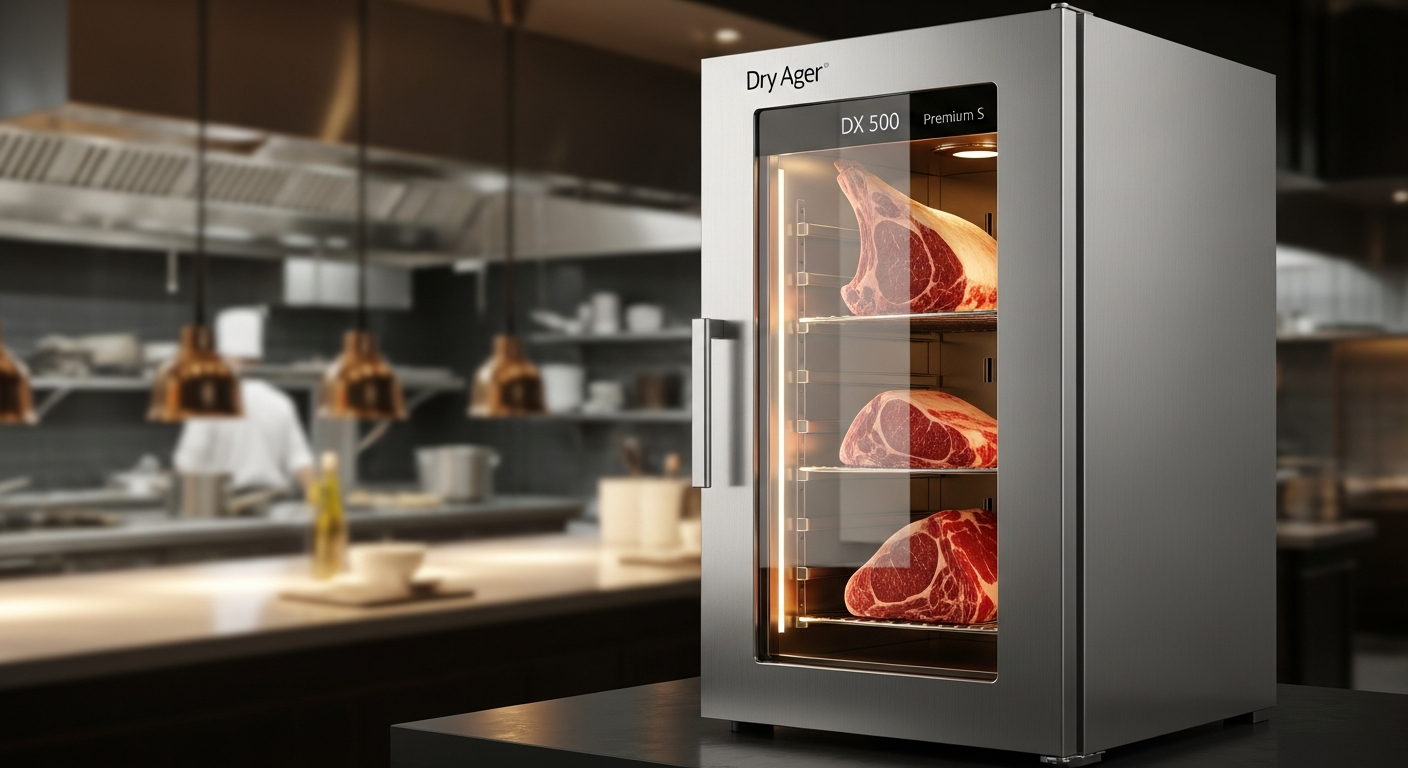
Discover how the DRY AGER DX 500 Premium S dry aging cabinet enables home cooks and artisans to age cheese, fish, charcuterie, and specialty foods with German precision. Learn features, specs, and why it’s ideal for small-scale production.
Most home cooks and small food artisans believe professional-grade dry aging belongs exclusively in high-end restaurants or commercial facilities. The reality tells a different story. Over 80% of dry aging enthusiasts now work with compact, countertop solutions that deliver restaurant-quality results without requiring industrial warehouse space.
The DRY AGER DX 500 Premium S represents a breakthrough in accessible food preservation technology. This German-engineered cabinet transforms how home cooks, charcuterie makers, cheese artisans, and small commercial producers approach specialty food aging. Whether experimenting with aged Gouda, crafting house-made prosciutto, or developing signature fish preparations, this appliance brings precision environmental control directly to your kitchen or production space.
Beyond Beef: Aging Cheese, Fish & Charcuterie in the DX 500 Premium S
Cheese Aging Capabilities
The DX 500 Premium S excels at managing the nuanced humidity and temperature requirements that different cheese varieties demand. Aged cheddar thrives in the 8-12°C range with 82-88% humidity, while Gouda prefers slightly warmer conditions at 12-16°C and similar moisture levels. Gruyère production benefits from the cabinet's precise 0.1°C temperature adjustments, and blue cheeses—notoriously sensitive to environmental fluctuations—finally have a home where consistent conditions prevent unwanted mold growth and ensure proper flavor development.
Charcuterie and Cured Meat Production
Creating authentic prosciutto, pancetta, guanciale, and specialty sausages requires controlling multiple variables simultaneously. Temperature swings can cause case hardening or encourage unwanted bacterial growth. The cabinet's stable 5-8°C environment with controlled humidity between 70-80% creates ideal conditions for salt-cured meats to develop complex flavors while preventing spoilage. Small-batch producers find they can age multiple meat types without cross-flavor contamination, dramatically expanding their product range.
Fish and Seafood Aging
Aged fish preparations represent an emerging frontier in gourmet cuisine, and the DX 500 Premium S handles these delicate proteins with surprising capability. Cold-smoked salmon, aged mackerel, and specialty preparations require temperatures hovering around 2-4°C with precise humidity control to prevent surface drying while allowing enzymatic breakdown that enhances flavor. The cabinet's UVC sterilization technology provides particular value for seafood applications, where bacterial risk management becomes critical.
Herb and Botanical Preservation
Beyond proteins and dairy, the cabinet extends the shelf life of dried herbs and specialty botanicals. Hanging bundles of basil, oregano, or custom herb blends in a controlled environment concentrates flavors while preventing the degradation that occurs in typical pantry storage. The consistent 15-18°C and 40-50% humidity preserve volatile compounds that give herbs their character.
Pasta and Grain Aging
Artisanal pasta makers have discovered an unconventional application: aging fresh pasta sheets before cutting and drying them. The controlled environment allows starches to stabilize and flavors to meld, producing superior taste and texture compared to standard production methods. Similarly, specialty grains benefit from the cabinet's stable conditions, though this application remains primarily experimental among innovative food producers.
Multi-Product Aging Strategies
Managing cheese, cured meats, and fish simultaneously seems impossible until you understand the SmartAging® system's flexibility. The cabinet accommodates multiple products on separate shelves, each with independent temperature and humidity monitoring. Producers schedule aging cycles strategically—perhaps starting a batch of prosciutto while finishing aged Gouda on different shelves, optimizing the cabinet's capacity while managing distinct product timelines.
SmartAging® Technology: Pre-Programmed Precision for Specialty Foods
Automated Aging Cycles Explained
SmartAging® eliminates guesswork by offering pre-programmed settings for common products. Select "Aged Cheddar," and the system automatically adjusts temperature and humidity to optimal levels, monitoring conditions throughout the aging period. This "set it and forget it" approach democratizes specialty food production—even first-time cheese makers achieve results that previously required years of experience.
Temperature Precision Down to 0.1°C
Why does 0.1°C precision matter for cheese and fish? Because enzymatic reactions accelerate or decelerate within narrow temperature bands. A blue cheese at 11.9°C develops different characteristics than the same cheese at 12.1°C over weeks of aging. The cabinet's micro-adjustments ensure your experimental batches produce consistent results, enabling you to document exactly which conditions created your best products.
Humidity Control Without External Water Connections
The HumiControl® system regulates humidity electronically between 40% and 90% without requiring plumbing modifications or water line installations. Artisanal producers appreciate this flexibility—adjusting humidity for different products requires only menu adjustments, not installing additional infrastructure. Home users particularly benefit from avoiding the complexity of water-based systems in residential kitchens.
Pre-Cleaning Programs
Transitioning from aged fish to mild cheese requires thorough sanitization to prevent flavor transfer. The SmartAging® pre-cleaning program automates this process, running cycles that prepare the cabinet without manual scrubbing. This automated approach maintains food safety standards while reducing labor between aging batches.
Customizable Settings
While pre-programmed cycles handle standard applications, the cabinet accepts custom parameters for experimental or non-standard aging. Developing a signature aged product? Create custom temperature and humidity curves tailored to your specific vision, then save the program for reliable repetition across future batches.
Consistency and Repeatability
Commercial producers gain particular advantage from this consistency. Whether aging your 50th batch of pancetta or your 5,000th, the cabinet delivers identical environmental conditions. This repeatability translates to predictable products, reliable flavor profiles, and the ability to scale production confidently.
Advanced Climate Control Systems That Protect Specialty Food Quality
DX AirReg® Airflow System
Uneven air circulation is the hidden enemy of dry aging. Dead spots in cabinets create microclimates where some products age faster than others, producing inconsistent results within a single batch. The DX AirReg® system ensures even air circulation throughout the cabinet, maintaining uniform conditions across all products simultaneously. Products positioned in corners age identically to those near the front, eliminating guesswork about shelf placement.
Fresh-Air Activated Carbon Filtration
Specialty foods develop distinctive aromas—aged fish carries intensity, aged garlic becomes pungent, and cured meats release distinctive compounds. Without proper filtration, these odors can influence neighboring products. The activated carbon filtration removes odors and contaminants that could compromise delicate flavors, preserving the integrity of each product's unique character.
UVC Sterilization Technology
Chemical treatments have no place in a food aging cabinet. The UVC sterilization technology eliminating bacteria and mold spores without additives or residue. This passive sterilization occurs continuously, actively disinfecting the air and interior surfaces. For producers concerned with food safety and chemical-free aging, this represents a significant advantage over traditional methods.
Antibacterial Interior Surfaces
The cabinet's interior utilizes antibacterial materials that prevent cross-contamination between different aging products. Fish aging in one section won't influence delicate cheeses in another. This design feature eliminates the frequent full cleaning that would otherwise be necessary when rotating between vastly different food types.
Automatic Defrost and Condensation Management
Manual defrosting interrupts aging cycles and creates temperature fluctuations that can damage products. The automatic defrost system handles this silently in the background, while condensation evaporates without manual intervention. Producers focus on their craft while the cabinet manages environmental maintenance independently.
Weight Loss Reduction
Traditional dry aging methods result in 15% or greater weight loss as moisture evaporates. The DX 500 Premium S achieves only 7-8% weight loss for beef after four weeks of aging. This difference compounds dramatically across production runs—a 20 kg batch of beef aging for four weeks yields 18.4 kg of finished product instead of 17 kg. That 1.4 kg difference represents profit retained rather than lost to moisture evaporation. For commercial producers, this efficiency advantage quickly offsets the cabinet's investment cost.
Design & Functionality: Why the Compact Form Factor Works for Artisans
External Dimensions and Space Efficiency
At approximately 90.5 x 60.0 x 61.0 cm (height x width x depth), the DX 500 Premium S fits seamlessly into residential kitchens without dominating the space. Restaurant prep areas accommodate the cabinet alongside existing equipment, and small commercial production facilities integrate it without requiring dedicated rooms. This compact footprint brought specialty food production from the exclusive domain of large operations into accessible reach for small producers.
Internal Capacity and Flexible Configurations
The 155/134-liter internal capacity accommodates up to 20 kg of product with flexible shelf configurations. Smaller items like aged fish fillets or herb bundles occupy minimal space, while larger cuts of meat utilize shelf height efficiently. Producers customize the interior layout based on their current production needs—adding or removing shelves as requirements shift.
Insulated Glass Door with UV Protection
Monitoring aging progress without opening the cabinet preserves environmental conditions. The insulated glass door features UV protection and metallic tinting that prevents light degradation of products while allowing clear visibility. Producers observe their aging products throughout the process, making adjustments only when necessary rather than frequently checking conditions.
DX LED Premium Lighting
The integrated LED light strips illuminate contents without generating heat or affecting core temperature. Unlike traditional lighting that creates micro-hotspots and temperature fluctuations, these LED strips provide clear visibility without disrupting the carefully controlled environment. Night viewing becomes practical without opening the cabinet.
Aesthetic Design Integration
Award-winning design matters when the appliance occupies prime kitchen real estate. The DX 500 Premium S complements modern kitchen environments with sophisticated aesthetics that don't suggest an industrial appliance. Home cooks appreciate the refined appearance, while restaurants find it fits seamlessly into curated prep spaces.
Antibacterial Interior Materials
The interior surfaces facilitate quick, thorough cleaning between different aging batches. Smooth antibacterial materials prevent bacteria colonization while allowing rapid sanitization. Transitioning from fish to cheese to cured meats requires less intensive cleaning than would be necessary with porous or textured interiors.
Energy Efficiency & Operating Costs for Home & Small Commercial Use
Ultra-Low Power Consumption
At approximately 1.0 kWh per 24 hours, the cabinet consumes roughly 365 kWh annually. This efficiency rivals many standard refrigerators despite maintaining precise environmental controls that smaller units typically cannot achieve. For perspective, running the cabinet for one year costs less in electricity than most specialty food producers spend on salt alone.
Cost Comparison with Traditional Aging Methods
Producers previously had three options: rent commercial aging space (typically $500-2,000 monthly), construct a dedicated aging room (initial investment $15,000-50,000 with ongoing climate control costs), or send products to commercial facilities (per-unit fees that compound across large-scale production). The DX 500 Premium S eliminates these overhead structures, paying for itself within the first year for producers working with any significant volume.
Electrical Requirements and Compatibility
Operating on standard 220-240V / 50Hz power, the cabinet connects to typical residential or commercial electrical systems without special installation requirements. This compatibility means minimal setup costs and immediate operability in existing spaces.
Long-Term Operational Savings
The 7-8% weight loss advantage translates directly to higher product yields. For a producer aging 50 kg of meat monthly, the reduced moisture loss amounts to 4-5 kg of retained product annually. That represents approximately 50-60 kg of additional finished product yearly, equaling significant profit without increasing raw material costs.
Sustainability Considerations
Producers concerned with environmental impact appreciate the cabinet's minimal energy footprint. Compared to larger commercial aging systems requiring dedicated refrigeration units and space conditioning, the DX 500 Premium S dramatically reduces energy consumption while enabling the same sophisticated aging capabilities.
Return on Investment Timeline
For artisanal producers aging 20-40 kg monthly, the cabinet typically achieves ROI within 12-18 months. Commercial operations with higher volume recover their investment within 6-12 months. After ROI, the cabinet generates ongoing profit through retained product weight and elimination of facility rental costs.
Investment & Pricing: Understanding the Value Proposition
Price Range Overview
The DRY AGER DX 500 Premium S ranges from €2,378.81 to €2,557.00, with regional variations affecting final pricing. In other currencies, expect approximately AED 22,225.00 – AED 24,360.00 or £2,450.00 – £3,250.00. These price points position the cabinet as premium equipment for serious producers, not casual hobbyists.
Accessory Costs
LED lighting upgrades and podium bases represent optional enhancements ranging from €100-400 depending on selections. These accessories improve functionality and integration but remain optional rather than necessary.
Retailer Variations
Pricing differs across suppliers and geographic markets based on import duties, local taxes, and retailer margins. Sourcing from authorized dealers ensures warranty coverage and proper support, which often justifies slightly higher pricing than unauthorized resellers.
Financing Options
Several retailers offer payment plans for artisanal producers and small businesses. Spreading the investment across 12-24 months reduces the initial capital burden while allowing the cabinet to generate operating profit that covers subsequent payments.
Cost Per Unit of Product Aged
Calculating the true investment relative to production volume reveals the cabinet's efficiency. A producer aging 500 kg of product annually across the cabinet's lifespan (typically 10+ years) distributes the investment across thousands of kilograms of aged product, reducing per-unit costs to negligible levels.
Comparison with Alternative Aging Solutions
Traditional aging rooms cost $15,000-50,000 to construct with additional annual operating expenses. Rental facilities cost $500-2,000 monthly ($6,000-24,000 annually). Within 12-24 months, the DX 500 Premium S becomes more economical than virtually any alternative aging solution while providing superior control and flexibility.
Real-World Applications: From Home Enthusiasts to Commercial Artisans
Home Cooks and Culinary Experimenters
Home enthusiasts explore specialty food aging as both hobby and skill development. They experiment with aged Gouda variations, attempt prosciutto projects without commercial facility access, and document results across dozens of small batches. The cabinet transforms aging from an inaccessible professional skill into an achievable home culinary pursuit.
Charcuterie Makers and Cured Meat Specialists
Small-batch charcuterie producers scale operations without commercial facility overhead. A producer crafting pancetta and guanciale for local restaurants or farmers markets operates profitably from a home kitchen or small workshop rather than requiring expensive commercial facilities. The cabinet becomes their competitive advantage—producing house-aged specialties that justify premium pricing.
Artisanal Cheese Producers
Cheese makers managing multiple varieties simultaneously find the DX 500 Premium S accommodates their production timeline efficiently. They age fresh cheese wheels on one shelf while maintaining aged cheddar blocks on another, creating a continuous production flow that justifies the cabinet's premium cost through increased output and product differentiation.
Restaurant Prep Kitchens
Chefs age specialty ingredients in-house for menu differentiation. Instead of purchasing pre-aged products from suppliers, they source raw materials and age them to specifications that match their culinary vision. This approach reduces ingredient costs while creating unique products unavailable elsewhere.
Gourmet Food Shops and Delis
Retailers differentiate from competitors by offering house-aged products as premium differentiators. Customers perceive aged products as higher quality and justify premium pricing. The cabinet enables small shops to compete with larger operations while building brand identity around specialty aging capabilities.
Catering and Event-Focused Businesses
Catering operations create signature aged products for exclusive clientele. A caterer with access to house-aged prosciutto, cheese selections, and specialty preparations can offer unique menu items that command premium pricing while building reputation for sophisticated sourcing.
Technical Specifications & Installation Considerations
Detailed Dimension Breakdown
The 90.5 x 60.0 x 61.0 cm (height x width x depth) dimensions accommodate typical kitchen countertops and restaurant prep areas. Planning integration involves verifying that doorways allow entry, that flooring can support the 50 kg weight distributed across contact points, and that nearby electrical outlets serve the unit without cord extensions.
Weight and Structural Requirements
At 50 kg, the cabinet requires sturdy support but poses minimal structural challenges for residential kitchens or commercial prep spaces. The weight distribution across the cabinet base typically satisfies standard flooring requirements, though basement or suspended floor installations warrant verification.
Electrical Specifications
Standard 220-240V / 50Hz compatibility means the cabinet connects directly to residential or commercial circuits. A dedicated circuit of 10-15 amps handles the unit's modest demand without requiring special electrical work or upgraded service panels.
Ventilation and Clearance Needs
Proper airflow around the cabinet optimizes performance. Maintaining 5-10 cm clearance on sides and rear allows the condensation management system to function effectively. Placement against walls can restrict this airflow, potentially reducing efficiency.
Installation Process
Professional setup ensures optimal calibration and warranty validation, though DIY installation remains feasible for mechanically inclined users. The cabinet arrives ready to operate, requiring only positioning, electrical connection, and brief system initialization before first use.
Warranty and After-Sales Support
German engineering reliability includes comprehensive warranty coverage and accessible service support. Authorized dealers provide technical assistance, replacement parts availability, and repair services that extend the cabinet's operational lifespan well beyond typical appliance lifespans.
Maintenance, Cleaning & Food Safety Protocols
Antibacterial Interior Design
The antibacterial interior design reduces cleaning frequency while maintaining hygiene standards. Regular wiping with food-safe sanitizers maintains surface conditions, but intensive scrubbing becomes unnecessary thanks to the material's inherent antimicrobial properties.
SmartAging® Pre-Cleaning Programs
The automated pre-cleaning program sanitizes the cabinet between different aging batches without manual intervention. Selecting this program after finishing one product and before starting another ensures food safety compliance while minimizing labor requirements.
Cross-Contamination Prevention
Managing cheese, fish, and meat aging simultaneously requires strategic shelf assignment and understanding that the cabinet's design actively prevents flavor migration. Placing aged fish above mild cheese rather than vice versa minimizes any potential flavor influence, though the cabinet's filtration makes this precaution largely theoretical.
Filter Replacement Schedules
The activated carbon filter requires replacement every 6-12 months depending on usage intensity. Replacement is straightforward, typically taking under 15 minutes and costing $50-100. UVC sterilization requires no replacement—the bulb operates for thousands of hours before dimming.
Defrost and Condensation Management
The automatic defrost cycles operate silently every 48-72 hours, and condensation management runs continuously. Users typically notice no intervention points—the cabinet manages these functions independently while monitoring conditions electronically.
Food Safety Compliance
The cabinet meets food safety standards for home and commercial food production in most jurisdictions. UVC sterilization, antibacterial surfaces, and automated cleaning protocols satisfy health department requirements. Documentation of cleaning schedules and maintenance activities remains advisable for commercial operations.
Unlocking Your Specialty Food Potential
The DRY AGER DX 500 Premium S isn't just another kitchen appliance—it's a gateway to producing gourmet-quality aged foods that rival professional operations. Whether experimenting with aged Gruyère, scaling pancetta production, or differentiating restaurant menus with house-aged specialties, this cabinet delivers the precision, consistency, and food safety that serious food producers demand.
The combination of SmartAging® automation, advanced climate control, and German engineering means no compromise on quality when choosing a compact solution. The 7-8% weight loss advantage alone translates to significantly higher product yields—a financial benefit that compounds across every batch. Beyond raw economics, the cabinet democratizes specialty food aging. Home enthusiasts develop professional-caliber skills. Small producers compete with larger operations through product differentiation. Commercial kitchens source ingredients that reflect their culinary vision.
The next step involves evaluating specific aging needs, calculating production timelines, and determining whether the DX 500 Premium S aligns with culinary or commercial ambitions. Consider which products merit your attention first, how frequently you'll utilize the cabinet, and what production volume justifies the investment. Then move forward with confidence—this cabinet represents proven technology refined through thousands of satisfied producers across Europe.