
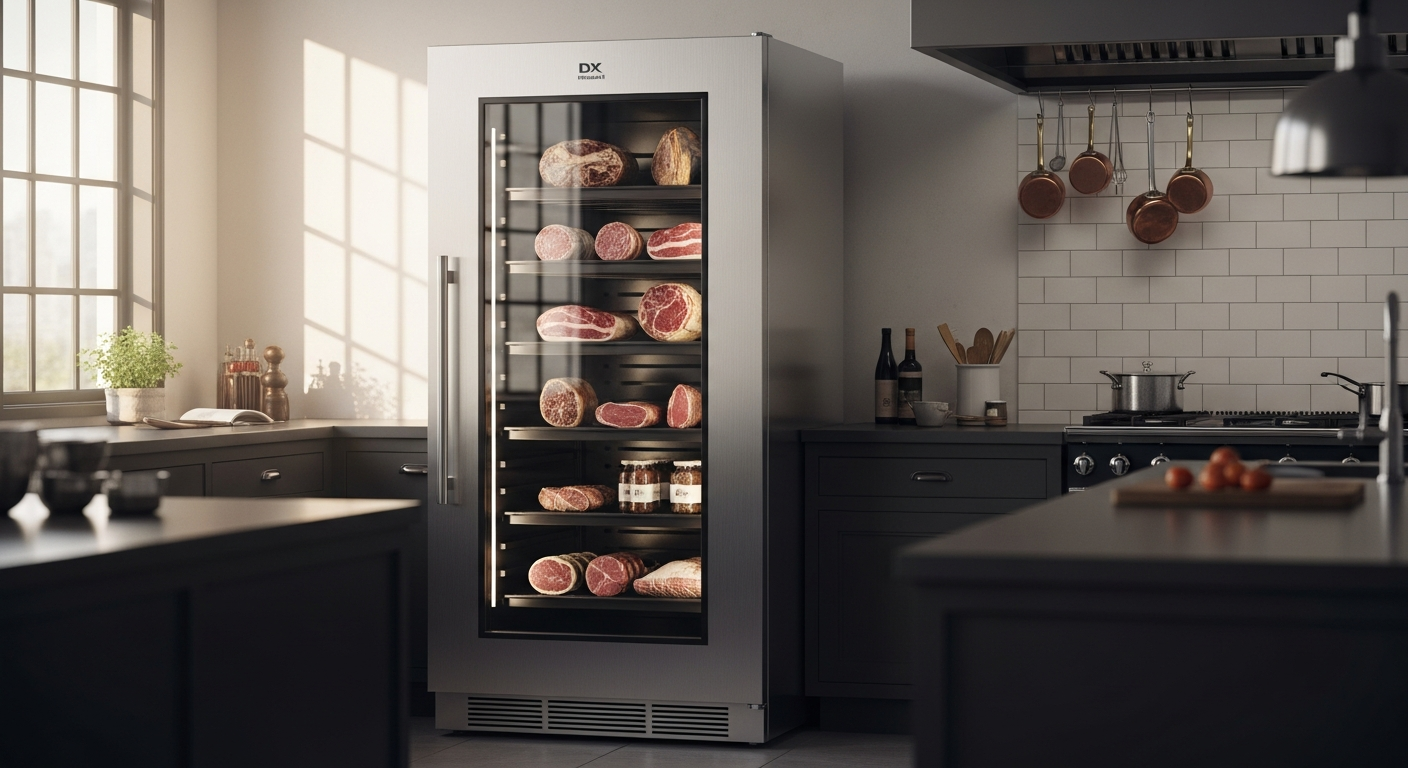
Discover how the DRY AGER DX 1000 Premium S dry aging cabinet extends beyond meat to age premium charcuterie, artisan cheese, and specialty foods with German precision and SmartAging® technology.
Most people think dry aging cabinets are exclusively for steakhouses and butcher shops—but that's where they're completely wrong. The reality? Premium dry aging technology has quietly revolutionized how artisan food producers, charcuterie makers, and cheese specialists create their signature products. Traditional aging methods rely on unpredictable environmental factors, inconsistent results, and significant product loss—constraints that have limited small producers for generations.
The DRY AGER DX 1000 Premium S isn't just another meat maturation device; it's a multi-purpose aging powerhouse that's reshaping how gourmet foods are crafted. Manufactured in Germany by DRY AGER, a globally recognized leader in precision aging solutions, the DX 1000 Premium S brings professional-grade food maturation capabilities to ambitious producers who refuse to compromise on quality. This cabinet represents a fundamental shift in how specialty food businesses approach product development—moving from traditional, unpredictable aging methods to controlled, repeatable excellence.
Beyond Beef: Expanding Your Aging Portfolio with the DX 1000 Premium S
How SmartAging® technology adapts to different food categories with one-touch presets
The SmartAging® technology embedded in the DX 1000 Premium S eliminates the complexity that traditionally plagued multi-product aging facilities. Rather than manually adjusting parameters for ham, sausage, cheese, fish, or beef, producers simply select their product category. The cabinet automatically configures optimal temperature, humidity, and air circulation settings—transforming a technically demanding process into accessible, repeatable production.
This intelligent system learns from each aging cycle, refining parameters based on your specific products and environment. A producer working with multiple charcuterie varieties no longer needs separate aging spaces or constant environmental monitoring. The cabinet handles the technical heavy lifting, freeing producers to focus on product development and market expansion.
The versatility advantage: why multi-product aging capability matters for specialty food producers
Consolidating multiple aging operations into a single cabinet fundamentally changes business economics for small-to-medium food producers. Traditional operations required separate aging rooms for different product categories—each with its own climate control infrastructure, monitoring systems, and operational costs. The DX 1000 Premium S collapses this complexity into one German-engineered unit.
For boutique producers, this versatility opens immediate opportunities for product line expansion. A charcuterie maker can simultaneously age prosciutto, dry sausage, and specialty cured meats without requiring additional facility investment. A cheese producer can manage multiple varieties at different maturation stages within the same cabinet. A restaurant concept can develop both aged beef and specialty aged fish products within a single, manageable footprint.
Real-world aging timelines for charcuterie, cheese, and non-beef proteins
Controlled environment aging accelerates flavor development while minimizing the timeline unpredictability of traditional methods. Dry-cured ham typically reaches optimal flavor complexity in 8-12 weeks within the DX 1000 Premium S—compared to 6-12 months in traditional aging rooms where environmental variation extends timelines. Artisan cheese varieties develop distinctive mold characteristics and flavor profiles in 6-10 weeks, rather than the 3-6 month range typical of uncontrolled environments.
Fish aging presents particularly compelling timelines. Premium aged fish develops concentrated umami characteristics in 2-4 weeks under the cabinet's precise conditions—a process that traditionally required unpredictable environmental management or specialized facilities. Game meats reach optimal flavor complexity in 3-5 weeks, compared to the 4-8 week variance of conventional aging.
Weight loss optimization: how the DX 1000 Premium S minimizes moisture loss across different product types
Traditional dry aging results in approximately 7-8% weight loss over 4 weeks for beef—a significant financial impact across larger production volumes. The DX 1000 Premium S reduces this degradation through precision humidity control (60-90%) and optimized air circulation. For high-value products like specialty aged fish or boutique cheese varieties, even small reductions in moisture loss translate directly to revenue preservation.
Cheese producers benefit particularly from this optimization. Natural rind development requires specific humidity levels—too dry and the protective mold layer fails to develop; too moist and contaminating organisms thrive. The HumiControl® system maintains the precise 70-80% humidity range that premium aged cheeses require, reducing product loss while accelerating the rind development that customers value.
Food safety considerations when aging diverse products in a single cabinet
The integrated UVC sterilization and activated carbon filtration system addresses the primary concern of multi-product aging: cross-contamination and pathogen development. The cabinet disinfects its air environment once per minute, eliminating harmful bacteria and germs that traditionally compromised aging operations. For producers aging fish alongside cheese or game meats, this continuous sterilization becomes essential.
Additionally, the cabinet's removable shelves and smooth interior surfaces enable straightforward cleaning protocols between product runs. Producers can transition from one product category to another without the deep sanitation requirements of shared traditional aging rooms. Food safety compliance documentation—critical for any producer targeting restaurants or retail distribution—becomes demonstrable and auditable.
Case studies: artisan producers successfully aging multiple product lines simultaneously
Boutique charcuterie operations have leveraged the DX 1000 Premium S to scale production from single-product focus to diversified offerings. Producers report achieving consistent quality across 4-6 different cured meat varieties simultaneously—something previously requiring either multiple facilities or sequential production schedules that extended timelines and reduced revenue.
Artisan cheese makers have reported particular success managing aged varieties requiring different maturation profiles within the same cabinet. Aged goat cheese, blue varieties, and washed-rind types can develop simultaneously under precisely controlled conditions, enabling producers to offer seasonal variety without facility expansion.
Precision Control Technologies That Make Specialty Food Aging Foolproof
HumiControl® humidity regulation (60-90%): why precision moisture management is critical for cheese and charcuterie development
Humidity represents the critical variable that separates exceptional aged products from mediocre ones. The human body exists at roughly 37% relative humidity—anything lower promotes surface drying and oxidation that damages delicate flavors; anything higher encourages unwanted mold and bacterial growth. The HumiControl® system maintains your specified humidity range with precision that traditional aging rooms simply cannot achieve.
For charcuterie, this precision accelerates proper casing development and ensures consistent flavor concentration. Prosciutto and specialty dry-cured meats develop their characteristic texture and complex flavors only within a narrow humidity window. The cabinet's automated adjustment prevents the environmental drift that traditionally caused batch variation and product loss.
DX AirReg® air circulation system: how intelligent airflow prevents product degradation and ensures even aging
Stagnant air promotes contamination and uneven maturation. Excessive air circulation dries products prematurely. The DX AirReg® system calculates optimal airflow patterns based on your product type and cabinet load, preventing both scenarios. Intelligent circulation ensures that all shelves experience consistent aging conditions—eliminating the traditional problem where lower shelves age differently from upper positions.
For cheese production, proper airflow becomes critical for controlled mold development. Washed-rind cheeses require specific air patterns to develop their characteristic aromas without encouraging contaminating organisms. The system's dynamic adjustment based on product category ensures that each variety receives the exact airflow conditions its maturation requires.
Temperature flexibility (0°C to 30°C): adapting the cabinet for different aging requirements across food categories
The cabinet's temperature range (0°C to 30°C / 32°F to 77°F) accommodates dramatically different aging requirements across food categories. Cheese typically matures at 10-15°C. Charcuterie develops optimally at 12-18°C. Fish aging requires cooler 4-8°C conditions. Rather than requiring separate facilities for each temperature zone, producers can adjust the cabinet based on current aging requirements.
Seasonal adaptation becomes straightforward. Summer months might focus on cooler-temperature fish aging or cheese maturation, while winter months accommodate charcuterie and cured meat development at higher temperature ranges. This flexibility enables year-round production diversification without facility constraints.
UVC sterilization and activated carbon filtration: eliminating contamination risks when aging delicate foods like fish
The cabinet's disinfection system operates continuously, sterilizing the air environment once per minute. For producers aging premium seafood—where contamination risks traditionally necessitated specialized facilities—this becomes transformative. The UVC system eliminates pathogens that could otherwise develop in the moist, cool environment that fish aging requires.
The activated carbon filter removes odors and volatile compounds, preventing the cross-contamination of flavors when aging multiple product types. A producer aging both aged fish and artisan cheese can prevent the fish characteristics from imparting unwanted flavors to their cheese varieties—something impossible in traditional shared aging spaces.
No external water connection required: simplifying installation for boutique food producers and small-scale operations
Traditional aging cabinets often require water connections for humidification systems, adding installation complexity and cost. The DX 1000 Premium S operates independently, using advanced humidification technology that doesn't depend on external water supplies. For boutique producers operating from repurposed kitchen spaces, commercial incubators, or non-traditional facilities, this independence becomes invaluable.
Installation becomes straightforward: position the cabinet, ensure adequate ventilation clearance, and connect electrical power. No plumbing contractors, no extended installation timelines, no facility modifications. Producers can establish aging operations in weeks rather than months.
Automated parameter adjustment: how the cabinet learns and optimizes conditions for your specific products
The SmartAging® system accumulates data from each aging cycle, refining its parameter adjustments based on your specific environment and products. Over time, the cabinet becomes increasingly optimized for your exact conditions—accounting for factors like ambient temperature variation, your local humidity patterns, and the specific characteristics of your source ingredients.
This learning capability means producers get better results over time. The cabinet's initial cycles establish baselines. Subsequent cycles increasingly match your products' exact needs. By year two of operation, most producers report noticeably superior results compared to year one—a continuous improvement trajectory impossible with static traditional aging methods.
German Engineering Meets Artisan Food Production
Made in Germany quality standards and their impact on food aging consistency and reliability
German manufacturing represents a specific quality philosophy: precision engineering, rigorous testing, and uncompromising durability standards. The DRY AGER brand embodies this tradition, with the DX 1000 Premium S engineered and manufactured to standards that prioritize long-term reliability over cost minimization.
This engineering rigor directly impacts food aging consistency. Every sensor, every control mechanism, every material selection has been validated for precision and longevity. Producers using the cabinet over 10+ years experience minimal performance drift—the system aged in year ten performs essentially identically to year one. This consistency becomes critical for building brand reputation around aged products.
Stainless steel construction: durability and hygiene benefits for premium food production environments
The cabinet's high-grade stainless steel construction withstands the demanding environment of food production—regular cleaning with food-safe sanitizers, temperature cycling, and humidity exposure that would degrade lesser materials. Stainless steel resists corrosion, maintains structural integrity under extended use, and supports rigorous sanitation protocols.
For producers targeting retail or restaurant distribution, stainless steel construction communicates quality standards to customers and inspectors. The cabinet's appearance reflects the professionalism and attention to detail that distinguishes artisan producers from commodity operations.
Glass door design: presentation and monitoring advantages for aging specialty products
The glass door serves dual purposes. Operationally, it enables real-time monitoring of aging progress without opening the cabinet and disrupting internal conditions. Producers can observe product development, assess mold formation, and monitor batch progression without environmental interference.
Aesthetically, the glass door transforms the cabinet into a visual asset. Restaurants can position the cabinet in visible locations, using the aging process as part of their brand narrative. Retail producers can showcase their aging operations, building customer confidence in quality and transparency. The visual presentation of aging products becomes part of the product's story and value proposition.
Removable shelves and smooth interior surfaces: easy cleaning protocols for food safety compliance
The removable shelf design enables straightforward sanitation between different product runs. Producers can clean shelves separately, maintain detailed sanitation documentation, and transition rapidly between product categories without extended downtime. The smooth interior surfaces prevent contamination harboring in cracks or crevices—a critical requirement for food safety compliance.
For producers targeting certification or retail distribution, the cabinet's design facilitates audit compliance. Sanitation logs, shelf replacement documentation, and air filter maintenance become verifiable, supporting third-party inspection processes.
100 kg (220 lbs) capacity: understanding load specifications for different product types
The cabinet's 100 kg capacity accommodates substantial aging volumes within a compact footprint. For charcuterie production, this translates to approximately 15-20 kg per shelf across multiple aging stages—enabling sequential production that maintains continuous cash flow while managing product variety.
For cheese aging, the 100 kg capacity supports 40-50 wheels or numerous smaller varieties simultaneously. Fish aging operations can maintain 25-30 kg of premium seafood in various maturation stages. Understanding product-specific load calculations enables producers to optimize production scheduling and inventory management.
Build quality and longevity: why German manufacturing reduces replacement costs over 10+ years
The cabinet's engineering and construction standards support 10+ year operational lifespans with minimal maintenance beyond routine filter replacement. This longevity fundamentally changes the equipment economics for producers. Rather than replacing aging infrastructure every 5-7 years, producers invest once and maintain that equipment across a decade of expanding production.
The total cost of ownership—including acquisition, energy consumption, maintenance, and eventual replacement—heavily favors German-engineered precision equipment over cheaper alternatives requiring earlier replacement cycles.
Transforming Charcuterie Production with Controlled Aging Environments
Dry-cured ham aging: how the DX 1000 Premium S accelerates flavor development in traditional products
Dry-cured ham requires precise humidity and temperature conditions to develop its characteristic complex flavors and delicate texture. The cabinet's precision environment accelerates this development from traditional 6-12 month timelines to 8-12 weeks while improving consistency. Each batch develops identical flavor profiles rather than the variation inherent in traditional aging rooms.
Producers report that cabinet-aged ham achieves flavor intensity traditionally requiring 12+ months of aging within 10-12 weeks. This acceleration directly impacts cash flow—significantly shorter inventory holding periods mean producers can reinvest revenue faster and respond more rapidly to market demand.
Sausage maturation: achieving proper casing development and flavor concentration without traditional aging rooms
Traditional sausage aging required dedicated aging rooms maintaining specific humidity and temperature combinations. The DX 1000 Premium S enables producers to achieve identical results within a compact cabinet. Sausage casings develop characteristic texture and flavor concentration in 3-6 weeks—compared to 4-8 weeks in traditional environments with uncontrolled humidity variation.
The cabinet enables producers to maintain continuous sausage aging cycles, processing fresh sausage through the cabinet while additional batches mature. This staggered production maintains consistent supply without requiring massive aging inventory at any single point.
Prosciutto and specialty cured meats: precision humidity control for optimal texture and taste
Prosciutto represents the pinnacle of charcuterie craftsmanship, requiring extraordinarily precise conditions. The cabinet's HumiControl® system maintains the 70-75% humidity that prosciutto maturation demands, preventing both the surface drying that damages flavor development and the excessive moisture that encourages contamination.
Temperature precision proves equally critical. Prosciutto develops optimal complexity at 12-15°C—the cabinet maintains this range with variations measured in single degrees. Producers report that cabinet-aged prosciutto rivals or exceeds traditional products aged in dedicated rooms while reaching maturation in substantially shorter timelines.
Batch consistency: eliminating seasonal variations and environmental factors that affect traditional aging
Traditional aging rooms experience seasonal temperature fluctuations, humidity variation, and inconsistent air patterns that cause batch-to-batch variation. Producers accept this as inevitable—a spring-aged batch differs from a winter-aged batch. The DX 1000 Premium S eliminates this variation. January and July aged batches develop identically.
This consistency becomes invaluable for producers building brand reputation. Customers purchasing charcuterie expect consistent flavor profiles across purchases. Cabinet-aged products deliver this expectation reliably, building customer loyalty and enabling premium pricing based on consistent quality rather than luck.
Product differentiation: creating signature aged charcuterie products that justify premium pricing
The cabinet enables producers to experiment with longer aging periods, unique humidity profiles, and specialized product development previously constrained by facility limitations. A producer might age specialty sausage for 12 weeks (compared to traditional 6 weeks) to develop extraordinary flavor complexity. Another might experiment with unique humidity curves during maturation to develop distinctive flavor characteristics.
These experimentally-developed signature products command premium pricing. A restaurant willing to pay €18/100g for exceptional house-made charcuterie becomes a reliable customer for producers who can deliver consistency and distinctive products. The cabinet enables this product differentiation at scale.
Scaling production: how the cabinet enables small producers to meet demand without expanding physical space
Growth constraints have historically limited small charcuterie producers. Expanding production required expanding aging facilities—a capital-intensive investment that forced many producers to remain small. The DX 1000 Premium S enables production scaling without facility expansion.
A producer operating from a 50 square meter kitchen can triple or quadruple production volume by implementing efficient batch scheduling within the cabinet. Multiple product types mature simultaneously on different shelves. Production cycles enable continuous sausage making while batches age. The cabinet becomes a production multiplier rather than a space limitation.
Artisan Cheese Aging: Creating Distinctive Flavors in a Controlled Cabinet
Aged cheese development: how temperature and humidity precision create complex flavor profiles
Cheese development represents arguably the most chemistry-intensive aging application. Beneficial bacteria and molds must develop under precisely calibrated conditions to create complex flavors and distinctive characteristics. Excessive humidity encourages contaminating organisms. Insufficient humidity prevents beneficial mold development. Temperature variation disrupts microbial activity.
The DX 1000 Premium S maintains the exact conditions each cheese variety requires. A blue cheese develops its characteristic veining under controlled mold cultivation. A washed-rind variety develops its distinctive aroma through precise humidity and temperature control. Aged cheddar develops complex nutty characteristics through extended aging under ideal conditions. Each cheese type matures identically across batches.
Mold development management: controlling beneficial mold growth (blue cheese, washed rind varieties) safely
Blue cheese production depends on Penicillium roqueforti mold development throughout the cheese structure. This requires precise humidity (85-90%) and temperature (10-14°C) conditions. Traditional caves achieved these conditions inconsistently. The cabinet maintains exact parameters, ensuring reliable blue cheese development with minimal contamination risks.
Washed-rind cheeses require different conditions—slightly lower humidity (75-80%) and temperature control (10-12°C) that encourages beneficial Brevibacterium linens while preventing unwanted contamination. The cabinet's flexibility enables producers to age multiple cheese types simultaneously under conditions each variety specifically requires.
Rind formation and protection: maintaining proper conditions for natural rind development
Natural rind development—the protective mold layer that characterizes many artisan cheeses—requires specific environmental conditions. The cabinet's humidity control (60-90% range) supports rind formation without excessive moisture that encourages contaminating organisms. Air circulation prevents localized moisture pooling while ensuring consistent rind development across all wheels.
Producers report superior rind characteristics compared to traditional aging—more consistent coloration, more developed protective characteristics, and distinctive flavors associated with mature natural rinds. The cabinet enables this development reliably, supporting the flavor and presentation that justify premium pricing.
Batch aging: managing multiple cheese varieties at different maturation stages simultaneously
The cabinet's capacity enables producers to maintain 4-5 different cheese varieties at different maturation stages within the single unit. A producer might age young fresh cheese (2-3 weeks maturation), developing cheddar (8-12 weeks), and aged varieties (12+ weeks) on different shelves under identical conditions optimized for all varieties.
This staggered maturation enables continuous retail supply. Rather than aging all production identically and then having inventory gaps when aged wheels sell, producers maintain rolling aging stages. Each shelf progresses toward maturity, with ready-for-sale wheels rotating out as newer wheels mature.
Compliance with food safety standards: UVC sterilization benefits for artisan cheese producers
The cabinet's integrated UVC sterilization and activated carbon filtration support food safety compliance required for retail or restaurant distribution. The continuous air sterilization (once per minute) eliminates pathogens while the activated carbon filter removes undesirable volatile compounds that might otherwise accumulate in enclosed aging environments.
For producers seeking certifications (organic, protected origin designation, etc.), the cabinet's documented sanitation capabilities support compliance documentation. Regular filter replacement provides demonstrable maintenance protocols that third-party inspectors verify.
Market positioning: how aged cheese production differentiates small producers from commodity suppliers
A producer selling fresh cheese competes against global commodity suppliers on cost. A producer offering aged cheese commands premium pricing through product distinctiveness. The cabinet enables this transition—transforming commodity milk into differentiated aged products that customers seek actively.
A restaurant chef willing to feature house-aged 18-month cheddar or distinctive blue cheese varieties becomes a storytelling opportunity. Producers leverage the cabinet's capability to create products so distinctive that customers actively seek them, supporting premium pricing and customer loyalty.
Specialty Foods Beyond Meat and Cheese: Fish, Game & Unique Aging Applications
Fish aging: delicate handling and precise conditions for premium seafood maturation
Premium fish develops concentrated umami characteristics and enhanced texture through controlled aging—a process historically accessible only to specialized seafood facilities. The cabinet's precise temperature control (4-8°C range) and humidity management creates conditions that intensify fish flavors while maintaining absolute food safety.
Aged fish commands premium pricing in high-end restaurants. A restaurant chef featuring "aged halibut" or "aged yellowtail" at €35+ per plate represents the market opportunity. The cabinet enables producers to supply this specialty market directly, bypassing traditional seafood distribution channels and capturing premium pricing.
Game meat aging: enhancing flavor complexity in venison, wild boar, and other specialty proteins
Game meats develop extraordinary flavor complexity through controlled aging—far surpassing fresh product characteristics. Venison aged 4-5 weeks develops distinctive flavors impossible to achieve with fresh product. Wild boar develops concentrated complexity through controlled maturation. The cabinet's temperature precision (12-15°C range) and humidity control (65-75% range) supports this flavor development while maintaining safety.
Specialty restaurants and high-end retailers actively seek aged game. A producer establishing reliable supply of aged venison or wild boar differentiates themselves significantly within their market. The cabinet enables consistent supply that supports premium pricing and customer relationships.
Mushroom preservation: extended storage with flavor concentration through controlled aging
The cabinet's humidity and temperature control supports extended storage of premium mushrooms with actual flavor concentration rather than degradation. Dried mushroom products aged in controlled conditions develop deeper, more complex flavors compared to conventional drying methods.
Producers can create signature mushroom products—aged porcini, aged shiitake—with flavor characteristics commanding premium pricing in gourmet markets. The cabinet enables production at scales that support consistent retail supply.
Specialty ingredient aging: exploring unconventional applications (cured egg yolks, aged butter, etc.)
The cabinet's flexibility enables experimentation with unique aging applications. Cured egg yolks develop distinctive texture and concentrated flavor through controlled aging. Aged butter develops complex characteristics through precisely controlled maturation. These experimental products command extraordinary pricing in high-end culinary markets.
Producers willing to experiment with unconventional products can establish entirely new market categories. A producer developing distinctive cured egg yolk products or aged specialty butter products differentiates dramatically within their market, supporting premium pricing and culinary partnerships with innovative restaurants.
Allergen management: keeping different food categories separated while using one cabinet
The cabinet's design supports allergen separation protocols critical for food safety and regulatory compliance. A producer aging both fish (potential allergen) and cheese (potential allergen) can maintain shelf-level separation and rigorous cleaning protocols between production runs.
The cabinet's removable shelves enable straightforward sanitation, supporting allergen separation documentation required for certification and retail distribution. Producers can demonstrate rigorous food safety practices through documented cleaning protocols.
Innovation opportunities: how the DX 1000 Premium S enables experimentation with new aging products
The cabinet fundamentally enables experimentation that traditional aging rooms discourage. Dedicating entire spaces to experimental products remains economically impractical. Dedicating a few cabinet shelves to experimental aging becomes reasonable. Producers can test new product ideas, refine formulations, and develop distinctive products that ultimately command premium pricing.
A producer might experiment with aged fish paired with specific herb infusions. Another might develop distinctive game meat marinades combined with controlled aging. Another might create distinctive mushroom blends. These experimental developments become signature products supporting brand differentiation and premium pricing.
Investment ROI: Understanding the €4,000+ Price Tag for Food Business Owners
Total cost of ownership: comparing cabinet investment against traditional aging room infrastructure
The cabinet's €4,000-€5,000 price tag appears substantial until compared against traditional aging infrastructure. Establishing a dedicated aging room requires construction costs (€8,000-€20,000+), separate climate control systems (€5,000-€15,000+), monitoring equipment, maintenance contracts, and ongoing facility expenses.
The cabinet's total cost of ownership—including acquisition, 10+ year operational lifespan, energy consumption, routine maintenance, and filter replacement—substantially undercuts traditional facility investment. Producers achieve professional aging capabilities for a fraction of traditional infrastructure costs.
Revenue multiplication: how premium aged products command 30-50% price premiums in specialty markets
Aged charcuterie commands 30-40% price premiums compared to fresh sausage. Premium aged cheeses command 50%+ premiums compared to fresh varieties. Aged fish commands 40%+ premiums. Aged game meats command 40-60% premiums compared to fresh product.
A producer operating at €100,000 annual revenue through fresh products might multiply this substantially through aged product development. A charcuterie maker introducing signature aged products into retail distribution might double revenue within two years. A cheese producer developing distinctive aged varieties might triple revenue within 18 months.
Production efficiency: reducing aging time and space requirements compared to conventional methods
The cabinet's controlled environment reduces aging timelines by 30-50% compared to traditional facilities. Revenue that traditionally turned over in 12 months turns over in 6-8 months—effectively doubling production velocity without facility expansion. The same investment in source ingredients generates double the revenue through faster aging cycles.
Space efficiency proves equally important. A producer occupying 100 square meters can implement cabinet-based aging rather than expanding to 150-200 square meters. This efficiency multiplier enables production scaling without corresponding facility expansion or relocation.
Consistency premium: eliminating failed batches and waste through automated parameter control
Traditional aging involves inherent failure rates. Environmental variation causes batch failures—products that fail to develop properly, fall to contamination, or require discarding. Producers estimate 5-15% failure rates with traditional methods. The cabinet's precision reduces failures to near-zero rates.
The revenue impact becomes substantial. A producer experiencing 10% failure rates across €100,000 annual aging volume loses €10,000 in annual revenue to spoilage. The cabinet's controlled environment essentially eliminates this waste, recovering €10,000+ in annual revenue that traditional methods sacrifice.
Scalability without expansion: increasing production volume without larger physical footprint
Growth limitations have historically constrained artisan producers. Scaling production required scaling facilities—capital-intensive investments that forced many producers to remain small. The cabinet enables production scaling without facility expansion.
A producer operating from 50 square meters can triple or quadruple production volume through efficient batch scheduling. Production timelines compress through faster aging. Multiple product types mature simultaneously on different shelves. The cabinet becomes a production multiplier enabling growth without expansion constraints.
Break-even analysis: typical timelines for artisan producers, charcuterie makers, and cheese operations
Charcuterie producers typically achieve break-even within 18-24 months through increased production volume and premium pricing for aged products. Cheese producers often achieve break-even within 12-18 months through distinctive aged varieties commanding premium retail positioning. Specialty food producers typically achieve break-even within 24-30 months as they establish aged product markets.
Post break-even, the cabinet generates pure profit through production scaling and premium pricing. A charcuterie maker might realize €8,000-€15,000 annual incremental profit from aged product sales post break-even. A cheese producer might realize €12,000-€25,000 annual incremental profit. These profit streams continue for 10+ years without additional major investment.
Installation, Maintenance & Operational Considerations for Food Producers
Space requirements: understanding footprint and ventilation needs for different kitchen environments
The DX 1000 Premium S occupies roughly 1.5-2 square meters of floor space—comparable to a large commercial refrigerator. Most food production kitchens accommodate the cabinet without substantial reconfiguration. The cabinet requires 15-30 cm clearance on back and sides for adequate ventilation, but this remains manageable in most spaces.
Producers should plan for basic electrical infrastructure supporting 220-240V power supply. The cabinet's electrical requirements remain within standard commercial kitchen capacity. Most existing facilities accommodate installation without electrical upgrades.
No external water connection: simplified installation advantages for boutique food operations
Unlike traditional humidification systems requiring water connections, the DX 1000 Premium S operates independently. This independence eliminates plumbing installation requirements, ongoing water utility costs, and drain-line maintenance. For producers operating from commercial incubators, shared kitchen spaces, or non-purpose-built facilities, this independence becomes invaluable.
Installation becomes straightforward: identify appropriate location, ensure adequate ventilation clearance, connect electrical power. Most producers complete installation within 2-4 hours—no specialized contractors, no facility modifications, no extended downtime.
Cleaning protocols: maintaining food safety standards with the removable shelf design
The removable shelf design enables rigorous sanitation protocols critical for food safety compliance. Between product runs, producers remove shelves and clean separately using food-safe sanitizers. The smooth interior surfaces facilitate straightforward cleaning without contamination harboring in cracks or crevices.
Producers should establish documented cleaning schedules—daily sanitization of surfaces, weekly shelf cleaning, monthly deep cleaning protocols. This documentation supports third-party inspection and certification requirements. The cabinet's design facilitates these protocols systematically.
Regular maintenance schedules: UVC filter replacement and activated carbon cartridge changes
The cabinet requires routine maintenance: UVC filter replacement (typically every 6-12 months depending on usage) and activated carbon cartridge replacement (typically every 3-6 months). These replacements cost €100-€300 annually—minimal investment compared to the cabinet's value and revenue generation.
Manufacturers provide clear maintenance documentation and replacement cartridge availability. Most producers perform these replacements independently, with supplies available through authorized distributors. The maintenance burden remains light compared to traditional aging infrastructure requiring professional HVAC maintenance contracts.
Temperature monitoring and alerts: staying compliant with food safety regulations
The cabinet includes integrated temperature monitoring and alert systems supporting food safety compliance. Producers can document continuous temperature operation, receiving alerts if conditions drift outside specified parameters. This monitoring capability satisfies regulatory requirements and enables rapid response to any operational issues.
Modern cabinets increasingly offer remote monitoring capabilities enabling producers to check cabinet status remotely. This connectivity supports peace-of-mind monitoring, particularly valuable for producers managing multiple facilities or traveling frequently.
Warranty and support: accessing German manufacturer expertise for troubleshooting and optimization
DRY AGER provides warranty coverage (typically 2-3 years depending on model and region) and ongoing technical support. Producers gain access to manufacturer expertise for troubleshooting, optimization, and product questions. This support infrastructure ensures producers maximize cabinet performance and address any operational questions.
German manufacturer commitment to product support reflects the brand's engineering philosophy—equipment engineering designed for reliability and long-term performance. This support infrastructure distinguishes German-engineered equipment from commodity alternatives lacking ongoing manufacturer relationships.
Comparing the DX 1000 Premium S to Traditional Aging Methods and Competitors
Cabinet aging vs. dedicated aging rooms: cost, space, and consistency comparisons
Traditional aging rooms cost €20,000-€40,000+ to establish, including construction, climate control infrastructure, monitoring systems, and maintenance contracts. The cabinet costs €4,000-€5,000. Over 10-year equipment lifespans, the cabinet delivers professional aging capabilities at 10-20% of traditional facility investment.
Space efficiency proves equally important. A 10 square meter aging room occupies valuable production space. The cabinet occupies 1.5-2 square meters. For producers operating in rental or shared kitchen spaces where square footage costs €50-€100+ monthly, this space efficiency multiplies. Over 10 years, the space savings alone justify the cabinet investment.
Consistency represents the final comparison dimension. Traditional rooms experience seasonal variation, inconsistent air patterns, and humidity drift. The cabinet maintains identical conditions year-round. Producers report superior consistency and significantly lower failure rates compared to traditional aging methods.
SmartAging® technology advantage: how automation reduces expertise requirements
SmartAging® enables producers without extensive aging expertise to achieve professional results. A charcuterie maker transitioning from fresh sausage production can develop exceptional aged products through automated parameter optimization. A cheese maker experimenting with aged varieties can achieve results comparable to traditional aging specialists.
This technology democratization represents genuine disruption. Traditional aging required specialized expertise—production knowledge requiring years to develop. SmartAging® systematizes this expertise through automation, making professional aging results accessible to ambitious producers willing to invest in the technology.
Competitive positioning: where the DX 1000 Premium S stands against other premium aging cabinets
The DX 1000 Premium S represents the premium segment of aging cabinet market, commanding pricing comparable to other high-end equipment. Competing systems exist, but most lack the German engineering, integrated sanitization, and comprehensive smart technology integration that characterize the DX 1000 Premium S.
Budget alternatives exist at €2,000-€3,000 price points, but these typically lack integrated sanitization, offer less precise humidity control, and provide limited automation. Producers choosing budget alternatives often upgrade to premium systems within 3-5 years as they identify capabilities limitations. Initial premium investment in the DX 1000 Premium S typically avoids later upgrade costs.
Hidden costs of traditional methods: labor, ongoing facility maintenance, and product loss
Traditional aging requires ongoing labor for environmental monitoring, manual parameter adjustment, product rotation, and maintenance. These labor costs accumulate substantially—often €500-€1,500 monthly for moderate production volumes. The cabinet's automation eliminates most of this labor requirement.
Facility maintenance compounds traditional aging costs. Professional HVAC maintenance contracts cost €1,000-€3,000 annually. Facility repairs and modifications accumulate. The cabinet's self-contained design eliminates these ongoing facility costs. Over 10 years, the labor and maintenance savings often exceed the cabinet's acquisition cost.