
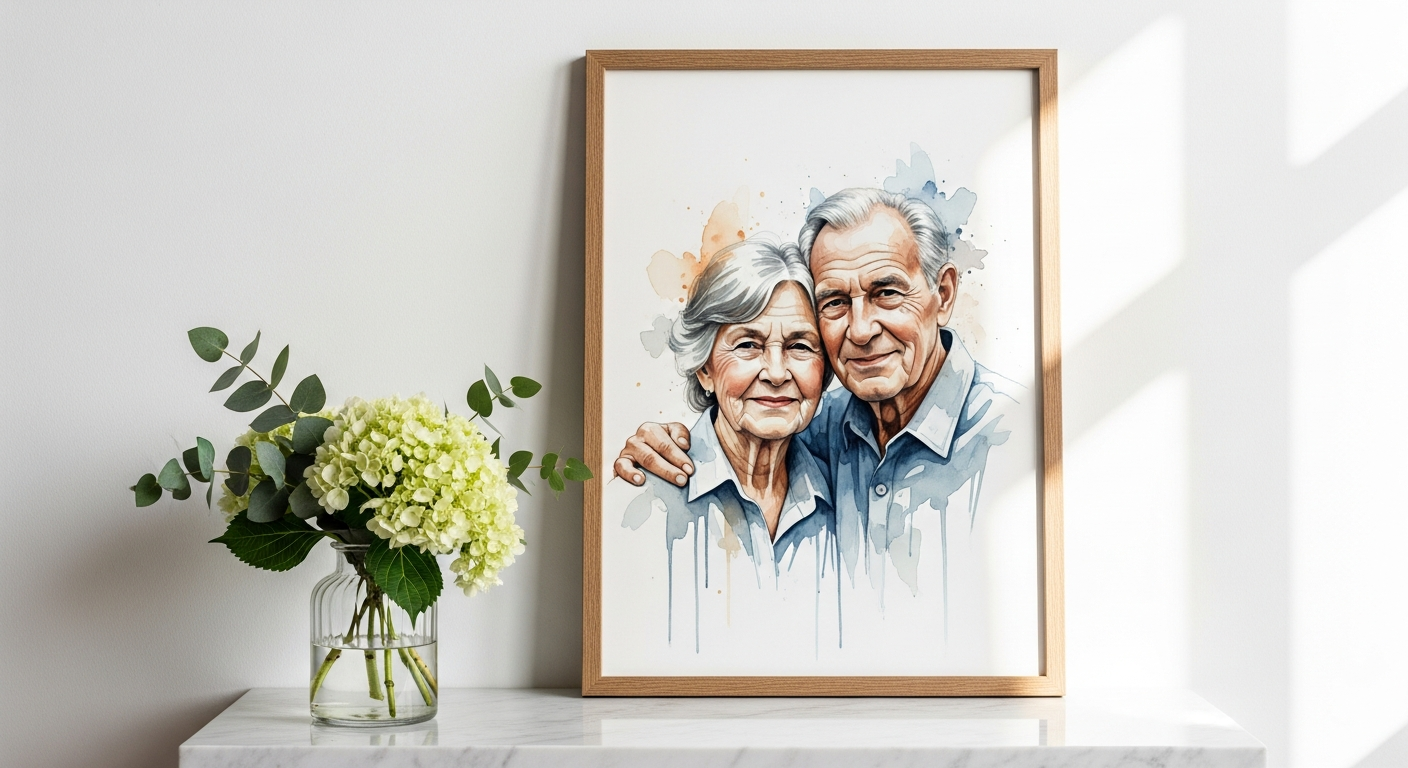
Transform cherished photos into handcrafted watercolor memorial portraits. Discover how custom memorial art brings deceased loved ones together with family in one meaningful tribute—fast, personalized, and beautifully executed.
Nearly 70% of people report feeling a profound sense of disconnection when unable to find or create photos that include all their loved ones—especially when some family members have passed away. That gap between memory and reality can ache in ways we struggle to articulate. The absence of a single photograph capturing everyone together becomes a quiet wound, a reminder of what's missing rather than what was shared.
Custom watercolor memorial portrait art has emerged as a deeply emotional solution for those seeking to bridge this void. Services like Memorialize Art have revolutionized how we remember by offering real artists—not algorithms—who can merge separate images into cohesive, handcrafted watercolor tributes. These aren't sterile digital composites; they're thoughtfully crafted artworks that honor the people we've loved and lost.
The Art of Merging Memories: How Watercolor Portraits Reunite Separated Loved Ones
How artists combine multiple photographs into a single cohesive composition
When artists undertake the work of merging separate photographs, they're performing a delicate act of visual storytelling. Rather than simply overlaying images, skilled watercolor artists study each photograph carefully, understanding the lighting, positioning, and emotional content of every subject. They then create a new composition where all subjects exist within the same artistic space, as if they were photographed together at a single moment in time.
The process begins with careful observation. An artist examines the angles, the way light falls on each face, the clothing and styling from different photographs. They consider how to arrange subjects within the frame so that the composition feels natural, balanced, and emotionally cohesive. This isn't technical copying—it's interpretive art that requires understanding human emotion and visual harmony.
The emotional significance of visualizing family members together who were never photographed as a group
There's something profoundly healing about seeing your complete family represented in a single image. For families separated by distance, time, or loss, this visual unity can feel transformative. A child who never met a grandparent, a parent unable to be present in a photograph, a beloved pet—when these individuals appear together in one artwork, something shifts internally.
This emotional impact goes beyond nostalgia. Psychologically, seeing separated loved ones unified in visual form can aid in grief processing, celebration of life, and the acknowledgment of connections that transcend physical presence. The portrait becomes a testament to relationships that matter, regardless of when or how they existed.
Techniques for seamlessly integrating deceased relatives and pets into family portraits
Artists employ several techniques to ensure that deceased family members and pets integrate naturally into compositions. They carefully match the tonal qualities, ensuring that integrated figures don't appear as obvious additions but rather as integral parts of the scene. Watercolor's fluid, blended nature lends itself beautifully to this work—there's an inherent softness that allows figures to coexist without jarring transitions.
Positioning is carefully considered. An artist might place a deceased grandparent slightly to the side, or position a pet in a way that acknowledges its presence without dominating the composition. The goal is visual harmony that feels intentional rather than forced.
The difference between AI-generated merges and hand-illustrated artistic blending
AI-generated image merging relies on algorithmic processes—mathematical calculations that blend pixels based on predetermined parameters. While technically proficient, this approach often produces results that feel sterile or artificial. The human eye immediately recognizes when something isn't quite right, even if we can't articulate exactly why.
Hand-illustrated artistic blending operates from an entirely different foundation. Artists make intuitive creative decisions, adjusting proportions, expressions, and positioning based on what feels emotionally true rather than what algorithms determine. They can capture nuance in a glance, soften a harsh edge in a way that honors the subject, and infuse the artwork with intentionality that no machine can replicate.
Real examples of how separate images transform into unified family tributes
Consider a family with a recently deceased father. A daughter submits three separate photographs: one of her father from ten years prior, one of her mother taken last year, and one of herself with her young children. An artist takes these disparate moments and creates a composition where all five figures exist together, their expressions peaceful, their arrangement suggesting a family gathering. The father's image is rendered with the same care and presence as the living family members, neither diminished nor overemphasized.
Another example: a family pet that passed years ago, never photographed with the grandchildren born afterward. An artist integrates the beloved dog into a family portrait, positioning it naturally among the grandchildren, creating a visual narrative that says, "This pet was part of our family story."
The psychological impact of seeing loved ones together in one artwork
When someone first sees themselves, their living family members, and a deceased loved one all rendered together in watercolor, the emotional response is often overwhelming. There's a sense of completion, of wholeness. Grief doesn't disappear, but it transforms into something that feels more integrated, more celebrated.
This visual unity can shift how families relate to loss. Instead of focusing on absence, the portrait acknowledges presence—the enduring impact of relationships that continue to shape our lives even after someone has passed. Family members who gather around such a portrait often find it becomes a focal point for conversation, memory-sharing, and connection.
Why this approach resonates more deeply than traditional photo editing
Traditional photo editing can create technically accurate composites, but they often lack soul. A watercolor memorial portrait, created by hand, carries the artist's intention in every brushstroke. There's an authenticity born from human artistry that digital manipulation simply cannot match.
The medium itself—watercolor's translucence, its delicate washes of color, its organic imperfections—speaks to the fragile, precious nature of memory and relationship. Families respond to this authenticity because it honors the significance of what they're mourning and celebrating.
Restoration Meets Artistry: Reviving Faded and Damaged Photographs
How artists work with old, faded, or damaged original photos
Many families have photographs that are treasured precisely because they're old—a family portrait from the 1970s, a Polaroid from decades past, a photograph damaged by water or handling over the years. These images hold irreplaceable memories, but their quality may be compromised.
Skilled watercolor artists excel at working with these challenging source materials. They examine faded images carefully, understanding what they once were and what they might become. Where colors have faded, artists draw on their knowledge of historical color palettes and human memory to restore warmth and vibrancy. Where details have become indistinct, artists use their interpretive skills to gently clarify while maintaining authenticity.
The restoration process before the watercolor portrait creation begins
Before an artist begins creating a watercolor memorial portrait, substantial preparation work occurs. They digitally enhance the source photographs where possible, bringing out details that time has obscured. This isn't about artificial enhancement; it's about recovering what was always there.
An artist studies faded clothing to determine its original color. They examine facial features carefully to understand expressions beneath the degradation. They assess damage—tears, water stains, discoloration—and determine how to work around or incorporate these elements into the final artwork. This investigative phase requires both technical skill and intuitive understanding.
Techniques for enhancing details from low-quality source images
Artists employ several techniques to extract maximum information from compromised source material. They may zoom in on specific areas to identify details invisible at normal viewing distance. They analyze lighting and shadow to understand three-dimensional form. They use their understanding of human anatomy and proportion to fill in gaps where detail has been lost.
All of this happens while maintaining scrupulous respect for the original photograph. An artist won't invent details that weren't present; rather, they'll sensitively clarify what was there, allowing the original image to reveal itself through the artistic interpretation.
Preserving the authenticity of original photographs while improving clarity
This is the essential tension in restoration work: improving without falsifying. An artist must enhance a faded photograph in ways that feel true to the original, not creating a version of what someone might have looked like, but rather recovering what they actually looked like in that captured moment.
Watercolor is particularly suited to this work. Its translucent quality means that subtle variations in tone and color can convey age and authenticity without appearing artificial. A slightly mottled background won't look like a mistake; it will appear as the natural character of an aged photograph brought to artistic life.
The role of artist expertise in interpreting unclear or partially visible subjects
When features are unclear, artist expertise becomes paramount. A trained watercolor artist understands human proportion, facial structure, and expression in ways that allow them to make educated interpretations. If a photograph is so faded that a face is barely visible, an experienced artist won't guess—they'll work with the family to understand who this person was, what they looked like, and create a respectful artistic interpretation.
This is where the human element becomes irreplaceable. An algorithm has no basis for understanding who someone was beyond pixel data. An artist can ask questions, listen to descriptions, and create work that captures not just appearance but the essence of a person.
Before-and-after transformations that showcase restoration capabilities
Families often report astonishment at what artists can achieve. A photograph so faded it's barely recognizable transforms into a vibrant, detailed watercolor portrait where expressions are clear and clothing colors are restored. A damaged image, perhaps with visible tears or water marks, becomes a beautiful artwork where the damage has been gently addressed without erasing the photograph's history.
These transformations do more than restore images; they restore connection. A grandchild who never knew their great-grandmother suddenly sees her face clearly, understands her expression, feels the presence of an ancestor who seemed lost to time.
Why choosing skilled artists matters for reviving cherished family photos
Not all artists possess the combination of technical skill, historical knowledge, and emotional intelligence required for restoration work. A skilled restoration artist brings decades of experience understanding how photographs age, how colors fade, how to coax life back into compromised images.
Choosing artists who demonstrate this expertise ensures that your cherished photographs are treated with the respect and care they deserve. These images are irreplaceable—they're the only visual record of people and moments that matter deeply. An experienced artist understands this responsibility.
Customization Options That Capture Your Unique Vision
Adding symbolic elements like halos, wings, or spiritual imagery
Beyond merging photographs and restoring images, customization allows families to infuse their memorial portraits with personal meaning. Some families request halos around deceased loved ones, a gentle spiritual touch that acknowledges their passage. Others choose wings, a symbol of transcendence and peace.
These elements aren't frivolous additions; they're meaningful symbols that help families express their spiritual beliefs and honor the significance of those they've lost. An artist can integrate these elements seamlessly, ensuring they enhance rather than overwhelm the composition.
Background color selection and how it influences emotional tone
The background of a portrait carries surprising emotional weight. A soft, muted background creates a contemplative mood. A warmer background—perhaps golden or peachy tones—can evoke warmth, light, and hope. Cool blues might suggest serenity or spiritual calm.
Families can choose backgrounds that align with their emotional intention. Some prefer neutral tones that keep focus on the subjects. Others select colors that hold personal significance—perhaps the color of a beloved garden, or a shade that reminds them of cherished moments.
Adjusting composition, positioning, and arrangement of subjects
How subjects are positioned within the frame profoundly affects the portrait's meaning. A deceased grandparent might be positioned at the center, suggesting their foundational role in the family. Alternatively, they might be positioned to the side, suggesting present but gentle presence.
Families can discuss with artists how they envision their loved ones arranged. Should subjects be close together, suggesting intimacy? Spread across the composition, suggesting a larger family? Standing, sitting, or in mixed positions? These decisions shape the final artwork's narrative.
Incorporating meaningful symbols, objects, or personal touches
Memorial portraits can include objects that held meaning—a beloved pet's toy, a book a parent treasured, flowers that bloomed in a cherished garden. These elements transform the portrait from a representation of people into a complete narrative about who they were and what they valued.
A musician might be portrayed with an instrument. A gardener might be surrounded by flowers. A family might request to include a beloved pet, even if the pet wasn't in the original photographs. These personal touches make the artwork uniquely meaningful.
Choosing portrait style variations (full body, bust, close-up focus)
Artists offer flexibility in how subjects are rendered. A full-body portrait tells one type of story. A bust or close-up focuses attention on faces and expressions, often creating greater emotional intimacy. Some families prefer mixed approaches—perhaps living family members shown full-figure while a deceased loved one is rendered in closer focus.
These stylistic choices allow families to emphasize what matters most to them, creating a composition that feels uniquely appropriate for their family's story.
Seasonal or thematic customization possibilities
Some families request seasonal elements—perhaps a winter background for those who've passed during cold months, or autumn colors for fall-born loved ones. Others choose thematic elements—a beach scene for families who love the ocean, a mountain landscape for those who cherish the outdoors.
These thematic choices ground the portrait in the emotional landscape of memory, creating a composition that feels deeply personal rather than generic.
How unlimited revisions ensure your vision comes to life exactly as imagined
One of the most significant advantages of working with skilled artists is the unlimited revision process. Families can review digital proofs—typically provided within 1-3 days—and request adjustments until the artwork feels exactly right.
If a background color doesn't evoke the intended emotion, it can be changed. If positioning feels off, subjects can be rearranged. If symbolic elements need adjustment, artists will revise. This iterative process ensures that the final artwork truly represents the family's vision, not a compromise but a realization of exactly what they imagined.
From Digital Proof to Final Delivery: Understanding the Timeline
Fast digital proof turnaround (typically 1-3 days) and what this means
The efficiency of the modern watercolor memorial portrait process is remarkable. After submitting photographs and specifications, families typically receive a digital proof within 1-3 days. This proof shows exactly how the finished portrait will look—composition, colors, positioning, all elements rendered in their intended form.
This rapid turnaround means families don't face extended waiting periods before beginning the revision process. They can provide feedback quickly, keeping momentum throughout the creation process.
The revision process and how unlimited changes work within the timeline
Once a proof is received, families have the opportunity to request revisions. The unlimited revision commitment means there's no penalty for requesting changes—whether a background color adjustment, a repositioning of subjects, or the addition of symbolic elements. Each revision typically takes 1-3 days to complete, maintaining the expeditious timeline.
This iterative process continues until families are completely satisfied. There's no pressure to accept something that doesn't feel right; artists work collaboratively until the vision is fully realized.
Production timeline for physical canvas paintings after approval
Once a digital proof is approved and the family commits to the final version, production of physical products begins. For canvas paintings, artists hand-illustrate the approved design onto canvas, a process that involves careful application of watercolor pigments and often additional finishing techniques.
This production phase is where the digital artwork becomes a tangible, physical object—a beautiful rendering on canvas that will last for generations. The craftsmanship during this phase is meticulous, ensuring that the final product matches the approved digital vision.
Average delivery window of approximately 10 days for physical products after approval
Following approval and production, families can expect delivery of physical products within approximately 10 days, though this timeline may vary depending on shipping distance and other logistics. This means that from initial submission to receiving a completed canvas painting, the entire process typically spans 2-3 weeks—remarkably efficient for such a personalized, artistry-intensive product.
Factors that may extend delivery time (complex revisions, shipping distance)
While standard timelines are efficient, certain factors may extend the process. Complex revisions requiring significant artistic rework might add days to the timeline. Shipping distance, particularly for international orders, can add time. Unusual customization requests might require additional planning or artist consultation.
These extensions, when they occur, are usually brief and always worth the additional wait, as they ensure that the final product is exactly what families envisioned.
Digital file delivery options and immediate access benefits
For families who prefer digital files over physical products, delivery is immediate upon approval. A high-resolution digital file can be received instantly, allowing families to view their memorial portrait on screens, share it with relatives, or use it for various purposes.
Digital files offer flexibility—they can be printed at any time, in any size, on any medium. They can be shared digitally with family members who live far away. They're perfect for families who want immediate access to their completed artwork.
Expedited options and how to plan ahead for time-sensitive projects
For families with time-sensitive needs—perhaps wanting a portrait ready for a memorial service or family gathering—expedited options may be available. Clear communication with artists about deadlines ensures that the timeline can be compressed when necessary, though this might require streamlined revision processes or additional coordination.
Planning ahead and communicating timeline needs upfront allows artists to prioritize accordingly, ensuring that even time-sensitive projects receive the full attention and artistry they deserve.
Pricing Breakdown: Finding the Right Format for Your Budget
Canvas painting pricing ($110.95–$221.95 depending on sales and specifications)
Physical canvas paintings represent the premium format for memorial portraits. Pricing typically ranges from $110.95 during sales to $221.95 for standard pricing, with variations depending on canvas size, complexity of the composition, and current promotions.
This investment covers not only the artistic creation but also the materials, production, and careful handling required to deliver a high-quality canvas painting that will last for decades.
Digital-only file pricing and cost-effective alternatives
For families seeking to minimize cost, digital-only files offer significant savings. Digital versions are often available at substantially lower price points, sometimes as low as $15.59 during sales, depending on the platform and promotional periods.
These digital files are high-resolution and suitable for printing at any future date, offering flexibility and immediate gratification without the physical product expense.
Price variations across platforms (Memorialize Art vs. Etsy and other marketplaces)
Pricing varies depending on where families commission their portrait. Memorialize Art offers dedicated service with established processes and artist consistency. Etsy and other marketplaces may offer varying price points depending on individual artists' pricing structures and demand.
Comparing options across platforms allows families to find pricing that fits their budget while maintaining quality standards.
Sale periods and seasonal discounts to maximize savings
Memorial portrait services often offer seasonal sales and promotions, particularly around major holidays or significant dates. Watching for these sale periods can result in substantial savings—often 50% off regular pricing during promotional periods.
Planning ahead and timing orders to coincide with sales can significantly reduce the overall cost while maintaining the same artistic quality.
What's included in each price tier and value comparison
Understanding what's included at each price point is essential. Lower-priced options might be digital-only, while mid-range pricing typically includes physical prints or canvas paintings. Higher-priced options might include larger canvas sizes, more complex compositions, or premium framing.
Comparing value—not just price—ensures families choose the option that best serves their needs and budget.
Investment justification: cost versus emotional and sentimental value
While pricing is important, the emotional value of a custom watercolor memorial portrait often far exceeds its monetary cost. This is artwork that will be displayed in homes for generations, a tangible representation of love and connection that holds profound meaning.
Families often describe the investment as worthwhile because the portrait becomes a cherished heirloom, a daily reminder of the people they love and the connections that define their family.
Budget-friendly options without sacrificing artistic quality
Quality doesn't require premium pricing. Digital-only files offer exceptional value for families on limited budgets. These high-resolution files can be printed on canvas at any future time when budget allows, or displayed digitally, offering flexibility without compromising artistic integrity.
Additionally, timing purchases to align with sales periods can reduce costs significantly while still accessing the same skilled artists and artistic quality.
Why Hand-Illustrated Portraits Outperform AI-Generated Alternatives
The irreplaceable human touch in capturing emotional nuance
AI-generated images process data; human artists interpret emotion. When an artist observes a photograph of someone, they don't just see pixels—they see expression, character, the subtle ways a face reveals a person's nature. This interpretation, translated into watercolor, captures emotional truth that algorithms cannot access.
The human touch means that a portrait carries intentionality. An artist understands that they're creating a memorial, not merely executing a technical task. This understanding infuses the work with reverence and sensitivity.
How real artists interpret and enhance your vision beyond technical parameters
Families often describe their memorial portrait request in words—explaining the emotional tone they want, the relationships they want to emphasize, the spiritual significance of the piece. A real artist listens, asks clarifying questions, and then translates these emotional concepts into visual form.
An algorithm has no framework for understanding "I want this to feel peaceful" or "I want viewers to sense the closeness of this family." A human artist understands these requests intuitively and creates work that embodies them.
Quality consistency and artistic integrity across every project
Skilled watercolor artists maintain consistent quality across all projects because they bring the same dedication, technique, and emotional investment to every commission. They don't produce assembly-line work; they create individual artworks where each piece receives full artistic attention.
This consistency means families can trust that their memorial portrait will be created with the same care and quality that the artist brings to every project.
The ability to make intuitive creative decisions that algorithms cannot
Throughout the creation process, artists make countless micro-decisions—the exact shade of a background, the subtle curve of a smile, the placement of a symbolic element. These decisions are guided by artistic intuition developed through years of training and experience.
Algorithms follow predetermined parameters; artists make creative leaps. When a proof doesn't feel quite right, an experienced artist intuitively understands why and adjusts accordingly. This intuitive problem-solving is impossible to replicate mechanically.
Customer testimonials praising the authenticity of hand-drawn work
Families consistently report that hand-illustrated memorial portraits feel fundamentally different from AI-generated alternatives. Customers describe the work as having "soul," as capturing something ineffable about the people depicted. They note that viewing the completed portrait evokes emotion in ways that technical reproductions do not.
These testimonials reflect an important truth: people can sense the difference between work created with intentionality and work generated mechanically, even if they can't always articulate exactly why.
Long-term value: archival quality and timeless appeal
Watercolor memorial portraits, created with quality materials and artist expertise, have archival longevity. Properly preserved, these artworks will remain vibrant and beautiful for decades or even centuries. They become family heirlooms, their value increasing over time as they acquire historical significance.
AI-generated images, by contrast, are inherently tied to current technology. As algorithms and standards evolve, these images may feel dated or may not be reproducible with current technology. Hand-illustrated art transcends technological fashion.
The difference you'll see and feel in a genuinely artist-created memorial
Standing before a hand-illustrated watercolor memorial portrait is a different experience than viewing a digital composite. There's tactile presence—the texture of canvas or paper, the visible brushwork that speaks to the artist's hand. There's emotional resonance that emerges from knowing a skilled human dedicated time and care to creating this specific artwork.
This tangible, emotional difference is what families choose when they select hand-illustrated portraits over technological alternatives.
Customer Stories: The Profound Impact of Memorial Portrait Art
Families reunited visually through merged photographs
A family with siblings spread across the country, some of whom had never been photographed together as adults, commissioned a memorial portrait that included their parents—one living, one deceased—along with all four adult children. The portrait arrived as a surprise for their mother's birthday. When she opened the canvas and saw her complete family represented together for the first time, she wept. The portrait now hangs prominently in her home and has become a centerpiece for family conversations and connection.
Stories of parents seeing deceased children included in family portraits
Parents who've lost children often struggle with the absence of family photographs that include both living and deceased children. One family commissioned a memorial portrait that merged a photograph of their recently deceased daughter with current photographs of her siblings and parents. The completed portrait transformed grief into something that felt more integrated—not erasing the loss but celebrating the daughter's enduring place within the family's visual story.
Pets honored alongside living family members in single compositions
A elderly woman whose beloved dog had passed years before commissioned a memorial portrait merging an old photograph of the dog with recent photographs of her adult children and grandchildren. The artist positioned the dog naturally among the family members, creating a composition where the pet's presence felt as significant as any human subject. When the woman received the completed portrait, she said it finally captured what she'd wanted for years—her complete family, including the beloved companion who'd been part of her life for so long.
Emotional reactions to receiving completed memorial artwork
Families consistently describe powerful emotional responses when receiving their completed memorial portraits. Some cry upon first viewing. Others feel a sense of completion, as if something that had felt fragmented is finally whole. Many describe the portrait as a turning point in their grief process—not eliminating sadness but transforming how they relate to loss.
The emotional impact often extends beyond the individual who commissioned the portrait. Family members who view it often experience similar emotional responses, finding the artwork becomes a shared touchstone for remembrance and celebration.
How these portraits become cherished heirlooms and conversation pieces
Memorial portraits occupy a unique place in homes. They're displayed prominently, often in central living spaces. Visitors ask about them; stories are told; connections are strengthened. Over time, these artworks become family heirlooms—objects imbued with significant meaning that families choose to preserve and pass forward.
Grandchildren who never knew a great-grandparent meet them through the portrait. New family members are introduced to the family's history. The artwork becomes a visual genealogy, a testament to the relationships that define the family.
Testimonials about customer service excellence and artist responsiveness
Families praise not only the finished artworks but also the experience of working with artists. Responsive communication, willingness to revise until satisfaction is achieved, and genuine care for the project's emotional significance shape the experience of commissioning a memorial portrait.
Artists who understand the gravity of their work approach each project with appropriate seriousness, becoming collaborators in families' processes of remembrance.
The role these portraits play in grief processing and celebration of life
Memorial portraits serve complex psychological functions. They acknowledge loss while celebrating presence. They facilitate conversation and memory-sharing. They provide a focal point for grief that might otherwise feel diffuse and unprocessed.
Many families report that the portrait helped them move from a primarily grief-focused relationship with loss to a more balanced perspective that honors both sadness and celebration. The artwork becomes a tool for healing.
Navigating Potential Considerations Before You Order
Higher cost of physical canvas prints compared to digital alternatives
Physical canvas paintings represent a higher financial investment than digital files. For families with limited budgets, this is an important consideration. However, weighing this cost against the lasting value—a physical object that will endure for generations—often justifies the higher price.
Alternatively, families might initially commission a digital file at lower cost, then print on canvas later when budget allows, creating flexibility without sacrificing the eventual physical product.
Delivery timeframes for those needing artwork quickly
While the standard timeline of 2-3 weeks is reasonably swift, families with urgent needs should communicate this upfront. Memorial services, significant anniversaries, or time-sensitive events might require expedited processes. Most artists can accommodate compression of timelines, though this requires planning and clear communication.
The importance of selecting high-quality source photographs
The quality of source photographs significantly impacts the final portrait. Clear, well-lit photographs with visible details allow artists to work most effectively. Extremely blurry or low-resolution images limit what artists can achieve, though skilled artists can work with compromised source material.
Families should provide the best-quality photographs available, understanding that photo clarity directly influences portrait quality.
Managing expectations around artistic interpretation
While artists work to honor original photographs faithfully, some artistic interpretation is inherent in the process. A photograph from 1975 captures a moment; the watercolor portrait interprets that moment, bringing it to artistic life. Understanding this distinction prevents disappointment—the portrait won't be a photograph, but rather an artistic rendering of a photograph.
Communication with artists to ensure your vision translates accurately
Clear communication about the intended emotional tone, desired composition, and any specific customization requests ensures that artists understand the vision. Detailed descriptions of relationships between subjects, the emotional significance of the portrait, and personal preferences help artists create work that aligns with what families imagine.
Storage and display considerations for physical prints
Canvas paintings should be displayed away from direct sunlight, which can fade colors over time. They should be protected from excessive moisture or temperature fluctuations. Understanding these considerations ensures that the completed artwork remains vibrant and beautiful for decades.
Return policies and satisfaction guarantees
Understanding the policies governing completed orders—what happens if a family is unsatisfied, whether revisions are possible after approval—provides protection and peace of mind. Most reputable artists offer satisfaction guarantees and are willing to address concerns, but understanding these policies upfront is wise.
Honoring Legacy Through Artistic Expression
Creating a custom watercolor memorial portrait is far more than commissioning artwork—it's an act of love, remembrance, and healing. Real artists understand that they're not simply painting; they're translating your deepest feelings into visual form. Whether you're seeking to include a deceased loved one in a family portrait, honor a cherished pet, or restore a treasured photograph from decades past, custom watercolor memorial art offers a meaningful, lasting solution.
If you've been searching for a way to bridge the gap between memory and reality, to see your complete family represented in one beautiful composition, now is the moment to take that step. Your legacy—and the connections that define your family—deserves to be celebrated, preserved, and shared for generations to come.