
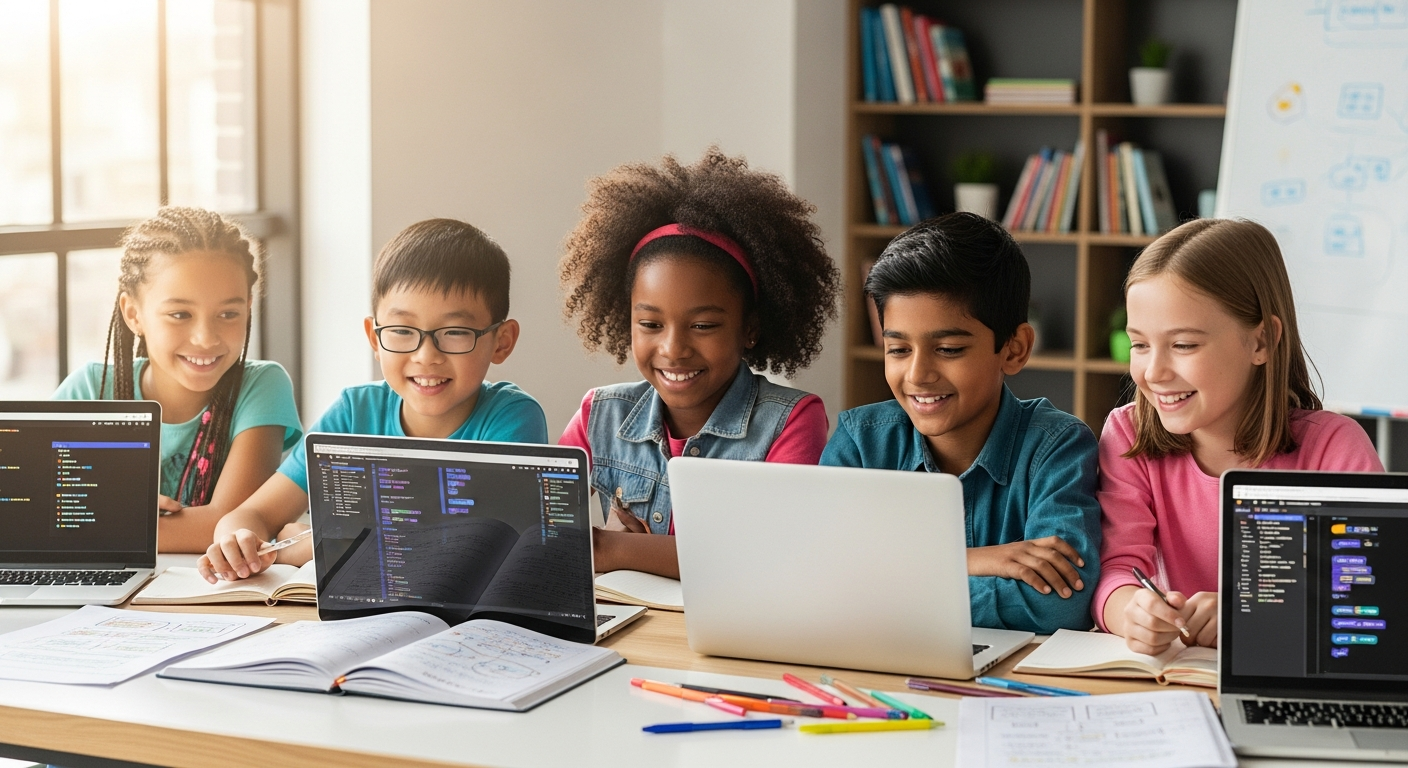
Discover what made BrightCHAMPS kids online coding classes stand out for 6-16 year-olds. Learn about personalized lessons, real-world projects, and why parents loved this platform—plus what changed in 2026.
Over 70% of parents now recognize coding as a critical skill for their children's future, yet finding quality instruction that actually engages kids remains challenging. The gap between theoretical knowledge and practical ability has widened, leaving families searching for programs that truly transform how children think about technology. Traditional classroom models often fail younger learners, while self-paced platforms lack the human connection that makes breakthrough moments possible.
BrightCHAMPS Kids Online Coding Classes captured this opportunity by delivering something rare: one-on-one lessons that transformed abstract programming concepts into tangible, publishable projects. Rather than lecturing students through coding theory, the platform emphasized hands-on project development, allowing kids aged 6-16 to build games in Scratch, design apps in Thunkable, and create experiences in Roblox. The globally aligned curriculum progressed from block-based coding fundamentals straight through to professional languages like Python and Java, meeting learners exactly where they stood.
Explore how personalized coding education transforms young learners by visiting BrightCHAMPS today.
What Set BrightCHAMPS Apart in the Online Coding Space
One-on-One Personalized Instruction
The foundation of BrightCHAMPS' approach centered on individual attention matched to each student's pace and learning style. Rather than addressing a classroom of 20 students simultaneously, instructors focused entirely on one child at a time. This meant lessons adapted in real-time—if a student struggled with loops, the instructor pivoted with fresh examples and analogies. If another child grasped concepts quickly, lessons accelerated to maintain engagement and challenge.
Expert Educators with Proven Teaching Excellence
BrightCHAMPS consistently recruited teachers who combined deep technical knowledge with genuine patience and enthusiasm for working with young learners. Parents frequently noted that instructors didn't just understand coding—they understood how to make it accessible and exciting. Teachers explained complex ideas through relatable metaphors, celebrated small victories, and maintained the kind of encouragement that transformed hesitant children into confident creators.
Flexible Scheduling Without Rigid Constraints
Families could book 60-minute sessions at times that worked for their schedules, typically recommending at least two sessions per week for optimal learning. This flexibility accommodated after-school routines, family commitments, and varying learning paces without forcing everyone into identical time slots. Classes ranged from $16 to $25 per session, with package deals potentially lowering the per-class rate and making consistent education more accessible.
Free Trial Sessions for Genuine Evaluation
Before committing financially, families could experience a complete lesson with a BrightCHAMPS instructor at no cost. This trial period allowed parents to assess teaching quality, observe how their child responded, and determine whether the platform matched their expectations. Trial sessions functioned as genuine vetting tools rather than marketing formalities.
Globally Aligned Curriculum
The program followed international coding standards, ensuring that skills developed through BrightCHAMPS remained relevant across different educational contexts and regions. Students learned methodologies and languages recognized worldwide, preparing them for advanced study regardless of where their educational journey continued.
The Learning Journey: From Block-Based Basics to Professional Programming
Age-Appropriate Progression with Logical Skill Levels
The curriculum divided learners into logical skill tiers spanning ages 6 through 16. Younger children started with visual, block-based systems that made programming logic immediately visible and intuitive. As students matured and their thinking became more abstract, lessons naturally transitioned toward text-based languages requiring greater precision and deeper conceptual understanding.
Foundation Through Block-Based Coding
Scratch formed the cornerstone for younger learners, providing a platform where dragging and connecting colored blocks created actual programs. This approach allowed children to grasp fundamental programming concepts—loops, conditionals, variables, functions—without wrestling with syntax or debugging mysterious error messages. Success came quickly, building confidence before introducing complexity.
Transition to Text-Based Professional Languages
Once students demonstrated mastery of block-based fundamentals, instructors introduced Python and Java. This progression felt natural rather than jarring because students already understood the underlying logic. Now they focused on syntax, proper formatting, and professional conventions while applying knowledge they'd already internalized through Scratch projects.
No Prior Experience Required
Every learner started as a complete beginner, regardless of age. The program contained suitable entry points for all skill levels, meaning a 6-year-old starting with Scratch and a 16-year-old jumping to Python both felt appropriately challenged and supported. Prior technology exposure wasn't necessary—just curiosity and willingness to create.
Structured Yet Individually Adaptive Pacing
While the curriculum followed a clear progression framework, instructors adjusted speed and depth based on each student's demonstrated understanding. Some children sprinted through foundational concepts; others needed more time exploring before moving forward. This balance between structure and flexibility prevented both boredom and frustration.
Real-World Project Creation: Making Code Tangible
Game Development in Scratch
Students designed and published original games using Scratch, creating something genuinely playable that they could share with friends and family. The satisfaction of completing a functional game—however simple—provided tangible proof that they'd actually built something. These weren't theoretical exercises or incomplete tutorials; they were finished products.
App Building with Thunkable
Intermediate learners moved into Thunkable, creating functional applications that mimicked real-world software. A student might design a quiz app, a note-taking tool, or a simple calculator. The transition from visual games to practical applications broadened their understanding of what coding could accomplish.
Roblox Design Experiences
Advanced students explored 3D game creation and interactive world-building through Roblox. This platform opened possibilities for sophisticated spatial thinking and complex project architecture, allowing learners to collaborate with other creators and see their worlds inhabited by real players worldwide.
Publishable Outputs as Portfolio Pieces
Every project resulted in something shareable—a game link, a playable app, a published world. Students accumulated tangible evidence of their capabilities, creating portfolios that extended far beyond traditional academic records. These projects demonstrated real skills to peers, family members, and eventually, schools or future employers.
Creative Problem-Solving Through Practical Projects
Projects inherently presented authentic problems requiring logical thinking and creative solutions. When a game's character didn't move correctly, students debugged their own code. When an app feature didn't work as intended, they refined their approach. This hands-on problem-solving taught far more than any lecture about programming logic.
Revision and Refinement as Learning Process
Instructors taught students to view completed projects not as finished products but as starting points for improvement. Feedback loops helped learners identify enhancements, fix bugs, and refine designs based on user experience. This iterative approach mirrored professional development practices while reinforcing that excellence emerges through refinement.
The Teaching Methodology: Why Kids Actually Stayed Engaged
Project-Based Learning Over Memorization
BrightCHAMPS centered lessons on creation rather than rote memorization of coding concepts. Instead of learning about loops in the abstract, students encountered loops as necessary tools for repeating actions in their game. Instead of studying functions as theoretical constructs, they implemented functions to organize their code. Context made everything meaningful.
Making Abstract Concepts Visible
Programming logic lives in the invisible realm of computational thinking. BrightCHAMPS translated this abstraction into visible outputs—a sprite moving across the screen, a button triggering an action, a game responding to player input. Children could see their thinking manifested in real results, transforming mental models into concrete evidence.
Building Technical Confidence Through Success
Every completed project boosted self-belief. A child who successfully created a game developed confidence that extended beyond coding. They learned that complex problems could be broken into manageable steps, that mistakes provided learning opportunities, and that persistence led to results. This confidence transferred to academic challenges in other subjects.
One-on-One Feedback Loops
When a student encountered difficulty, the instructor provided immediate, specific help rather than generic explanations. "Try adding another loop here" or "What happens if you change this number?" guided learners toward independent problem-solving rather than simply providing answers. This Socratic method built critical thinking alongside technical skill.
Balancing Fun with Rigor
BrightCHAMPS made learning enjoyable without sacrificing depth or challenge. Classes felt like creative play rather than academic punishment, yet students developed genuine expertise. Instructors maintained just enough challenge to keep engagement high—not so difficult that students felt overwhelmed, not so easy that boredom set in.
Encouraging Curiosity
The platform fostered genuine interest in technology rather than treating coding as a chore students endured. Instructors celebrated questions, explored tangential interests when they emerged, and helped students understand how coding connected to their own passions. A child interested in game design learned coding as a tool to create; a young artist learned programming as a medium for expression.
Impact on Student Development and Confidence
Measurable Improvement in Logical Thinking
Parents observed stronger problem-solving abilities extending across subjects. Children who learned to break coding problems into steps began applying similar systematic thinking to math problems, essay organization, and scientific method. Logical reasoning developed through programming transferred broadly.
Boosted Technological Confidence
Many children arrived intimidated by technology, viewing computers as mysterious devices controlled by others. BrightCHAMPS transformed this perspective. Students who felt uncomfortable with technology became comfortable experimenting, testing ideas, and learning from failures. This shift extended to willingness to explore new software, troubleshoot problems, and approach technology with curiosity rather than anxiety.
Enhanced Academic Performance
Parents frequently reported positive spillover effects in math and science. Programming's emphasis on precision, logic, and systematic problem-solving aligned perfectly with mathematical thinking. Students often improved their grades in related subjects as coding skills reinforced fundamental academic capabilities.
Fostered Genuine Tech Interest
Beyond classroom requirements, many students developed authentic passion for technology. They started pursuing coding outside lessons, exploring personal projects, and expressing interest in technology careers. This organic enthusiasm indicated that BrightCHAMPS ignited genuine fascination rather than just teaching technical skills.
Preparation for STEM Pathways
Early coding education provided competitive advantage for students considering STEM subjects at secondary level. They approached advanced mathematics and sciences with technological fluency and problem-solving frameworks that advantaged them compared to peers without coding experience.
Improved Communication Skills
Explaining their code to instructors and learning to discuss technical problems improved how students articulated complex ideas. Programming requires precision in communication; students developed ability to explain logic clearly and listen carefully to technical feedback.
The 2026 Shift: What Changed for UK Customers
BrightCHAMPS UK Closure on July 20, 2026
A significant disruption occurred when the UK branch ceased operations, ending service for British families mid-year. For students in the middle of their learning journey, this represented sudden loss of their instructors and the personalized relationships they'd developed. The closure illustrated that even established, well-regarded platforms could experience regional shutdowns.
Global Platform Continued Beyond UK
Importantly, the global BrightCHAMPS entity continued operating outside the UK despite the regional branch closure. The platform remained active internationally, serving students across other regions. The UK discontinuation reflected business decisions specific to that market rather than overall platform failure.
Service Discontinuation Impact
UK students faced an unfortunate reality—their ongoing education halted abruptly. Families who'd planned continued instruction with their chosen instructors suddenly needed to explore alternative providers. The disruption underscored that subscription-based learning services carry inherent risks if the provider exits a market.
Alternative Platform Search
Affected families began evaluating competing services, creating opportunity to assess what alternatives offered comparable experiences. This transition period forced reflection on what features truly mattered: Was personalization essential? Could group lessons substitute for one-on-one instruction? What about curriculum quality and progression?
Importance of Service Stability
The closure highlighted why parents should investigate platform stability before enrollment. How long has the service operated? What's the company's financial stability? Does the provider have a track record of sustaining commitments? These questions became increasingly relevant in the post-closure environment.
Customer Service Concerns During Transition
Mixed experiences emerged during the closure period. While some families received helpful guidance toward alternatives, others felt abandoned without sufficient support. Customer service inconsistency during this transition created additional frustration beyond the disruption itself.
Finding Quality Alternatives After BrightCHAMPS UK
Evaluating Similar One-on-One Platforms
After closure, families searched for comparable services offering personalized instruction. Key evaluation criteria included instructor qualifications, student support quality, platform reliability, and whether services demonstrated long-term sustainability. The BrightCHAMPS experience provided a benchmark for what quality looked like.
Curriculum Comparison
New platforms needed to offer comparable progression from visual block-based coding through advanced professional languages. Simply teaching Scratch wasn't sufficient; families sought programs that could support learners across years of development, from age 6 through to 16 and beyond if desired.
Instructor Quality Assessment
Verifying teaching credentials and classroom experience became essential. Parents asked: Did instructors have formal teaching training? Could the platform demonstrate that educators understood both subject matter and pedagogical approach? Did reviews consistently praise teaching quality?
Trial Sessions as Vetting Tools
Families who'd experienced BrightCHAMPS knew the value of free trial classes. When evaluating alternatives, they used trial sessions to assess fit before commitment, observing how new instructors interacted with their children and whether teaching approaches matched expectations.
Community and Peer Learning Considerations
Some families discovered that while one-on-one instruction offered personalization, group-based options provided community, peer collaboration, and different engagement dimensions. The ideal solution might combine personalized lessons with community platforms offering peer learning opportunities.
Long-Term Platform Stability Research
Families became more cautious about long-term commitments, researching company history, financial stability, and market presence. Services with longer track records and broader geographic reach appeared lower-risk than newer entrants or platforms dependent on single markets.
What Parents Valued Most About the BrightCHAMPS Experience
Visible Progress and Tangible Outcomes
Parents could observe weekly creations, seeing concrete evidence of their child's learning. Unlike abstract academic subjects where progress sometimes remains invisible, coding produced shareable games and apps. This visibility provided reassurance that investment was delivering results.
Personalized Attention
The knowledge that their child received customized instruction rather than one-size-fits-all teaching created confidence. Parents recognized that their individual learner's pace, learning style, and interests shaped the experience. This personalization made fees feel justified.
Teacher-Student Relationships
Consistent instructors building rapport with students created motivation and accountability. Children developed relationships with their teachers, wanting to impress them and show progress. These connections transformed instruction from transactional to relational.
Confidence Transformation
Witnessing hesitant children become excited about coding was perhaps the most valued outcome. Parents observed shy students becoming vocal about their projects, anxious learners developing willingness to experiment, and uncertain kids embracing challenges. This transformation extended beyond coding into broader confidence and resilience.
Future-Ready Skill Development
Parents valued peace of mind that their children were developing capabilities increasingly important for their futures. In an uncertain economic landscape, coding proficiency provided tangible competitive advantage for secondary education and beyond.
Balanced Challenge Level
Lessons stretched students without frustration or overwhelm. Parents appreciated that instruction remained appropriately challenging—difficult enough to maintain engagement, accessible enough to prevent discouragement. This balance proved remarkably difficult to achieve and was deeply valued when found.
Key Takeaways: What Made BrightCHAMPS Worth the Investment
Personalization at Scale
One-on-one instruction adapting to each learner's needs delivered something typically only available through expensive private tutoring. BrightCHAMPS proved that online platforms could provide genuine personalization at more accessible price points than traditional private instruction.
Project-Driven Curriculum
Students created rather than consumed learning materials. This approach transformed passive reception into active production, with motivation driven by the desire to build something real rather than by external grades or rewards.
Expert Instruction Quality
Combining subject expertise with skill at engaging young learners proved crucial. Instructors needed both deep coding knowledge and pedagogical ability—a rare combination that BrightCHAMPS successfully cultivated.
Measurable Outcomes
Progress manifested in published games, completed apps, and visible skill development. Parents could point to specific accomplishments rather than abstract assessments. This tangibility justified investment and motivated continued enrollment.
Holistic Skill Development
Beyond technical abilities, the program developed confidence, creativity, logical thinking, and communication skills. Students gained capabilities extending far beyond programming syntax.
Accessibility and Flexibility
Pricing and scheduling accommodated real family life. The program remained accessible to middle-class families without requiring wealthy circumstances, and flexible timing worked with diverse schedules.
Moving Forward: Lessons From BrightCHAMPS for Today's Coding Education
The BrightCHAMPS Kids Online Coding Classes story offers valuable insights for families navigating the online learning landscape in 2026 and beyond. What made this platform resonate—personalized instruction, project-based learning, expert teachers, and tangible outcomes—remains the gold standard for quality coding education. The platform proved that children don't just tolerate coding; they thrive when they're creating something real, receiving individual attention, and learning from instructors who genuinely care about their growth.
The 2026 closure of the UK branch underscores an important reality: even excellent services can shift or disappear. This reinforces why parents should evaluate platform stability, instructor quality, and curriculum depth before enrolling. Look for programs with established track records, transparent business models, and geographic diversification suggesting financial stability.
The principles that made BrightCHAMPS effective—one-on-one personalization, progression from visual to professional languages, project-based outcomes—should guide your search for alternative coding education today. Whether your child is just discovering coding or ready to tackle Python and Java, the BrightCHAMPS model demonstrates what's possible when instruction prioritizes individual growth over batch processing.
As you explore options, examine how platforms handle personalization, whether curriculum supports multi-year progression, how instructors balance challenge with support, and whether students produce shareable work. Prioritize platforms demonstrating genuine commitment to teaching excellence rather than simply delivering content. Trial sessions reveal far more about quality than marketing materials ever could.
The future belongs to children comfortable with technology and confident in their ability to solve problems systematically. Coding education at its best isn't about creating programmers; it's about developing thinking, building confidence, and opening possibilities. Whatever platform you ultimately choose, remember that the most important elements remain unchanged: quality instruction, individualized attention, meaningful projects, and genuine engagement with each child's learning journey.