
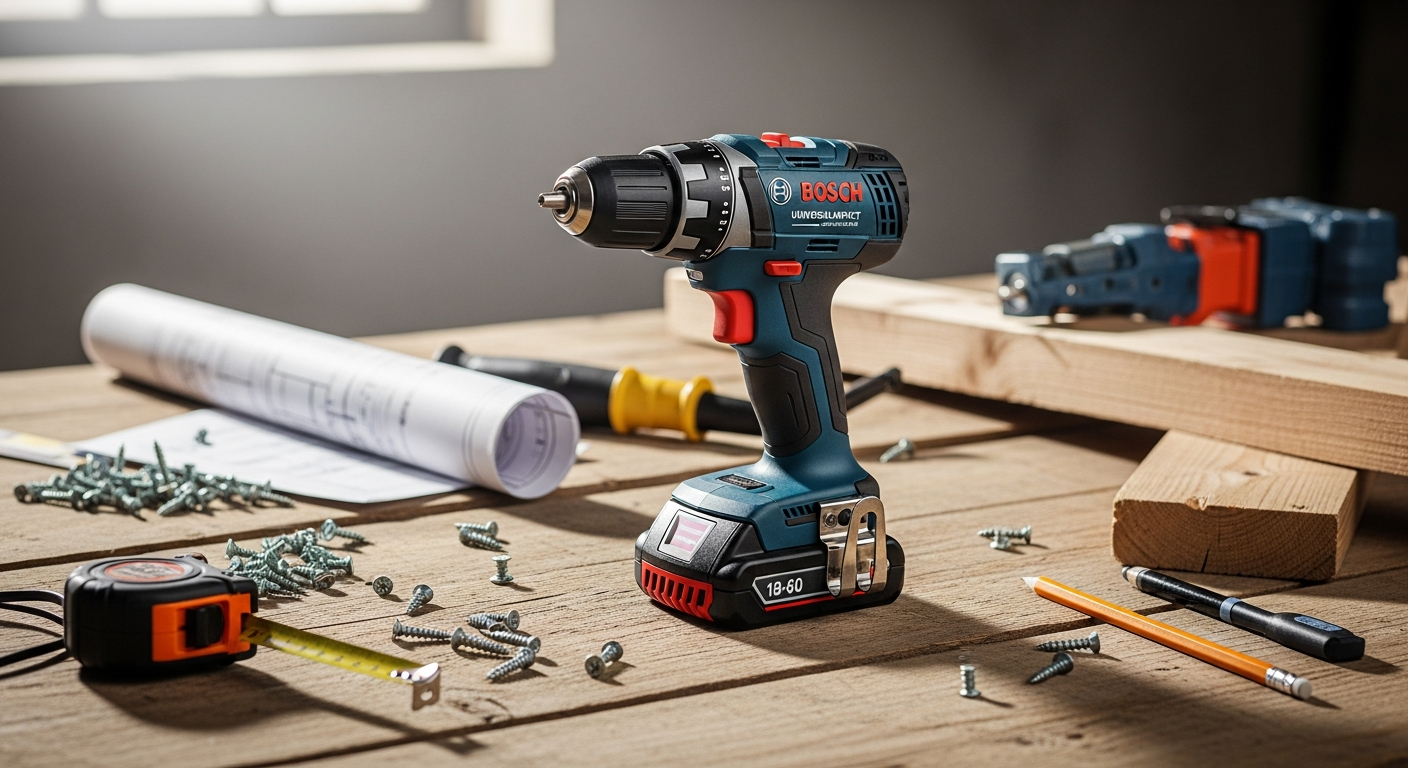
Discover how the Bosch UNIVERSALIMPACT 18V-60 combi drill tackles drilling, screwing, and impact work with brushless power. Read our complete contractor-focused guide with specs, real-world applications, and buying tips.
If you've spent time on job sites, you've witnessed the same frustrating pattern: contractors burning through valuable hours switching between different tools for individual tasks—time that generates zero revenue. Multiply those wasted minutes across dozens of projects annually, and you're looking at hundreds of pounds in lost productivity. The Bosch UNIVERSALIMPACT 18V-60 P4A has become a top seller precisely because it tackles this inefficiency head-on, delivering the brushless power and durability that tradespeople demand without forcing compromises on performance.
The construction and renovation sectors have shifted dramatically toward cordless platforms over the past decade, and for good reason. Modern battery technology combined with brushless motor engineering creates tools that outperform their corded predecessors while eliminating cable management headaches entirely. The UNIVERSALIMPACT 18V-60 sits at the sweet spot where versatility meets practicality—capable of handling drilling, screwing, and impact work across wood, metal, and masonry without requiring you to juggle multiple tools on your van.
Explore the Bosch UNIVERSALIMPACT 18V-60 on Tooled-Up today to see current configurations and pricing. This guide walks you through the practical advantages that make this drill stand out for contractors, explains how Power for All Alliance compatibility saves you money, pinpoints the applications where it genuinely excels, and helps you decide whether the investment aligns with your workflow.
Why Contractors Choose Brushless Impact Drills Over Traditional Models
Brushless motor technology eliminates carbon brushes that traditionally require periodic replacement and maintenance. This fundamental design change delivers measurable benefits on job sites. Without brushes generating friction, the motor operates more efficiently, converting battery energy directly into work rather than heat loss. The result: extended runtime per charge and significantly longer overall tool lifespan.
The compact brushless design allows manufacturers to engineer drills that deliver genuine power without the bulk of older brushed models. Contractors working in confined spaces—interior walls, tight cabinet installations, overhead applications—benefit immediately from reduced weight and improved handling. Simultaneously, the tool runs quieter, which reduces operator fatigue during full-day use and actually improves communication on busy sites where noise levels matter.
Heat management separates quality brushless drills from budget alternatives. Professional-grade brushless motors distribute thermal stress more effectively, preventing the performance throttling that occurs when tools overheat during demanding extended use. You maintain consistent power output from start to finish, rather than watching your drill's effectiveness diminish as internal temperatures rise.
The cost-per-use calculation shifts dramatically in favor of brushless technology once you factor in maintenance elimination and extended tool lifespan. A brushed drill might cost less upfront, but warranty claims, replacement parts, and eventual tool replacement drive lifetime costs significantly higher.
The 18V Sweet Spot: Power, Weight, and Runtime Balance
The 18V platform represents a deliberate engineering compromise that favors practicality over raw power. This voltage range delivers sufficient torque for nearly every common drilling and driving application—from anchoring fasteners in structural work to boring through hardwood framing—without the excessive weight that higher voltage systems demand.
Battery technology advancement has transformed 18V capabilities. Modern lithium-ion cells pack far more energy density than older battery designs, meaning today's 18V systems deliver runtime performance that rivals older 20V+ platforms. A contractor working a standard job site day can operate almost entirely on a single 4Ah battery with a second battery charging simultaneously, virtually eliminating downtime between tasks.
Weight distribution affects real-world usability more than raw specifications suggest. Overhead work, whether drilling ceiling joists or installing cabinet hardware, becomes substantially less fatiguing with an 18V drill compared to heavier alternatives. The lighter tool allows better control during precision work and reduces strain during repetitive applications like driving multiple fasteners in succession.
The 18V system excels at the task-switching reality of modern construction. One minute you're drilling anchor holes, the next you're driving structural screws, then shifting to impact drilling for masonry work. The UNIVERSALIMPACT 18V-60 transitions fluidly between these applications without requiring tool swaps. Cordless freedom simultaneously eliminates extension cord management—no tangled cables limiting your working distance, no dependence on power outlet availability.
Power for All Alliance Compatibility: Building a Cohesive Tool Ecosystem
The P4A designation represents a strategic advantage that many contractors overlook when evaluating drill specifications. This certification means your 18V batteries function across tools from multiple manufacturers—Bosch, AEG, Ryobi, and others within the alliance. The practical implication: you stop duplicating battery systems when expanding your tool collection.
Significant cost savings emerge as you build your toolkit. Your second tool purchase, whether a circular saw, impact driver, or reciprocating saw, requires only the bare tool cost rather than including batteries and chargers again. Multiply this across five or ten tools, and the cumulative savings exceed hundreds of pounds.
Battery interoperability simultaneously simplifies job site logistics. You're not managing separate charging stations for different voltage platforms, tracking incompatible batteries, or dealing with the inventory confusion of mixed ecosystem tools. Everything charges on the same system; everything shares the same battery pool.
The growing P4A ecosystem future-proofs your investment. Manufacturers continue expanding compatible product ranges, meaning your decision to standardize on 18V today gains increasingly robust options tomorrow. You retain flexibility to choose tools based on specialization and performance rather than feeling locked into a single brand's limited catalog.
Real-World Applications: Where the UNIVERSALIMPACT 18V-60 Truly Shines
Drilling through hardwood, softwood, and engineered timber represents bread-and-butter work for this drill. Whether you're boring pilot holes for structural fasteners or drilling through thick dimensional lumber, the brushless motor delivers consistent torque without bogging down. The variable-speed control allows adjusting for different wood densities rather than relying on a single fixed speed.
The impact function activates for masonry applications—brick, concrete block, and stone work that would stall traditional drills. The rapid-fire impact frequency (approximately 3,000 impacts per minute) fractures material rather than relying solely on rotational force, making holes in concrete substantially faster and with less frustration.
Fastener driving across construction, cabinet-making, and structural applications showcases the drill's precision capabilities. The ability to modulate torque and speed prevents the damage that occurs when screws strip, when threads shear in delicate materials, or when tool slip-outs damage surrounding surfaces. Professional finishing work demands exactly this level of control.
Renovation projects—which inevitably combine demolition, drilling, and installation phases—benefit from having a single tool that transitions between these activities. One moment you're removing old fixture anchors, next you're drilling holes for replacements, then driving fasteners in new installations. The versatility reduces your tool count and transport requirements while maintaining performance throughout the day.
Maintenance work on equipment and machinery frequently demands variable-speed control and precise torque modulation. The UNIVERSALIMPACT 18V-60 excels in these technical applications where power consistency matters as much as power output.
Bare Tool vs. Kit Configurations: Making the Right Purchase Decision
Your existing tool collection heavily influences which purchase configuration makes financial sense. If you already own compatible 18V batteries and chargers, the bare tool option maximizes value by eliminating redundant components. However, if you're building your first serious cordless collection, complete kits provide everything needed to start working immediately.
Battery capacity selection matters significantly for intended use patterns. A 2Ah battery offers portability for light-duty work and job site transitions but requires mid-day charges during full-day continuous use. The 4Ah+ capacity batteries extend runtime substantially, enabling most contractors to operate the entire working day on a single charge while a second battery charges.
Dual-battery kits provide genuine workflow advantages. While one battery charges using a fast charger, you continue working with the second. This setup virtually eliminates waiting time and keeps productivity flowing without interruption.
Budget analysis should span multiple tools rather than treating the drill purchase in isolation. The real financial picture emerges when calculating total toolkit investment across several tools while accounting for battery and charger sharing through P4A compatibility. A seemingly expensive complete kit often costs less overall than purchasing multiple bare tools and duplicating batteries separately.
Resale value remains strong for Bosch tools regardless of configuration choice, which provides financial recovery if you eventually upgrade or transition away from the 18V platform.
Performance Specifications That Matter for Professional Use
Variable speed control allows task-specific adjustments without requiring tool substitution. Slower speeds (typically 0–500 RPM) maximize torque for powerful driving applications, while higher speeds (up to 1,500+ RPM) enable faster drilling through softer materials. This range covers nearly everything you'll encounter on a typical job site.
Two-speed transmission represents another efficiency feature—low-speed mode provides maximum torque for driving heavy fasteners, high-speed mode reduces cycle time for repeated light drilling. The ability to shift between these modes extends the drill's versatility without requiring separate tools.
The chuck type and size affect both bit compatibility and holding security. Quality chucks grip bits reliably without slipping, which prevents bit rotation damage and ensures precise hole placement.
LED work light might seem cosmetic until you're working inside a cabinet, under a sink, or in shadowed ceiling cavities where natural light doesn't penetrate. The illumination reduces setup errors and improves precision substantially.
Ergonomic grip design directly impacts fatigue during extended use. A well-designed handle distributes pressure across your palm rather than concentrating stress on specific points, making all-day operation substantially more comfortable.
Weight distribution and balance characteristics affect control during overhead applications and sustained driving tasks. A poorly balanced tool exhausts operators faster than a heavier tool with superior balance characteristics.
Durability and Reliability: The Bosch Brand Advantage
Bosch's reputation for quality manufacturing translates directly to fewer warranty claims and repair requirements. This isn't abstract brand prestige—it's measurable reliability data reflected in independent reviews and contractor feedback across multiple platforms.
Brushless motor design means fewer moving parts subject to wear and failure. Eliminating brushes removes one common failure point entirely, and the simplified internal engineering reduces the potential failure modes that brushed alternatives introduce.
Robust construction handles the inevitable job site abuse—drops, impacts, exposure to dust and moisture. Professional tools require engineering that accounts for real-world conditions rather than idealized laboratory environments.
Parts availability through established Bosch dealer networks ensures quick repairs when needed. You're not waiting weeks for specialized components or discovering that the manufacturer has discontinued support for your model.
Resale value remains competitive because the Bosch name carries weight in the secondhand market. Contractors recognize quality and pay accordingly when upgrading or changing tools.
Long-term cost of ownership strongly favors quality construction over budget alternatives once you factor in warranty claims, repair costs, and eventual replacement timing. The initial price premium typically recovers within the first three to five years of professional use.
Limitations and When to Consider Specialized Alternatives
Extremely heavy-duty continuous drilling—industrial applications with sustained high-volume boring—might benefit from larger 20V+ systems specifically engineered for that demand. The UNIVERSALIMPACT 18V-60 handles this work competently, but specialized tools excel in their respective domains.
Core drilling beyond certain diameter specifications requires dedicated equipment with specialized chucks and bit retention systems. Standard chucks aren't designed for the forces involved in large-diameter boring.
Auger work in soil conditions demands torque characteristics and chuck designs that differ from general-purpose drilling. Attempting auger work with standard drills risks both tool damage and operator injury from sudden torque reversal.
High-volume production environments where a single tool operates continuously throughout the day might justify investment in larger or more specialized equipment that tolerates sustained operation better than general-purpose tools.
Overhead work for extremely extended periods can fatigue even with lightweight designs. Some applications might justify investing in specialized overhead drilling rigs that mechanically support the tool rather than relying on operator strength.
Professional demolition work sometimes demands more robust impact-rated designs engineered specifically for jackhammer-style applications rather than precision drilling.
Budget-conscious homeowners tackling occasional projects might find lower-cost 12V alternatives adequate for their genuine needs, though professional contractors typically discover that initial savings disappear quickly in productivity losses and tool replacement cycles.
Total Cost of Ownership: Investment vs. Long-Term Value
The upfront cost varies significantly between bare tool and complete kit configurations—sometimes £64.95 for bare tools versus several hundred pounds for kits including batteries and chargers. However, the relevant calculation spans multiple years rather than the initial purchase moment.
Battery replacement costs factor into multi-year ownership calculations. Quality 18V batteries typically retain usable capacity for 300–500 charge cycles before degradation becomes problematic. Expect to replace batteries every three to five years depending on usage intensity. However, this cost distributes across years of reliable operation.
Reduced maintenance requirements lower lifetime operating expenses dramatically compared to brushed alternatives. No brush replacements, no motor servicing, no unexpected component failures from carbon dust accumulation.
Versatility eliminates purchasing multiple specialized tools. Contractors who maintain separate chucks, dedicated fastener drivers, and specialized drills for specific applications quickly realize the cost of that approach. The UNIVERSALIMPACT 18V-60 replaces several specialized tools through its multi-function capability.
Resale value recovery provides meaningful financial offset when eventually upgrading. Quality Bosch tools retain 40–60% of original purchase value on the secondhand market, which directly reduces your net investment.
Rental costs for specialized tools become unnecessary with a toolkit that covers most common applications. Rather than renting a heavy-duty drill for occasional masonry work, you own equipment ready immediately when needed.
Productivity gains from tool reliability translate to measurable project cost reductions. Time spent replacing failed equipment, troubleshooting unreliable tools, or waiting for repair service translates directly to reduced profitability. Reliable equipment supports faster job completion and reduces cost overruns.
The Bottom Line for Contractors and Serious DIYers
The Bosch UNIVERSALIMPACT 18V-60 represents a genuinely practical investment for anyone managing multiple projects simultaneously. You're acquiring brushless efficiency, proven reliability, and the flexibility to handle drilling, screwing, and impact work without constant tool swaps. The P4A compatibility means you're not locked into a single ecosystem—you're building a modular collection that grows with your needs and adapts to your preferences.
Whether you're a contractor looking to streamline your kit or a DIYer tackling serious renovation work, this drill earns its place through consistent performance rather than flashy features. The real value emerges over months of use when you realize you haven't needed to reach for a different tool, when your battery still holds a charge after hundreds of cycles, and when you're moving between jobs without the friction of incompatible equipment.