
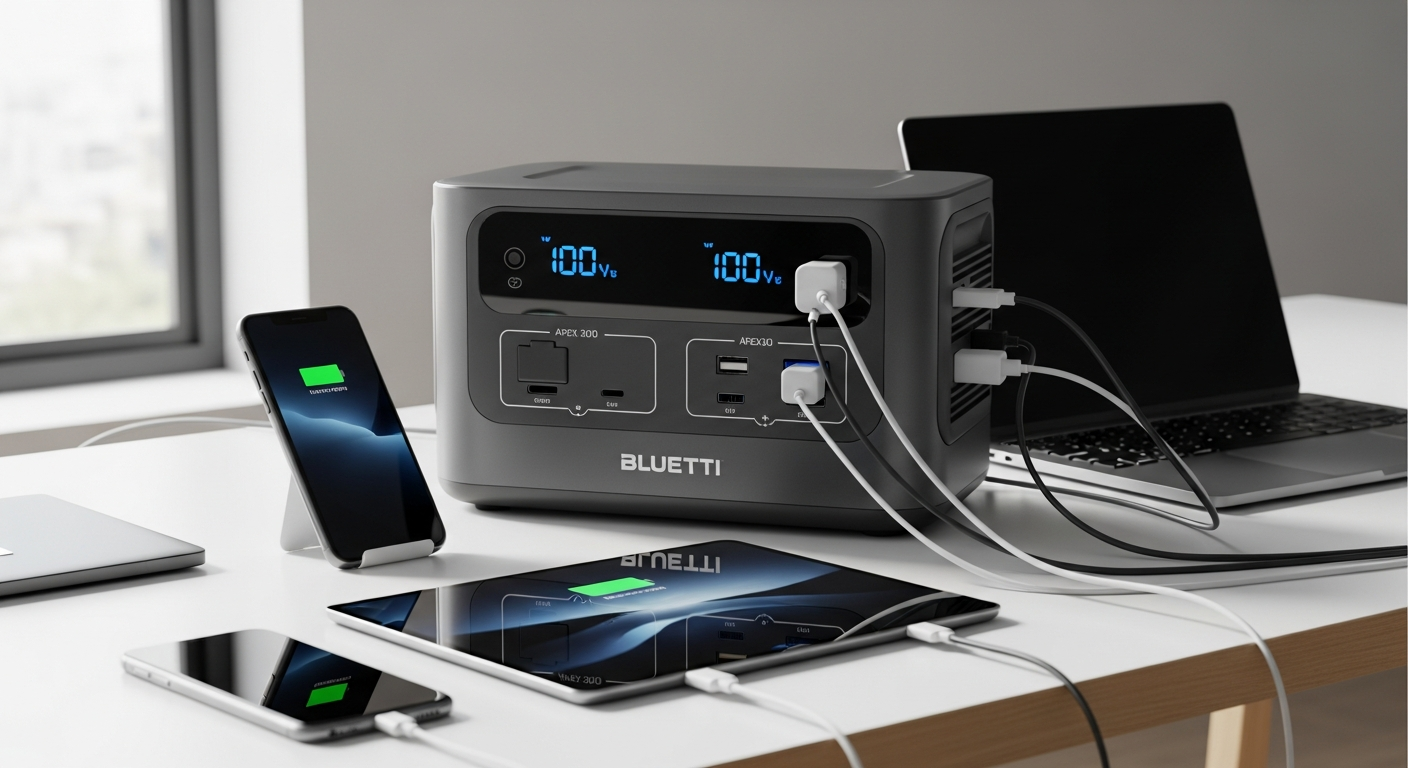
Discover why the BLUETTI Apex 300 is the top choice for home backup, RVs, and off-grid living. Learn about its 240V dual-voltage capability, expandable capacity, and fast charging options.
What if a single power station could handle your home’s air conditioning, your RV’s 240V appliances, and your electric vehicle charger all at the same time? The BLUETTI Apex 300 Versatile Power Station shatters the limitations of traditional portable power solutions. Named Sustainability Product of the Year, this powerhouse has earned its status as a best-seller for good reason.
Throughout this guide, you’ll understand everything that makes the Apex 300 stand out—from its groundbreaking 120V/240V dual-voltage architecture to its modular expansion capabilities that can scale up to 58kWh. You’ll see the real-world implications of its 3,840W continuous output, discover why its 0ms UPS switchover matters for your electronics, and explore whether this investment aligns with your energy needs and budget.
The power station market has evolved dramatically, but few devices truly bridge the gap between portable convenience and whole-home reliability. The Apex 300 occupies that rare middle ground where infrastructure-grade performance meets practical versatility.
Discover the BLUETTI Apex 300 and transform your power independence today.
Why the 240V Dual-Voltage Output Changes Everything for RV and Home Users
Most portable power stations force a compromise: they operate at either 120V or 240V, requiring additional equipment or multiple units to handle mixed appliance setups. The Apex 300 eliminates this friction entirely through simultaneous operation of 120V and 240V appliances without additional transformers or converters.
For RV owners, this capability transforms the experience. You can power your air conditioning unit on 240V while simultaneously running 120V entertainment systems and appliances. Homeowners benefit similarly during extended outages—you can operate an electric water heater or heat pump on 240V while keeping essential 120V devices running throughout the home.
The practical advantage becomes obvious when considering real-world outage scenarios. Heavy-duty devices like air conditioning units, electric water heaters, and EV chargers require 240V input that most portable solutions simply cannot provide. With the Apex 300, you eliminate the need for multiple power stations or backup systems, consolidating your backup infrastructure into a single, intelligent unit.
RV setups particularly benefit from this unified approach. Traditional RV power solutions often require choosing between running air conditioning or other high-draw appliances. The Apex 300’s architecture means you’re never making that compromise again—mixed appliance voltages operate simultaneously without degradation.
Understanding the Apex 300’s Battery Technology and Lifespan Advantage
The heart of the Apex 300 lies in its LiFePO₄ battery chemistry, a fundamental technology choice that separates this unit from competitors relying on conventional lithium-ion alternatives. LiFePO₄ batteries deliver superior thermal stability, inherently safer chemistry, and crucially, dramatically longer cycle life.
The specification sheet promises 6,000+ life cycles to 80% capacity, translating to a remarkable 17-year potential lifespan under normal operating conditions. Understanding cycle life requires moving beyond the marketing language: one complete cycle equals discharging the battery from full to empty and recharging it back to full. In practical terms, this means the Apex 300 could provide daily backup cycles for nearly two decades before significant degradation occurs.
The environmental benefits of LiFePO₄ technology extend beyond personal advantage. Compared to older lithium-ion chemistry and traditional lead-acid batteries, LiFePO₄ produces fewer toxic byproducts during manufacturing and maintains superior recyclability at end-of-life. For buyers prioritizing sustainability—particularly relevant given the Apex 300’s Sustainability Product of the Year recognition—the battery chemistry reinforces the environmental commitment.
Long-term ownership calculations become compelling when you factor in this lifespan. Unlike traditional backup generators requiring annual maintenance, spark plug replacements, and fuel stabilization, the Apex 300’s battery degrades predictably without active maintenance demands.
Power Output Specifications That Matter: Continuous vs. Power Lifting Mode
The Apex 300 delivers 3,840W of continuous output, representing the sustained power available for standard appliance operation over extended periods. This distinction matters because continuous output reflects real-world capability when multiple devices operate simultaneously throughout your home or RV.
Beyond continuous output exists Power Lifting Mode’s 7,680W peak capacity, effectively doubling the power ceiling for high-demand tools and equipment that draw temporary current spikes during startup. Electric motors, compressors, and power tools typically require peak power significantly higher than their running power consumption—a principle called inrush current.
The practical distinction determines what you can actually operate simultaneously. Running your air conditioning unit (typically 3,500–4,000W) uses most continuous capacity, leaving limited headroom for other devices. However, Power Lifting Mode accommodates the startup surge when air conditioning compressors initially engage, then sustains operation within the continuous output envelope.
Specific appliances reveal this dynamic: a microwave might draw 1,200W continuously but spike to 1,500W during magnetron activation. A refrigerator runs at 600W continuous but draws 1,200W when the compressor starts. The Apex 300’s dual-output specification ensures you can run these appliances simultaneously without triggering the system’s protective shutdown.
Job site applications particularly benefit from Power Lifting Mode capability. A circular saw, impact driver, and cordless drill can all operate without circuit concerns—the system handles the staggered startup demands while maintaining steady power for concurrent operation.
Charging Speed Across Multiple Methods: AC, Solar, and EV Integration
Recharging speed dramatically influences practical ownership experience, and the Apex 300 addresses this through multiple simultaneous charging pathways. AC charging achieves 80% capacity in approximately 45 minutes, remarkable speed that enables rapid recovery after modest power draws.
Solar input capacity reaches 2,400W with MPPT (Maximum Power Point Tracking) technology, allowing efficient energy harvest from roof-mounted or portable solar arrays. For serious off-grid installations, the optional SolarX 4K regulator enables 30kW super-fast solar charging potential—transforming the Apex 300 from backup device into primary energy infrastructure.
The integration possibilities extend into EV charging station compatibility, where the Apex 300 can actually charge from your electric vehicle charger while simultaneously providing emergency home power. This circular energy flow creates flexibility rarely seen in portable power solutions.
Practical charging scenarios demonstrate the diversity available. A homeowner might top up overnight via AC charging, while an off-grid resident relies primarily on solar with occasional AC charging during cloudy periods. An RV adventurer might charge via solar while parked at a campground, supplemented by occasional AC charging at RV parks.
The Modular Expansion System: Scaling from 2,764Wh to 58kWh
Conventional battery systems require choosing your capacity upfront—you’re either over-provisioned and wasting capital or under-provisioned and facing limitations. The Apex 300’s modular architecture shatters this constraint through the B300K expansion battery, which adds another 3,072Wh (3kWh) of capacity while maintaining seamless integration.
The fundamental advantage of modular design: you never replace the base unit. If your power needs grow—perhaps you acquire power-hungry appliances or commit to off-grid living—you simply add expansion batteries. A user might start with the base 2,764.8Wh unit, then add a single B300K for 6kWh total capacity, eventually expanding to multiple expansion units reaching the 58kWh upper limit.
Scalability pathways adapt to different use cases. Someone weathering occasional grid outages might operate indefinitely with the base unit. An RV full-timer seeking autonomy between solar charging sessions might pair the base unit with one or two expansion batteries. An off-grid homestead supporting year-round sustainable living could build toward the 58kWh ceiling, effectively achieving whole-home backup.
Expansion costs and ROI considerations favor this approach. Rather than investing €3,000+ upfront in excess capacity you might never fully utilize, you purchase capacity as your needs justify the expense. Each B300K addition increases your system’s resilience incrementally, spreading capital expenditure across time periods when you actually require the extra capacity.
Uninterruptible Power Supply (UPS) Functionality and 0ms Switchover
Power outages don’t arrive with advance warning, and the milliseconds between grid loss and backup power activation matter profoundly for sensitive electronics. The Apex 300’s 0ms switchover means computers experience zero perception of interruption—no momentary darkness, no unexpected shutdown triggers, no data loss from abrupt power removal.
Most battery backup systems require finite switching time, typically 5–10 milliseconds, as the system detects grid failure and activates the inverter. During this interval, sensitive equipment powered by standard outlets experiences a brief power interruption. The Apex 300 eliminates this window entirely through instantaneous UPS mode activation that occurs simultaneously with power detection.
The practical implications extend across your digital infrastructure. Computers remain mid-operation without interruption. Servers continue providing connectivity. Smart home systems maintain automation functions without rebooting. Sensitive audio/video equipment avoids the signal disruptions and dropout experiences common with delayed switchover systems.
Home office workers particularly benefit from this capability. Imagine working on a critical document when grid power suddenly fails. Traditional backup systems might trigger equipment shutdown before you save your work. The Apex 300’s 0ms switchover preserves your work environment seamlessly, allowing you to complete operations and properly shut down systems rather than experiencing forced interruption.
Connectivity and Smart Control Features for Modern Users
The Apex 300 connects via Bluetooth and WiFi to your smartphone through a dedicated mobile app, providing real-time monitoring and remote control capabilities that transform how you interact with your power infrastructure. Rather than checking physical displays during outages or maintenance, you monitor system status from anywhere—your office, your RV while exploring, your phone while away from home.
The app interface displays instantaneous power draw, remaining capacity, charge rates, and detailed analytics about your consumption patterns. This visibility enables optimization: understanding which appliances consume surprising amounts of power, identifying inefficient usage patterns, and planning capacity needs based on actual data rather than assumptions.
Remote power management from your smartphone provides practical advantages. You can initiate charging from an external source while away, shut down non-essential systems to extend backup duration, or verify system status before returning home after extended absences. In RV applications, smartphone control eliminates the need to physically access your power station—you manage everything from the driver’s seat or campsite comfort.
Smart home ecosystem integration extends the utility further. Automation platforms can coordinate with the Apex 300, prioritizing critical loads during extended outages or adjusting consumption based on available power. These integrations transform the power station from isolated backup device into coordinated home energy management system.
Real-World Applications: Home Backup, RVs, Off-Grid Living, and Job Sites
The Apex 300’s versatility spans multiple lifestyle and professional applications, each benefiting differently from its capabilities.
Home Backup During Grid Outages
Homeowners face unpredictable outages lasting hours to days. The Apex 300 powers essential appliances—refrigeration, heating, lighting, internet connectivity—maintaining comfort and preventing food loss. The 240V capability means you can operate electric heat pumps or water heaters rather than relying on small appliances alone. With expansion batteries, you’re covered for extended outages without grid restoration.
RV Full-Time Living
Full-time RV adventurers demand reliable power independent from campground hookups. The Apex 300’s dual-voltage architecture eliminates the constant compromise between air conditioning, appliances, and entertainment systems. Combining it with roof-mounted solar panels and occasional AC charging at RV parks creates genuine energy independence for extended periods between hookups.
Off-Grid Cabin or Homestead Systems
Sustainable off-grid living requires reliable power foundation. The Apex 300 partners with solar arrays to create self-sufficient energy infrastructure. Multiple expansion batteries enable year-round operation without grid connection, storing seasonal solar surplus for winter consumption. The result is genuine sustainable living supporting modern appliances and comfort without fossil fuel dependency.
Construction and Job Site Power
Mobile professionals and contractors require portable power supplying tools and equipment remotely. The Apex 300’s Power Lifting Mode handles startup surges from power tools, while its 240V output supports specialized equipment. Unlike gasoline generators, the Apex 300 operates quietly—acceptable for residential neighborhoods and client sites where noise restrictions apply.
Pricing, Value Proposition, and Total Cost of Ownership
The base unit pricing ranges €1,500–€2,300 in the European market, representing significant capital expenditure compared to entry-level portable power stations. Understanding true value requires moving beyond initial acquisition cost to calculate total cost of ownership across the device’s 17-year lifespan.
Cost per watt-hour analysis reveals advantages over competitors. While the Apex 300’s upfront price appears premium, its capacity, lifespan, and performance efficiency produce favorable per-watt-hour economics compared to cheaper alternatives requiring replacement after 5–8 years.
Long-term value calculation demonstrates compelling returns. A homeowner replacing a gas generator—requiring annual maintenance, seasonal fuel purchases, and eventual replacement—finds the Apex 300’s zero-maintenance operation and extended lifespan deliver superior lifetime cost. RV users eliminating campground hookup dependency recover the investment through reduced nightly campground fees. Off-grid residents achieve energy independence without six-figure solar installation costs.
Return on investment extends beyond financial metrics. Generator owners experience noise pollution and maintenance hassles. Apex 300 owners enjoy silent, hands-free operation with smartphone monitoring. The lifestyle benefits—quieter mornings, zero fuel smell, maintenance-free operation—add intangible value beyond spreadsheet calculations.
Limitations and Honest Trade-Offs You Should Consider
Acknowledging limitations provides balanced perspective. The premium pricing creates genuine barriers for budget-conscious buyers unable to invest €1,500+ without financial strain. For occasional backup needs, cheaper alternatives might satisfy requirements while preserving capital for other priorities.
Weight and size present practical constraints. At approximately 38 kg, the base unit isn’t designed for casual portability by hand. While substantially lighter than whole-home generators, it requires deliberate transport via vehicle, dolly, or two-person carrying. This limitation affects spontaneous mobility scenarios but aligns with the device’s infrastructure-grade positioning.
Accessory dependence emerges for maximum functionality. The SolarX 4K regulator required for 30kW solar charging costs separately. Advanced DC power integration in RVs demands supplementary equipment. Building a complete system with all advanced features requires budget planning beyond base unit cost.
The learning curve for optimizing app features and settings demands initial investment. While the interface proves reasonably intuitive, mastering advanced automation and monitoring features requires familiarity. Users preferring mechanical simplicity might find the technology overhead frustrating.
Sustainability Credentials and Environmental Impact
The Sustainability Product of the Year recognition signifies genuine environmental advantage beyond marketing messaging. The award reflects BLUETTI’s commitment to reducing fossil fuel dependency through renewable energy integration and responsible battery manufacturing.
LiFePO₄ environmental advantages over conventional lithium-ion batteries include superior thermal stability reducing cooling requirements, longer lifespan reducing replacement frequency, and improved recyclability at end-of-life. Manufacturing impact assessments favor LiFePO₄ chemistry through lower environmental burden during production.
The reduction of fossil fuel dependency becomes substantial across the lifespan. A homeowner using the Apex 300 for backup power instead of running a diesel generator prevents years of accumulated emissions. An off-grid resident eliminating propane dependency for heating and appliances removes significant carbon footprint. An RV full-timer reducing generator usage eliminates fuel consumption and emissions across thousands of annual miles.
Carbon footprint comparison with generator-based backup systems reveals dramatic differences. A generator operating 200 hours annually (modest outage frequency) produces approximately 1 ton of CO₂ annually. Across 17 years, that accumulates to 17 tons of emissions. The Apex 300’s manufacturing carbon footprint gets offset after roughly 10 years of compared operation, then produces net environmental benefit thereafter.
Making the Investment Decision: Is the Apex 300 Right for You?
Determining whether the Apex 300 aligns with your situation requires honest assessment of your actual power requirements rather than theoretical maximums.
Start by listing essential appliances you’d operate during outages: refrigeration, heating/cooling, lighting, internet connectivity, medical equipment, and any critical devices. Calculate their power draw—you can typically find wattage on device labels or documentation. Estimate simultaneous operation duration under outage conditions: will you run everything concurrently for hours, or prioritize and rotate?
Capacity planning based on essential appliances and usage patterns prevents over-investing in unnecessary capacity or under-provisioning for realistic demands. Someone weathering 12-hour outages with two essential circuits needs dramatically less capacity than an off-grid resident supporting full-time sustainable living.
Budget considerations extend beyond unit acquisition. Factor in expansion battery costs if your analysis suggests capacity growth. Account for optional accessories enabling full functionality. Consider solar panel investment for RV or off-grid applications. Financing options through BLUETTI and retailers distribute costs across multiple payments if lump-sum investment creates hardship.
Lifestyle alignment questions clarify long-term fit: Do you plan RV adventures where power independence matters? Are you building toward off-grid living? Do you face regular grid outages justifying premium backup investment? Does the technology appeal to you, or do you prefer mechanical simplicity? These subjective factors matter as much as objective capacity calculations.
Your Path to Reliable, Scalable Power Independence
The BLUETTI Apex 300 Versatile Power Station represents more than just a backup power solution—it’s an infrastructure investment that grows with your needs. Its 240V dual-voltage capability eliminates the compromises that plague conventional power stations, while its modular design means you’re never locked into a single capacity level. The €1,500–€2,300 investment might feel substantial upfront, but when you calculate the 17-year lifespan, infrastructure-grade reliability, and freedom from generator maintenance, the value proposition becomes compelling.
Whether you’re weathering occasional grid outages, embracing full-time RV adventures, or building a sustainable off-grid homestead, the Apex 300 delivers performance that justifies its premium positioning. Start by assessing your essential appliances, calculating your actual capacity requirements, and considering whether expandability matters for your future plans. The right power station isn’t always the cheapest—it’s the one that reliably powers what matters most to you.
Begin your journey toward energy independence with the BLUETTI Apex 300 today.