
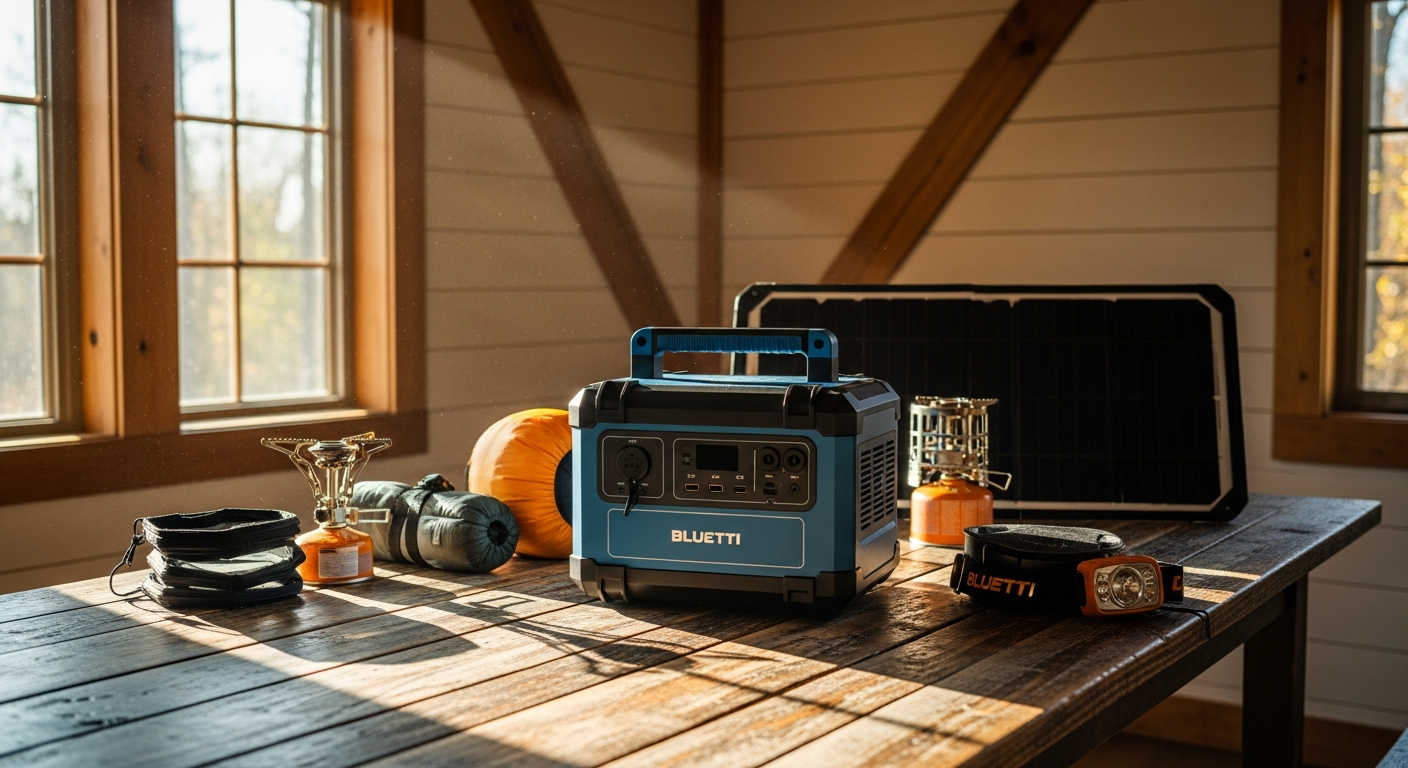
Discover whether the BLUETTI AC200MAX expandable portable power station is the right off-grid power solution for your remote living, emergency backup, and energy independence goals.
Imagine losing power during a critical moment—no refrigeration, no heating, no way to charge your devices—and realizing you’re completely unprepared. This scenario plays out for thousands of households every year, often catching people without adequate backup solutions. The stakes are real, and the consequences of underpreparedness can range from inconvenient to dangerous.
The BLUETTI AC200MAX has emerged as a heavyweight contender in the portable power station market, particularly for users seeking serious capacity and long-term reliability. This expandable system combines a robust 2048Wh LiFePO4 battery with the flexibility to grow up to 8192Wh, adapting to your power needs as they evolve. Unlike fixed-capacity competitors, the AC200MAX grows with you rather than forcing you into uncomfortable compromises between initial cost and future capability.
Throughout this article, I’ll break down whether the AC200MAX truly delivers on its promises for off-grid living and emergency preparedness. You’ll discover how its expandable architecture works in practice, how it performs under heavy loads, what charging options provide real flexibility, and whether this power station genuinely aligns with your energy independence goals.
Explore the BLUETTI AC200MAX expandable power station today.
Expandable Battery Architecture: Building Your Energy Foundation
How the 2048Wh Base Capacity Works and Why It Matters for Initial Setup
The AC200MAX arrives with a 2048Wh LiFePO4 battery—a substantial starting point that handles most household backup scenarios without expansion. This base capacity powers essential devices for extended periods: a refrigerator for 12+ hours, multiple laptops and phones indefinitely, medical equipment continuously, or smaller appliances in rotation. For many users, the base unit alone provides sufficient peace of mind for typical power outages lasting 4–8 hours.
The 2048Wh figure represents a sweet spot between initial investment and practical capability. It’s not so large that early-stage buyers overpay for capacity they don’t immediately need, yet substantial enough that they’re not constantly frustrated by capacity limits. The LiFePO4 chemistry means this base battery delivers reliable, consistent power without the degradation curves that plague lithium-ion alternatives.
Connecting BLUETTI B230 and B300 Expansion Batteries to Reach 8192Wh Capacity
The AC200MAX’s true power emerges through its expansion capability. Users can connect additional B230 (2048Wh) or B300 (3072Wh) expansion batteries to multiply total capacity. Adding two B230 units brings the system to 6144Wh, while combining the base unit with three expansion batteries (using B300 units) reaches 8192Wh of total capacity—a four-fold increase from the original configuration.
The expansion process itself is straightforward: simply connect expansion batteries via integrated connector cables without requiring rewiring or external equipment. The AC200MAX automatically recognizes additional batteries and displays total capacity on its touchscreen. This modular approach means you avoid the all-or-nothing dilemma of purchasing a massive unit upfront when you only need to expand later.
Scaling Strategy: When and Why to Add Expansion Batteries for Growing Power Needs
Smart expansion timing depends on your actual usage patterns. Users should monitor their first few months with the base unit, tracking how many days they need to recharge and what percentage of capacity they typically consume. If you’re regularly draining more than 70% of your 2048Wh reserve, adding expansion batteries prevents the frustration of running out of power mid-emergency.
Off-grid homesteaders typically add batteries as their household grows or as they add new appliances (heating systems, larger refrigeration, workshop equipment). RV enthusiasts often expand when planning extended remote trips away from resupply infrastructure. The beauty of this approach is that you’re not paying for capacity sitting idle in early months—you’re scaling deliberately as genuine needs emerge.
LiFePO4 Chemistry Advantages: 3500+ Life Cycles and Long-Term Cost-Per-Watt-Hour Value
LiFePO4 batteries fundamentally outperform conventional lithium-ion in longevity and safety. The AC200MAX’s battery specification of 3500+ life cycles to 80% capacity translates to real durability. If you charge the system daily, that’s nearly a decade of reliable service before capacity degrades to 80%—and the battery continues functioning beyond that threshold, just at reduced capacity.
Calculate the true cost-per-watt-hour-per-year by dividing the purchase price by total watt-hours and expected years of service. A $2,000 AC200MAX with 2048Wh lasting 10 years costs roughly $0.10 per watt-hour annually—competitive with or superior to cheaper units that require replacement within 5 years. LiFePO4 chemistry also offers superior thermal stability and safety profiles, reducing fire risk compared to standard lithium-ion alternatives.
Power Output Performance: Can It Really Run Your Appliances?
Continuous 2200W Output: What Devices This Actually Powers Reliably
The AC200MAX’s continuous 2200W output rating defines what you can run simultaneously without triggering protection mechanisms. This handles most household essentials: a microwave (typically 1000–1200W) plus several other devices, a space heater (1500W) alone, coffee makers (750–1000W), blenders, power tools, and refrigerators (600–900W). The key word is “simultaneously”—you can run a microwave and charge a laptop together without issue, but stacking three high-draw appliances simultaneously approaches or exceeds this threshold.
Real-world usage patterns typically stay well below continuous limits because you rarely operate every high-power appliance at once. Understanding your household’s typical simultaneous draw prevents frustrating shutdowns. Most users find 2200W continuous output provides abundant capacity for their actual daily needs.
Surge Capacity of 4800W: Handling Startup Demands for Microwaves, Coffee Makers, and Power Tools
The 4800W surge capacity addresses a critical reality: many appliances demand momentary power spikes when starting before settling into normal running consumption. An air compressor’s motor startup might spike to 3000–4000W before dropping to 1500W running draw. A power drill startup demands similar spikes. Standard microwaves draw peak power at startup before settling. The AC200MAX’s generous 4800W surge capacity handles these demands without protection circuits cutting power.
This surge specification separates capable power stations from underpowered competitors that shut down when appliances demand legitimate startup power. You can confidently operate workshop tools, large compressors, and demanding kitchen appliances rather than worrying about whether the system will deliver what it promises.
Pure Sine Wave Inverter Benefits for Sensitive Electronics and Medical Equipment
The AC200MAX’s pure sine wave inverter produces AC power matching utility grid output rather than the cheaper modified sine wave approximation. This matters significantly for sensitive electronics: medical equipment, vintage audio systems, variable-frequency motors, and precision power tools function reliably with pure sine wave power but may malfunction or suffer damage from modified sine wave approximations.
If you’re powering medical devices (CPAP machines, portable ventilators, dialysis pumps), the pure sine wave inverter isn’t a luxury—it’s essential. Even for general use, pure sine wave power extends electronics lifespan and prevents the subtle performance degradation that occurs when sensitive devices operate on inferior power quality.
Check BLUETTI AC200MAX specifications and order your reliable power station.
Charging Flexibility: Multiple Pathways to Full Battery
AC Charging via 500W Adapter: Speed, Limitations, and UPS Considerations
The AC200MAX includes a 500W AC charging adapter, enabling recharging from any standard household outlet. This 500W input rate means the base 2048Wh battery charges fully in approximately 4 hours—slower than some competitors’ faster chargers, but adequate for overnight charging or daytime top-ups during partial outages.
The 500W limitation presents one drawback: if you’re using the AC200MAX as an uninterruptible power supply (UPS) for a computer consuming 800W while simultaneously trying to charge the battery, the system actually drains because charging input (500W) can’t overcome the simultaneous draw. This limitation affects office backup scenarios more than emergency or off-grid situations. Heavy-duty continuous-operation UPS scenarios require stronger AC input or grid power directly.
Solar Input Capacity up to 900W and Optimal Panel Configurations
The AC200MAX accepts up to 900W of simultaneous solar input, enabling rapid recharging from renewable sources. This 900W capacity is substantial—enough to support a 600–800W solar panel array while leaving headroom. In sunny conditions, 900W solar input can recharge the base 2048Wh battery in 2–3 hours, with proportionally faster recharging for partial depletes.
Optimal solar configurations use panels rated 500–900W connected via compatible MPPT controllers. A typical setup pairs four 250W panels or three 300W panels, connecting them in series-parallel configurations that produce the sweet-spot voltage and amperage for maximum charging efficiency. Users in cloudy climates should consider slightly larger panel arrays (1200–1500W rated) to overcome weather variability.
Car Charging Capability for Mobile and Travel Scenarios
The car charging port enables recharging from vehicle 12V systems while traveling—useful for RV adventures, overlanding expeditions, or emergency scenarios where grid power is unavailable but vehicle access exists. Car charging rates are modest (100–150W), requiring 12+ hours to significantly recharge the battery from a standard vehicle electrical system, but it provides backup charging when other options disappear.
This capability transforms the AC200MAX into a true mobile power solution rather than a stationary backup device. Combine solar and car charging, and you’re recharging from multiple renewable sources simultaneously when grid power evaporates.
Port Versatility and Connectivity: Powering Everything Simultaneously
Five AC Outlets on the Front Panel and Their Individual Load Ratings
The AC200MAX provides five AC outlets on the front panel—more than competitors offering two or three outlets. Each outlet handles the full 2200W continuous rating, enabling simultaneous operation of multiple standard appliances. Five outlets transform the unit from a single-device power source into a mini distribution center capable of powering your entire off-grid kitchen, workshop, or bedroom simultaneously.
Layout matters too: front-mounted outlets mean cables don’t tangle around a central body, and the spacing prevents bulky plugs from blocking adjacent outlets. This practical design consideration separates the AC200MAX from competitors whose limited outlet spacing requires extension cords or splitters.
DC Port Options and Compatibility with Various Devices and Adapters
Beyond AC outlets, the AC200MAX offers multiple DC port options: 12V DC outputs for automotive equipment, RV appliances, and LED lighting; a 12V car outlet matching standard RV configurations; and various connector types accommodating different device standards. These DC ports enable powering devices without needing 120V AC inversion, improving overall efficiency by 10–15% since conversion losses disappear.
DC outputs particularly benefit RV users powering water pumps, fans, and lighting systems designed for 12V operation. Off-gridders using 12V solar systems can charge directly into the DC system without inversion losses.
USB-A and 100W USB-C Ports for Modern Device Charging
Multiple USB-A ports and a 100W USB-C port address modern device charging needs: smartphones, tablets, laptops, and portable power banks. The 100W USB-C output is particularly significant—it charges power-hungry laptops at full power rather than the trickle-charge rates of standard USB ports. You can simultaneously charge a laptop via USB-C, two tablets via USB-A, and a smartphone while operating AC appliances.
The abundance of charging ports eliminates the frustration of limited charging options when multiple household members need simultaneous charging during extended outages.
Investment Value and Total Cost of Ownership
Price Range of $1,899–$2,199 and Available Bundle Discounts
The AC200MAX typically prices between $1,899 and $2,199 depending on retailer, current promotions, and bundle configurations. This positions it in the premium segment of expandable power stations—comparable to high-end competitors but substantially cheaper than lithium solar generators from niche manufacturers. Retailers frequently offer bundle discounts combining the AC200MAX with solar panels (typically $300–500 savings) or expansion batteries ($200–400 savings).
Watch for seasonal promotions around spring (Earth Day) and fall (back-to-grid season) when outdoor power equipment typically discounts. Buying during promotional periods can reduce effective cost by $200–400 compared to standard pricing.
Cost-Per-Watt-Hour Analysis Versus Competitors and Single-Unit Alternatives
A $2,000 AC200MAX providing 2048Wh costs approximately $0.98 per watt-hour—competitive or superior to most competitors. Expansion batteries cost $400–600 each, bringing marginal cost-per-watt-hour slightly higher ($1.00–1.20) as you scale, but total system cost remains reasonable. A fully expanded 8192Wh system costs roughly $3,600–4,000 total, or $0.44–0.49 per watt-hour of final capacity—far cheaper than purchasing four separate 2000Wh units.
Compare this to fixed-capacity competitors: a 5000Wh single unit from competing brands might cost $3,500–4,000, providing no expandability. If your needs grow, you’re replacing the entire unit. The AC200MAX’s modularity prevents this replacement waste and provides better scaling economics than any fixed-capacity alternative.
Expansion Battery Costs and ROI Calculations for Scaling Capacity
Individual B230 or B300 expansion batteries cost $500–800 each depending on current pricing and sales. Adding a single expansion battery increases capacity by 100% (from 2048Wh to 4096Wh) at marginal cost of $600 divided across that additional 2048Wh—or $0.29 per watt-hour of added capacity. This expansion ROI dramatically improves when compared to purchasing replacement units.
Calculate ROI by determining your daily energy consumption, multiplying by the number of days you need autonomy, then dividing by the expansion cost. If you consume 1000Wh daily and need 5-day autonomy, you need 5000Wh total capacity. The base unit provides 2048Wh; adding one expansion battery (4096Wh total) covers this need for under $3,000 versus $5,000+ for competing single-unit alternatives.
The Bottom Line: Is the AC200MAX Your Off-Grid Solution?
The BLUETTI AC200MAX stands out because it refuses to compromise on capacity, expandability, and power delivery. For users serious about energy independence—whether building an off-grid homestead, securing emergency backup, or powering extended RV adventures—this expandable power station delivers genuine value. The 3500+ life cycle LiFePO4 battery means you’re making a long-term investment, not a temporary workaround.
Its 4800W surge capacity handles the demanding appliances that other mid-range units struggle with, and the ability to expand to 8192Wh prevents the painful undersizing mistakes that plague fixed-capacity systems. Five AC outlets, comprehensive DC options, and multiple charging pathways (AC, solar, car) provide the versatility that transforms this from a backup device into a genuine off-grid power solution.
The real question isn’t whether the AC200MAX is powerful or reliable—it clearly is. The question is whether its specific strengths align with your energy needs and lifestyle. If expandability, rugged durability, and serious power output matter more to you than lightweight portability or Wi-Fi connectivity, this system deserves serious consideration. For anyone willing to invest in genuine energy independence rather than settling for underpowered shortcuts, the AC200MAX delivers on its promises.
Discover the full potential of the BLUETTI AC200MAX and secure your energy independence.