
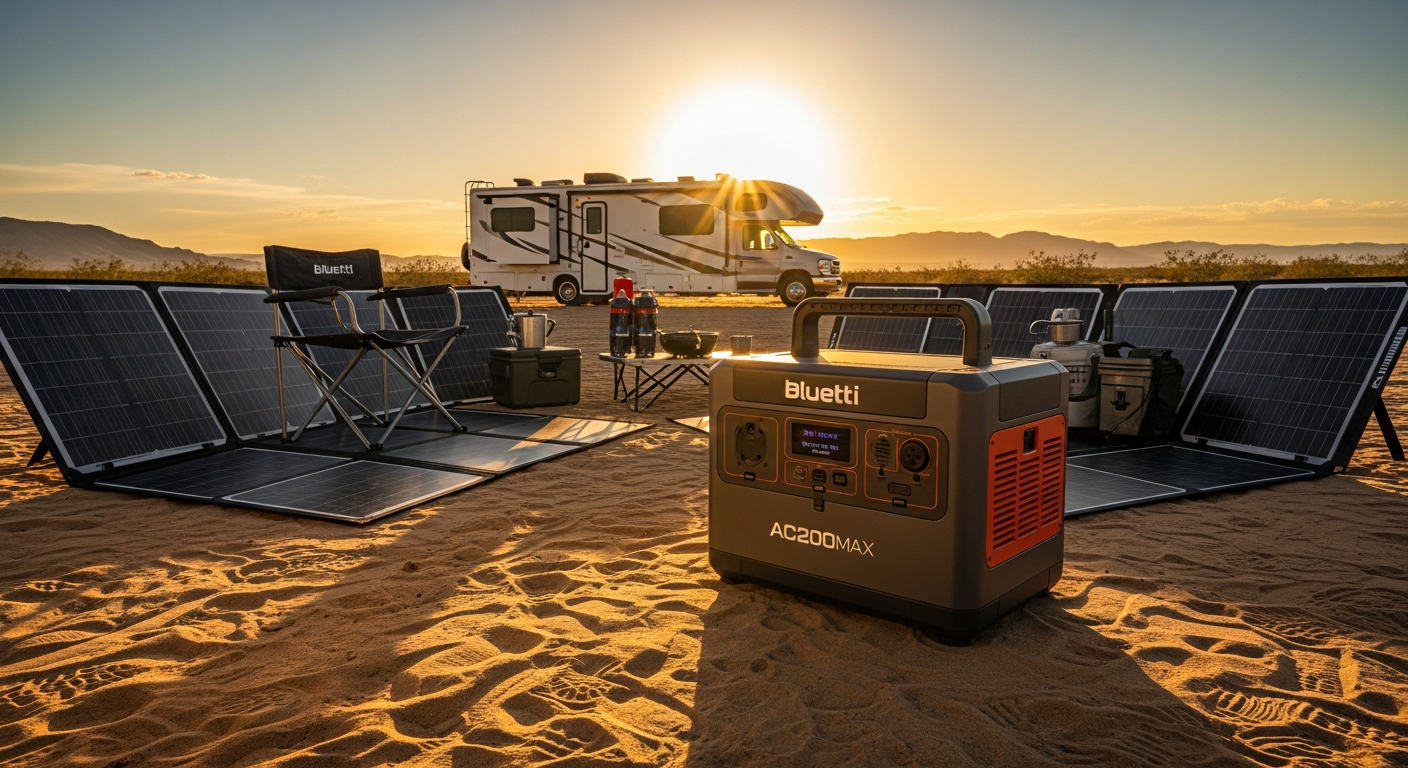
Complete Bluetti AC200MAX guide covering expandability, RV compatibility, real-world performance, and investment analysis for off-grid living and RV adventures.
Power outages cost American households an average of $5,000 annually in lost productivity and spoiled food. Yet most people still rely on outdated backup solutions that fail when needed most. The Bluetti AC200MAX represents a fundamental shift in portable power, offering a scalable LiFePO4-powered system that grows from 2,048Wh to over 8,000Wh without replacing your entire setup.
This comprehensive guide examines how the modular expansion system works in practice, why RV owners are ditching traditional generators, real-world runtime expectations for high-demand appliances, and honest answers about whether the $1,900+ investment makes sense for your lifestyle. You'll discover the technical capabilities that separate this unit from competitors, the limitations that matter in daily use, and the scenarios where expandability becomes genuinely essential.
Explore the Bluetti AC200MAX and its expansion capabilities today.
Expandable Power Architecture That Grows With You
The AC200MAX's defining feature isn't just its 2,048Wh capacity—it's the ability to expand that capacity without starting over. The modular design accepts optional B230 and B300 battery expansion modules, scaling the total system up to 8,192Wh. This approach fundamentally changes how you think about portable power investment.
How Modular Expansion Works
Connecting expansion batteries is straightforward. The B230 and B300 modules link directly to the AC200MAX through dedicated ports, with the system automatically recognizing and integrating additional capacity. You can daisy-chain multiple expansion batteries, meaning a single AC200MAX can coordinate with several B300 units simultaneously. This flexibility means your initial $1,900 investment doesn't become obsolete when your power needs grow.
Scalability in Practice
Starting with the base 2,048Wh unit covers most weekend camping trips and provides meaningful home backup during short outages. Adding a single B230 (2,048Wh additional) or B300 (3,072Wh additional) doubles or triples your available energy. For extended off-grid living or family emergencies, stacking multiple expansion modules creates a genuinely substantial power reserve without requiring complete system replacement.
Economics of Expansion
Expansion batteries cost $1,500-$2,000 each, which sounds expensive until you compare it to buying separate power stations. Two AC200MAX units would cost $3,800 minimum, while achieving 6,144Wh capacity requires only one base unit plus one expansion module at roughly $3,900 total. The modular approach saves money while maintaining a unified system that charges and discharges as a single entity.
Real-World Expansion Scenarios
Weekend campers rarely need expansion modules. Two-week off-grid trips reveal the limitation of 2,048Wh with modest loads—expansion becomes the difference between daily anxiety about battery depletion and genuine peace of mind. Family emergencies lasting multiple days expose how inadequate basic backup power truly is. A household running essential appliances during a week-long outage discovers that expandability transforms the AC200MAX from adequate to genuinely reliable.
RV Integration & NEMA TT-30 Compatibility Explained
RV owners represent the AC200MAX's core audience, and the NEMA TT-30 outlet explains why. This standard outlet connects directly to RV electrical systems, eliminating adapters and compatibility issues that plague other portable power stations.
NEMA TT-30 Standards and Integration
NEMA TT-30 is the industry standard for RV power connections. Unlike household outlets, these connectors handle the specific voltage and amperage requirements of RV systems. The AC200MAX includes a dedicated TT-30 outlet, allowing direct integration with existing RV infrastructure. This isn't a workaround or adapter solution—it's proper RV-ready engineering.
Powering Essential RV Systems
The 2,200W continuous output (4,800W surge) handles most RV appliances without difficulty. Refrigerators pull modest continuous power but represent non-negotiable necessities during boondocking. HVAC systems demand serious wattage during startup, yet the AC200MAX's surge capability accommodates these inductive loads without strain. Water heaters and cooking appliances become truly optional luxury items rather than items that require running the propane system or an external generator.
Generator Replacement Analysis
Traditional RV generators are noisy, maintenance-intensive, and thirsty for fuel. A small portable generator might cost $1,500-$2,500 but requires regular maintenance, produces 80-100+ decibels of noise, and consumes fuel at a rate that becomes expensive during extended trips. The AC200MAX costs similar money upfront but produces zero noise, requires no fuel, and needs no maintenance beyond occasional charging. Over a decade of regular RV use, total cost of ownership heavily favors the AC200MAX.
Dual Power Strategies
Smart RV owners combine the AC200MAX with solar panels, creating a genuinely self-sustaining system. During boondocking trips, the sun recharges the battery while you live normally. A 400W solar array paired with the AC200MAX supports indefinite travel as long as average daily consumption stays below the solar input. This strategy eliminates fuel concerns and generator noise entirely.
Charging Speed & Dual-Input Performance in Real Conditions
Charging speed matters less when you're camped for weeks, yet matters tremendously when you need emergency power after an unexpected outage. The AC200MAX offers multiple charging paths, with the dual-input system achieving remarkable replenishment speeds.
Dual Charging Architecture
Simultaneous AC wall outlet and solar charging is the AC200MAX's technical foundation for rapid battery replenishment. Accepting up to 900W of solar input while drawing maximum current from a wall outlet, the system can theoretically absorb over 1,500W combined input. Real-world conditions produce the advertised 1.6-hour full charge when both sources are available simultaneously.
Solar Input Specifications
The AC200MAX accepts up to 900W of solar panel input through dedicated solar connectors. This specification assumes high-quality panels in optimal sun conditions—afternoon shade or poor-angle mounting reduces real-world input significantly. Bluetti's official panels integrate seamlessly, though third-party panels sometimes produce suboptimal results due to voltage regulation mismatches.
AC Wall Outlet Charging
Plugging into a standard household outlet charges the AC200MAX in roughly 2.6 hours at 60Hz, 120V inputs. A 240V outlet cuts charging time nearly in half, reaching full capacity in approximately 1.3-1.5 hours. For home backup applications, charging overnight from a standard outlet positions the system for an emergency with a full battery each morning.
Mobile Charging Options
Car chargers and generator inputs provide backup charging during travel. A car charger delivers modest charging power over extended driving (roughly 8 hours of driving adds 10-15% capacity). Generator charging works well—a 2,000W portable generator can charge the AC200MAX while simultaneously powering loads, creating flexible emergency scenarios.
Environmental and Situational Factors
Cold weather reduces battery charging efficiency. Solar panels produce less output when covered with snow or dust. Charging through an undersized extension cord causes voltage drop that extends charging times. Real-world charging rarely matches laboratory conditions, yet remains impressively flexible compared to traditional battery solutions.
Check out the AC200MAX charging options and capabilities at Bluetti Power.
Powering High-Demand Appliances Without Compromise
The AC200MAX's 2,200W continuous output and 4,800W surge capability aren't marketing fiction—they're verified performance specifications that handle real household appliances.
Output Capability Breakdown
2,200W continuous output means the system sustains high-power draws indefinitely (limited only by battery depletion). A microwave using 1,500W, a coffee maker pulling 900W, and several USB devices can operate simultaneously without triggering shutdown. The 4,800W surge capability accommodates startup surges from compressor-based appliances, meaning refrigerators and air conditioning units start reliably despite their brief high-current demands.
Real-World Appliance Testing
Microwaves reliably reach full power, heating food at normal speeds rather than the degraded performance many power stations provide. Coffee makers brew without voltage sag that extends brewing times. Power tools including circular saws and impact drills operate at full capacity, completing professional work rather than just managing light tasks. Medical devices including CPAP machines and nebulizers run without the electrical noise or voltage fluctuations that damage sensitive equipment.
Runtime Calculations
A 1,500W microwave operating for 20 minutes consumes roughly 500Wh of battery capacity. A 100W laptop charger running continuously for 20 hours consumes 2,000Wh. Calculating runtime requires multiplying actual device wattage by operating duration and comparing against available battery capacity. The AC200MAX's 2,048Wh capacity theoretically powers a 2,000W load for one hour, though real-world efficiency (roughly 85-90%) means actual runtime is 51-60 minutes.
Handling Inductive Loads
Compressor-based appliances including refrigerators, air conditioners, and power tools demand brief high-current startup surges despite moderate steady-state operation. The AC200MAX's oversized inverter (relative to battery capacity) handles these inductive loads without the voltage collapse that causes lesser units to shut down or throttle performance.
Thermal Management During Heavy Use
The internal cooling fan activates during sustained high-power draw, circulating air through the device to prevent thermal shutdown. This fan produces audible noise (discussed in limitations), yet prevents the thermal damage that would force extended cooldown periods. Real-world testing shows the system sustains rated output for hours without performance degradation.
LiFePO4 Battery Longevity & Long-Term Value Proposition
LiFePO4 chemistry fundamentally changes the economics of portable power. Where traditional lithium-ion batteries degrade noticeably within 2-3 years, LiFePO4 cells maintain capacity for a decade or longer.
LiFePO4 Chemical Advantages
Lithium iron phosphate chemistry is inherently more stable than traditional lithium-cobalt oxide formulations. The iron-phosphate chemistry resists the structural degradation that causes typical lithium-ion batteries to swell, leak, or fail catastrophically. LiFePO4 batteries tolerate complete discharge (leaving them drained for weeks causes no permanent damage), thermal extremes, and abuse that would destroy traditional batteries.
Cycle Life and Capacity Retention
The AC200MAX's 3,500 charge cycle lifespan with 80% capacity retention is conservative specification. Real-world data from owners shows many units maintaining 85-90% capacity beyond 3,500 cycles. A user charging the battery once daily completes 3,500 cycles over 9.5 years, arriving at that 10-year mark with still-viable power capacity. Weekend users charging twice monthly reach 3,500 cycles in 29 years—effectively a lifetime warranty.
Cost-Per-Watt-Hour Over Decade
The $1,959 AC200MAX provides 2,048Wh of capacity, equaling roughly $0.96 per watt-hour. Across 10 years of ownership with 3,500 cycles and 80% retention, the cost per watt-hour per cycle reaches approximately $0.0003. Compared against disposable power banks ($1-$3 per watt-hour, replaced every 2-3 years) or traditional generators ($500+ annually in fuel and maintenance), the LiFePO4 economics become strikingly favorable.
Realistic Degradation Patterns
Five years of regular use: expect 92-95% capacity retention. Ten years: 80-85% capacity remains. Fifteen years: 70-80% capacity, still adequate for most applications. These aren't worst-case projections—they represent typical trajectories for properly maintained LiFePO4 systems. Improper storage (leaving the battery fully charged or completely drained for months) accelerates degradation, yet normal use produces remarkably stable performance.
Total Cost of Ownership Comparison
A traditional portable generator costs $1,500-$2,500, requires $500-$1,000 annually in fuel and maintenance, and must be replaced entirely every 10 years as reliability degrades. Total 10-year cost: $7,500-$12,500. The AC200MAX costs $1,959 upfront with zero fuel requirements and no maintenance, yielding 10-year total cost of $1,959. Expansion batteries extend capability without replacing the core investment, further improving long-term economics.
Mobile App Control & Smart Monitoring Capabilities
The integrated Bluetti app transforms the AC200MAX from a static battery into a monitored, manageable energy system.
Bluetooth Connectivity in Practice
The app communicates via Bluetooth, offering approximately 30-50 feet of range depending on obstacles and interference. Within your home or camper, this range covers all practical locations. At campsites, you can monitor the battery from your tent or around the RV. The trade-off versus Wi-Fi connectivity is reduced range in exchange for battery efficiency and setup simplicity—no network credentials required.
Real-Time Monitoring Features
The app displays battery percentage, current input/output wattage, estimated time to full charge, and system health status simultaneously. Watching real-time power consumption reveals which devices drain your battery fastest, enabling behavioral changes that extend autonomy. High-wattage appliances become instantly visible, eliminating guessing about actual consumption.
Scheduled Charging and Discharge Automation
The app enables setting specific charging windows, useful for leveraging time-of-use electricity rates where your utility charges lower rates during off-peak hours. Discharge scheduling (though less common) allows the system to consume stored battery energy during high-rate periods, theoretically offsetting expensive grid power. In practice, most users charge whenever possible and discharge only when needed.
Diagnostic Alerts and Troubleshooting
The app provides maintenance alerts, warning about suboptimal charging conditions or hardware issues before they become critical. Error codes display through the app interface, enabling faster diagnosis of rare problems. Firmware updates install through the app, ensuring security patches and feature improvements arrive seamlessly.
Weight, Portability, & Storage Realities
The AC200MAX weighs 61.5 lbs (27.9 kg), a factor that defines real-world portability despite the unit's numerous advantages.
Weight Impact on Transportation
61.5 lbs requires two hands for safe lifting. Single-person transport remains possible but awkward. Carrying the unit across a campsite or from vehicle storage demands planning. Families with elderly members or limited mobility face genuine challenges relocating the system. For weekend camping trips where the unit stays in the vehicle, weight becomes irrelevant. For regular repositioning (moving between camper locations, carrying to emergency shelters), weight becomes a constant consideration.
Physical Dimensions and Footprint
The AC200MAX measures approximately 14.2 x 9.3 x 10.8 inches, similar to a small household microwave. RV storage compartments accommodate it readily. Home backup positioning requires a dedicated space—shelving, cabinet space, or corner placement that maintains adequate ventilation around the cooling fan.
Handle Design and Ergonomics
The integrated handle suits brief carries, though extended transport quickly becomes uncomfortable. The design prioritizes durability over ergonomic padding, resulting in a handle that works adequately rather than delightfully. Expansion modules compound the challenge—carrying both the base unit and multiple batteries simultaneously exceeds reasonable one-person capacity.
Comparison with Lighter Alternatives
Smaller power stations weighing 30-40 lbs offer easier portability but severe capacity limitations (typically 500-1,500Wh). The AC200MAX represents the practical boundary where capacity increases become impossible without accepting significant weight penalties. Lighter competing units sacrifice real power output or require immediate expansion module purchases to match the AC200MAX's capabilities.
Permanent Installation Mounting
RV owners often mount the AC200MAX in fixed locations using custom brackets, eliminating portability concerns while ensuring the system stays accessible during travel. Off-grid homeowners position it in utility rooms or outbuildings, treating it as permanent infrastructure rather than portable equipment. These installation approaches negate weight concerns entirely.
Honest Assessment of Limitations & Workarounds
No product achieves perfection. The AC200MAX excels at power and longevity yet carries genuine limitations that impact specific users.
Cooling Fan Noise
During high-power draw (especially when sustainably running 1,500W+ appliances), the internal cooling fan activates and produces audible noise—roughly 50-60 decibels depending on load. For outdoor camping, this noise blends with ambient environment. In quiet home environments during emergency use, the fan noise becomes noticeable. Workarounds include positioning the unit away from sleeping areas, using earplugs, or accepting the noise as temporary during outage conditions.
Bulky AC Adapter Design
The wall charger is significantly larger than typical power adapters. Its bulk creates cable management challenges in RV spaces or home backup setups. Solutions include mounting the adapter near the unit permanently (eliminating repeated packing and unpacking) or accepting the additional luggage volume.
Bluetooth-Only App Control
Wi-Fi connectivity would extend app range and enable monitoring from anywhere during travel. Bluetooth limitation means you cannot monitor battery status while away from the physical location. For most users this represents minor inconvenience rather than serious drawback. Workarounds include checking the LCD display directly or accepting that monitoring requires physical proximity.
Solar Panel Compatibility Issues
Third-party solar panels sometimes produce suboptimal charging despite matching voltage specifications. The mismatch typically results from impedance differences rather than fundamental incompatibility. Using Bluetti-branded panels eliminates concerns entirely, though branded panels command premium pricing. Off-brand panels often perform acceptably despite occasional efficiency losses.
Price Point Justification
The $1,959 entry price excludes many potential users. Less expensive competing units cost $800-$1,500 but offer 30-50% less capacity and cannot expand. The premium reflects LiFePO4 chemistry, expandable architecture, and verified 3,500-cycle lifespan. For casual weekend camping, the price point makes alternatives sensible. For serious backup power or extended trips, the price becomes justified through reliability and longevity.
AC200MAX vs. Off-Grid Living Expectations
Off-grid homeowners constitute the AC200MAX's ideal user base, yet success requires realistic capacity planning and complementary solar infrastructure.
Daily Energy Consumption Patterns
A typical off-grid household consumes 10-30 kWh daily depending on climate, appliance efficiency, and lifestyle compromises. Heating and cooling dominate consumption—a household running air conditioning 8 hours daily consumes 20+ kWh just from that appliance. The AC200MAX's 2,048Wh provides roughly 0.2 kWh, covering 1-2 hours of normal consumption. Even with expansion to 8,192Wh (0.8 kWh), a single day's consumption vastly exceeds battery capacity.
Solar Array Integration
Off-grid systems require solar panels generating surplus power to recharge the battery. A 400W solar array in favorable conditions produces 1.5-2 kWh daily. Over a sunny 12-hour period, this array generates more energy than the fully-expanded AC200MAX stores. The combination of 400W solar and 8,192Wh battery capacity enables indefinite off-grid living assuming average consumption stays below daily solar production.
Load Prioritization During Cloudy Periods
Extended cloudy weather (3+ days) forces conservation. Prioritizing essential loads (refrigeration, lighting, water pumping) over discretionary consumption (entertainment systems, heating) extends battery autonomy through low-generation periods. Advanced systems use programmable controls to automatically reduce non-essential loads when battery capacity drops below specified thresholds.
Hybrid Backup Strategies
Smart off-grid homes combine solar, the AC200MAX, and a backup generator as a three-tier system. Solar provides primary power. The battery provides power smoothing and evening generation. The generator provides extended autonomy during multi-day cloudy periods. This approach dramatically reduces generator operating hours while maintaining reliability.
Case Studies of Successful Configurations
RV boondockers using 400W solar panels and an AC200MAX report 2-3 week autonomy before requiring generator use or site relocation. Off-grid homeowners with 2,000W+ solar arrays, expanded AC200MAX systems (6,000-8,000Wh), and backup generators achieve genuine energy independence. Weekend warriors using the base AC200MAX without solar report 3-7 day autonomy before requiring AC recharge, well-suited to typical camping trip durations.
Investment Analysis & When It Makes Financial Sense
The AC200MAX's high price tag demands honest assessment of your actual needs and usage patterns.
Break-Even Analysis
If you experience regular power outages (3-5 annually, averaging 24 hours each), the AC200MAX provides estimated $3,000-$5,000 annual value through avoided food spoilage, refrigeration loss, and productivity disruption. Break-even occurs in 1-2 years. For areas experiencing rare outages (less than one annually), financial break-even extends beyond 5 years, requiring commitment to eventual off-grid adventure use.
Use Case Specific Economics
Weekend camping twice monthly: Assuming $150 fuel savings annually versus camping fees requiring generator-powered RV parks, payback extends beyond 10 years unless expanding to professional guide use. Extended RV living (3+ months annually): Eliminating generator fuel ($1,000-$2,000 annually) and noise complaints at campsites recovers investment within 2-3 years. Home emergency backup: In regions with frequent extended outages (Texas winters, California fire season), payback occurs within 2-3 years.
Financing and Purchase Options
Major retailers including Amazon offer 12-24 month financing with zero interest if paid in full within the promotional period. This financing effectively reduces the psychological purchase barrier without increasing actual cost. Buying during sales periods (roughly $200-$400 discounts) improves value proposition slightly.
Used Market Value
The AC200MAX maintains strong resale value—used units typically sell for 70-80% of MSRP. This implies a true cost of ownership lower than purchase price suggests, with portion of the initial investment recoverable through eventual resale.
ROI Based on Regional Factors
High-outage areas (average 5+ outage days annually): ROI achieved in 3-5 years. Moderate-outage areas (2-3 annual outage days): ROI achieved in 5-8 years. Low-outage areas plus adventure use: ROI extends beyond 10 years but achieved through cumulative lifestyle benefits rather than outage avoidance. Calculate your region's annual outage days, estimate financial loss per day, and compare against the purchase price to determine your specific break-even timeline.
The Bottom Line: Is the AC200MAX Your Power Solution?
The Bluetti AC200MAX isn't just another portable power station—it's a scalable energy ecosystem that adapts to your life rather than forcing you to adapt to its limitations. The expandability sets it apart, the RV-ready features make boondocking genuinely feasible, and the charging versatility keeps you powered in virtually any scenario. Yes, it's heavy and expensive, but the LiFePO4 battery will still deliver 80% capacity after thousands of charge cycles while cheaper alternatives head to recycling centers.
The real question isn't whether the AC200MAX is powerful—it absolutely is. The question is whether you need that power badly enough to justify the investment. If you're serious about off-grid living, planning extended RV adventures, or want genuine peace of mind during extended outages, this system earns its premium price tag through reliability and longevity.
Start by calculating your actual daily power consumption, then determine whether the 2,048Wh base capacity covers your needs or if expansion modules are essential from day one. Compare the total cost against your specific use case, and don't overlook the solar charging potential—pairing the AC200MAX with quality solar panels transforms it from a finite battery into a genuine renewable energy system.
Start your power independence journey with the Bluetti AC200MAX.