
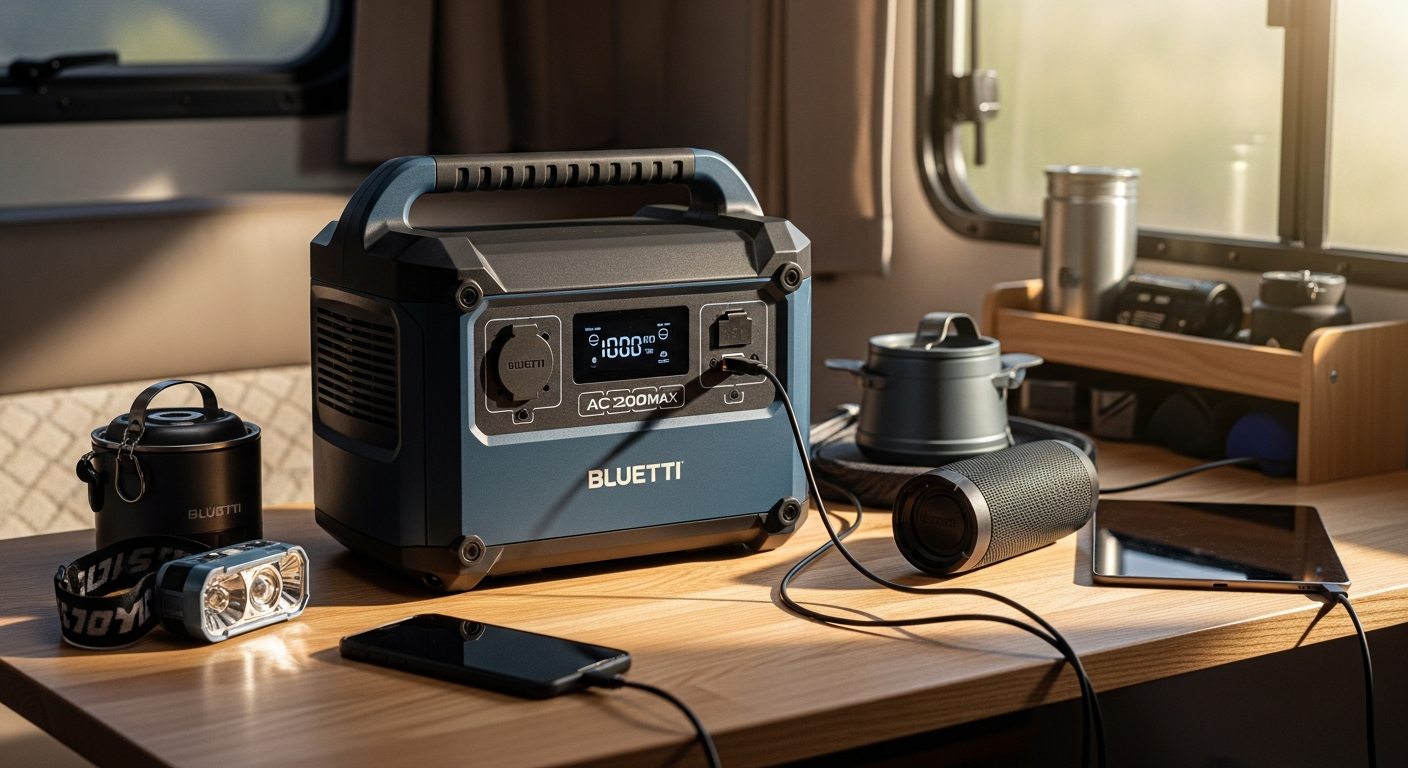
Discover how the BLUETTI AC200MAX portable power station revolutionizes RV and camping adventures with expandable capacity, multiple charging options, and the 30A RV outlet. Perfect for off-grid living and outdoor travel—learn why it’s the top choice for mobile enthusiasts.
Imagine pulling into your favorite remote campsite only to realize you can power your refrigerator, charge all your devices, and run essential appliances without a generator's noise or fumes. Over 70% of RV enthusiasts cite reliable power access as their biggest challenge on the road. The BLUETTI AC200MAX portable power station has quietly become the go-to solution for RV owners, van lifers, and serious campers who refuse to compromise on comfort or convenience.
Unlike traditional generators, this expandable power hub delivers clean, silent energy through advanced LiFePO4 battery technology. It's specifically engineered for the mobile lifestyle, complete with an RV-dedicated 30A NEMA TT-30 outlet that makes integration seamless. The system combines impressive capacity with real-world flexibility that transforms how you experience life on the road.
Discover how the BLUETTI AC200MAX can revolutionize your RV power setup today.
Throughout this guide, you'll uncover exactly how the AC200MAX transforms your mobile adventures, break down its RV-specific features, show you real-world power scenarios for different trip lengths, compare it against traditional generator setups, and help you determine whether expansion batteries make sense for your travel style.
The RV Owner's Power Problem—And Why Traditional Generators Fall Short
Common power challenges RV owners face during extended trips
Extended RV trips expose a fundamental reality: your vehicle's built-in electrical system wasn't designed for comfort appliances running simultaneously. Running the refrigerator while charging phones and powering LED lighting drains auxiliary batteries faster than you'd expect. Shore power hookups solve this problem, but finding available sites during peak season means competing with hundreds of other travelers or settling for crowded commercial campgrounds when you'd prefer solitude in remote locations.
Why propane generators create noise, emissions, and maintenance headaches
Traditional propane generators solve capacity problems but introduce new frustrations. The constant hum at 80+ decibels ruins the peaceful camping experience you traveled to find. Morning generator starts wake neighbors across the campground. Propane storage requires safety precautions in compact RV spaces—tanks leak, damage valves in accidents, and create smell issues during hot weather. Maintenance demands regular oil changes, spark plug replacements, and seasonal winterization rituals that most casual RV users forget until problems emerge.
The limitations of shore power dependency and campground hookups
Relying on campground hookups chains your adventures to established facilities with limited availability. Peak season means booking months ahead or accepting overcrowded conditions. Premium sites with full hookups command premium prices, eroding your trip budget. True exploration—backroad dispersed camping, remote national forest sites, BLM land—becomes impossible without independent power. Shore power also ties you to specific parking locations, limiting flexibility to move as weather shifts or better views present themselves.
How silent, clean energy solutions enhance the camping experience
Lithium battery systems operate in complete silence, letting you enjoy natural soundscapes and genuine relaxation. No emissions mean healthier air in and around your RV, particularly important during extended trips where ventilation becomes limited. The absence of fuel storage eliminates safety concerns and smell issues. Clean power means your sensitive electronics—medical devices, laptop chargers, phone batteries—receive stable voltage without the voltage fluctuations that propane generators produce.
The rise of lithium battery technology in mobile power applications
Lithium iron phosphate (LiFePO4) represents the modern standard for portable power in mobile living. These batteries charge faster, last longer, and maintain consistent power output throughout their discharge cycle. Unlike older lead-acid technology that degrades quickly or standard lithium-ion cells with safety concerns, LiFePO4 chemistry prioritizes both longevity and safety. The technology has matured from premium niche product to mainstream choice for serious travelers who value reliability over budget compromises.
Why RV-specific outlets matter more than general-purpose power stations
Most portable power stations offer standard household outlets and USB ports. RV living demands something different—the 30A NEMA TT-30 outlet that directly integrates with your RV's electrical panel. This dedicated connection means you're not running extension cords through living spaces or powering your rig through adapters. Direct integration simplifies installation, reduces fire risk from overloaded outlets, and allows the power station to function as a genuine part of your RV's electrical infrastructure rather than an add-on device.
AC200MAX Features Built Specifically for Mobile Living
The 30A NEMA TT-30 RV outlet and direct RV integration capabilities
The AC200MAX includes a dedicated 30A NEMA TT-30 outlet—the same connector used by RV electrical panels. This isn't a conversion port or adapter; it's purposeful engineering for mobile living. You can connect the AC200MAX directly to your RV's electrical system, allowing the unit to function as either your primary power source or a backup when shore power fails. This integration capability transforms the portable power station from a standalone device into a genuine RV system component.
2,048Wh base capacity with expandable options (B230 and B300 modules explained)
The base AC200MAX arrives with 2,048Wh of LiFePO4 battery capacity—sufficient for most weekend trips. However, BLUETTI designed the system for growth. Adding B230 battery modules expands capacity to 4,096Wh or 6,144Wh depending on how many you attach. The premium B300 modules provide even larger capacity bumps, reaching 6,144Wh with one module or 8,192Wh with two modules. This modularity means you purchase exactly what you need initially, then expand as your travel adventures evolve and power demands increase.
Pure sine wave inverter (2,200W continuous, 4,800W surge) for sensitive RV appliances
The AC200MAX features a 2,200W continuous sine wave inverter with 4,800W surge capacity. This distinction matters significantly for RV applications. Sensitive appliances like refrigerators, CPAP machines, and laptop chargers require clean, stable power. The pure sine wave output mimics grid electricity, protecting electronics that modified sine wave generators can actually damage. The 4,800W surge capacity handles appliance startup demands—your fridge compressor, water heater, or air conditioning unit drawing significant current for initial startup without power dips affecting other devices.
Multiple output ports: five AC outlets, USB-C/USB-A charging, wireless pads, and DC outlets
Connectivity extends far beyond the RV outlet. Five standard AC outlets power coffee makers, hair dryers, power tools, and laptop chargers. USB-C and USB-A ports charge phones, tablets, and other portable devices simultaneously. Two wireless charging pads top off compatible phones without cable management. Five DC outlets provide 12V power for automotive accessories or direct camper appliance connections. This comprehensive port array means everyone in your RV can charge their devices while running larger appliances without competing for limited connections.
Bluetooth app control and touchscreen monitoring for on-the-go management
Managing power in your RV doesn't require complicated interfaces. The AC200MAX features a full-color touchscreen built into the unit itself—no smartphone necessary for basic operation. For remote monitoring, the BLUETTI App works via Bluetooth, allowing you to check battery status, input/output power, and remaining capacity from anywhere within wireless range. This app connectivity proves particularly valuable on extended trips where you want to monitor power consumption patterns without approaching the unit physically.
LiFePO4 battery longevity: 3,500+ cycles supporting years of weekend trips and extended adventures
The LiFePO4 battery chemistry guarantees 3,500+ charge cycles before degrading to 80% original capacity. For weekend campers charging the unit twice monthly, this translates to roughly 175 charging cycles annually—meaning 20 years of regular use before noticing meaningful capacity loss. Full-time RVers might cycle through batteries faster but still expect 10+ years of reliable operation. This longevity transforms the AC200MAX from a consumable device into a genuine long-term asset that justifies its investment.
Powering Your RV: Real-World Scenarios and Runtime Expectations
Weekend camping trips: refrigerator, lighting, and device charging duration
A typical weekend trip involves running your RV refrigerator (150-200W continuous), LED lighting (20-50W), and charging phones and tablets. The AC200MAX's 2,048Wh base capacity handles this scenario for 2-3 days of moderate usage without requiring recharging. Your refrigerator runs continuously—roughly 8-10 hours of actual compressor operation daily—while still leaving substantial capacity for evening lighting, device charging, and small appliance use. Most weekend warriors find the base unit sufficient without expansion modules.
Extended off-grid stays: sizing capacity for 7-10 day adventures
Seven to ten day trips demand more strategic power management. The base AC200MAX alone supports this duration only with conservative appliance use. Adding a single B230 or B300 battery module creates substantially more headroom. With expanded capacity, you're running your refrigerator continuously, using LED lighting freely, charging multiple devices nightly, and operating small appliances like coffee makers or hair dryers without anxiously monitoring battery level. Expansion modules transform extended trips from a power-rationing exercise into genuine comfort camping.
Simultaneous power demands: running multiple appliances and understanding surge capacity
The 4,800W surge capacity becomes important when multiple appliances start simultaneously. Your refrigerator compressor starting while someone runs the microwave and another person uses a hair dryer creates a combined surge demand that exceeds 4,800W—which the AC200MAX handles through smart power management. Understanding surge capacity means recognizing that running major appliances sequentially rather than simultaneously keeps overall power demands manageable. The touchscreen display shows real-time watts being drawn, helping you learn your specific usage patterns.
Solar recharging while parked: 900W solar input capability for daytime power generation
The AC200MAX accepts up to 900W of solar input, making daytime charging viable during stationary camp days. A quality 400W solar panel system generates roughly 200-300W under typical midday conditions, adding meaningful charge during your parked hours. This solar capability means extended trips no longer require constant recharging between adventures. Park for three days with decent weather, and your batteries charge substantially while you relax, hike, or explore the surrounding area.
Dual charging strategy: combining AC and solar for faster turnaround between trips
The AC200MAX supports simultaneous charging from two sources—for example, AC wall power plus solar panels. This dual charging approach reaches up to 1,400W total input, recharging the base unit in under two hours compared to four hours with AC alone. For RV owners who charge overnight at home or at hookup-equipped campgrounds, dual charging delivers maximum flexibility. Solar keeps the battery topped off during daytime park periods, while AC charging at home or premium campgrounds reaches full capacity before your next adventure.
Expansion battery calculations: when B230 vs. B300 modules make financial sense
The B230 module adds 2,048Wh capacity at approximately $800-900, while the premium B300 module adds 2,048Wh for roughly $1,000-1,100. For most weekend campers, a single B230 expansion represents the sweet spot—doubling capacity for extended trips without excessive cost. Full-time RVers or those running power-hungry appliances might justify two B300 modules, reaching maximum 8,192Wh capacity. Your specific travel style, campground access, and appliance usage determine whether expansion modules make financial sense.
Seven Charging Methods—Flexibility for Every Travel Scenario
AC wall charging (500W): fast overnight charging at home or campgrounds with hookups
The included 500W AC adapter charges the base AC200MAX in roughly four hours from empty. At home or at campgrounds with full electrical hookups, overnight charging delivers a fully charged unit for morning departure. This 500W charging rate represents the standard offering, though BLUETTI sells upgraded adapters pushing higher wattage for faster turnaround between trips. For most users, overnight AC charging at home provides reliable baseline charging without additional expense.
Solar panel integration: harnessing sun power during stationary camp days
Solar charging transforms extended trips by generating power passively while you're relaxing at camp. The AC200MAX accepts up to 900W of solar input through properly configured panel systems. A quality 400W solar array produces 200-300W under typical midday conditions, meaningfully topping off your battery during stationary camp periods. Solar panels represent a higher initial investment but deliver unlimited free charging during daytime hours—particularly valuable during extended off-grid stays.
Vehicle charging: maintaining battery health during long driving days
Using your vehicle's 12V outlet to charge the AC200MAX during long driving days maintains battery health for evening arrival at camp. This charging method runs slower than AC or solar options but provides meaningful trickle charging during travel time. The DC input accepts standard automotive voltage, making vehicle charging practical without special equipment. For full-time RVers or those towing to distant locations, vehicle charging accumulates meaningful capacity over long driving days.
Generator backup: emergency charging when solar and AC aren't available
The AC200MAX can accept charging from portable generators when solar and AC connections aren't available. This backup method proves valuable during extended off-grid stays with cloudy weather eliminating solar charging and no nearby campground hookups. A modest 2000W portable generator can charge the AC200MAX while you're exploring or relaxing, recovering capacity before evening power needs spike. Generator charging provides a safety net for worst-case scenarios without permanently tying you to generator noise.
Lead-acid battery charging: compatibility with older RV electrical systems
RVs with older electrical systems might feature lead-acid auxiliary batteries rather than modern lithium technology. The AC200MAX can charge from these lead-acid sources when necessary, providing flexibility for vintage RV owners or those integrating with existing electrical systems. This compatibility means you're not locked into single charging methods but rather benefit from multiple input options for maximum flexibility.
Dual charging strategy: combining two methods simultaneously for 1,400W input
The revolutionary capability involves charging from two sources simultaneously—AC wall power plus solar panels, or AC plus generator, or any compatible combination. This dual charging reaches up to 1,400W total input, cutting recharge time nearly in half compared to single-source charging. After camping at a hookup-equipped site with decent solar exposure, combining AC and solar reaches full capacity in roughly two hours instead of four, giving maximum flexibility between adventures.
Charge time comparison: reaching full capacity in under two hours with optimal setup
Using the highest-capacity charging setup—500W AC adapter plus 900W of solar input—theoretically reaches 1,400W input, charging the base AC200MAX from empty in just over one hour. Real-world conditions rarely hit these theoretical maximums, but combining quality AC adapter with substantial solar input reaches full charge in 1.5-2 hours. Understanding these charging dynamics helps you plan recharge timing around your camping schedule, ensuring adequate battery capacity for each adventure phase.
Portability Meets Power: Understanding Weight, Size, and Installation
61.9 lbs weight consideration: manageable for single placement but not truly portable
The AC200MAX weighs 61.9 pounds—roughly equivalent to a large suitcase. This weight is manageable for initial placement in your RV, particularly with a second person assisting. The integrated handle simplifies repositioning when needed, though the 61.9 lbs ensures this isn't something you'll casually move in and out of your RV. For true portability, BLUETTI's smaller units might serve better. For RV applications where the unit stays relatively stationary, this weight represents a non-issue that provides capacity advantages.
Compact dimensions (16.5 x 11.0 x 15.2 inches) fitting RV storage constraints
The AC200MAX measures 16.5 by 11.0 by 15.2 inches—roughly the dimensions of a large toaster oven. This footprint fits under most RV beds, in storage cabinets, or on dedicated shelving. The compact profile means you're not sacrificing precious living space, a critical consideration in RV design where every square inch carries value. Compared to larger portable power stations or traditional generator footprints, the AC200MAX occupies minimal space while delivering substantial power capacity.
Placement options: under-bed storage, cabinet integration, or dedicated power center setup
Different RV layouts suggest different placement strategies. Under-bed mounting keeps the unit accessible yet out of sight, maximizing living space visually. Cabinet integration with ventilation cutouts creates permanent installation. Dedicated power center setups position the AC200MAX on a shelf or stand with organized cable management, creating a technical hub where charging and power distribution happens centrally. Your specific RV layout determines the optimal placement approach.
Integrated handle design for occasional repositioning within the RV
The built-in handle enables moving the unit within your RV when needed—perhaps repositioning for maintenance, seasonal storage changes, or expansion battery installation. While 61.9 pounds prevents casual movement, the handle makes occasional repositioning manageable for one person without significant strain. This thoughtful design detail distinguishes the AC200MAX from wall-mounted systems that eliminate flexibility entirely.
Thermal management: ventilation requirements and heat dissipation during heavy use
The AC200MAX generates heat during intensive charging or power output sessions. Strategic placement with surrounding ventilation prevents thermal stress that reduces battery lifespan. Avoid placing the unit directly against walls or in enclosed cabinets without airflow provisions. A few inches of clearance on multiple sides ensures adequate cooling during extended use. Understanding thermal dynamics means your AC200MAX maintains optimal performance across varied climates and usage intensities.
Cable management: organizing seven charging input options and multiple output ports
The AC200MAX offers seven charging input options and numerous output ports, creating potential cable chaos without organization. Running dedicated cable paths from your RV's exterior (for solar) to the unit, establishing a central charging location, and using cable management sleeves maintains safety and visual order. Thoughtful organization prevents tripping hazards and reduces the likelihood of accidental disconnections during movement around your RV.
Expansion Strategy: When and Why to Add Battery Modules
Starting with 2,048Wh base unit: sufficient for most weekend campers
The base AC200MAX delivers impressive capacity for typical weekend trips. Two to three days of moderate usage—refrigerator running, evening lighting, device charging, occasional small appliance operation—consumes well under 2,048Wh. Most weekend campers will find the base unit perfectly adequate without expansion. This baseline approach minimizes initial investment while evaluating whether expansion modules make sense for your actual travel patterns.
B230 battery module addition: expanding to 4,096Wh for week-long trips
Adding a single B230 module doubles capacity to 4,096Wh, supporting week-long trips with significantly more appliance flexibility. Week-long adventures no longer require power rationing—run your refrigerator continuously, use lighting freely, operate small appliances without anxiety. At roughly $800-900, a single B230 module represents a reasonable expansion cost that genuinely extends your camping comfort horizons. Many RV owners find this single expansion module provides the sweet spot between cost and capability.
B300 module upgrade path: reaching 6,144Wh or 8,192Wh for serious off-gridders
The premium B300 modules offer higher capacity at slightly higher cost. A single B300 reaches 6,144Wh capacity, while two B300 modules maximize the system at 8,192Wh. This configuration supports full-time RV living with genuine energy independence—running air conditioning, water heaters, and multiple appliances simultaneously without external power sources. The substantial investment reflects serious off-grid commitment, appropriate for those living permanently mobile or undertaking extended expeditions to remote locations.
Cost-benefit analysis: initial investment versus long-term adventure flexibility
Expansion module costs range from $800-1,100 per module. Calculating return involves assessing your travel frequency and camping locations. If you spend 30+ nights annually at remote locations without shore power access, expansion modules deliver genuine lifestyle enhancement justifying their cost. Casual weekend campers with occasional off-grid adventures might find the base unit perfectly adequate. Your specific usage patterns determine whether expansion modules make financial sense.
Stacking modules: understanding daisy-chain capabilities and limitations
The AC200MAX supports connecting up to two battery expansion modules simultaneously, either B230 or B300 variants. Battery modules daisy-chain together with simple connectors, requiring no complex wiring. Stacking two B300 modules reaches maximum capacity of 8,192Wh. The system recognizes all connected modules and displays total capacity through the touchscreen interface and app. Understanding these daisy-chain connections helps you plan future expansion without expensive installation complications.
Future-proofing: building expandable power infrastructure as travel needs evolve
The expandable architecture means purchasing the base unit today doesn't lock you into that capacity forever. As your travels evolve—perhaps transitioning to full-time RV living or pursuing more ambitious off-grid adventures—battery modules await when needed. This modularity avoids the frustration of outgrowing your power system and facing expensive replacement. Start with capacity matching your current lifestyle, then expand methodically as adventures demand more power independence.
AC200MAX vs. Traditional RV Power Solutions—The Comparison That Matters
Portable power station advantages over built-in RV batteries
Built-in RV auxiliary batteries (typically 100-200Ah lead-acid) provide modest capacity for short-term usage but degrade rapidly under heavy draw. The AC200MAX's 2,048Wh LiFePO4 capacity equals or exceeds most built-in battery banks while delivering better performance. Lithium chemistry maintains consistent voltage throughout discharge, while lead-acid voltage drops significantly as capacity depletes, reducing appliance effectiveness. The AC200MAX remains independent of your RV's electrical system, allowing troubleshooting or upgrades without full rewiring.
Silent operation versus propane generator noise and emissions
Propane generators operate at 80+ decibels—louder than a lawnmower, audible throughout campgrounds, and interrupting the peaceful camping experience you traveled to find. The AC200MAX operates silently, eliminating noise pollution. No emissions mean healthier air quality in and around your RV, particularly important during extended trips or family camping with children. The peace of silent power delivery transforms the camping experience from a generator-dependent operation into genuinely relaxing mobile living.
Maintenance requirements: lithium battery care versus generator upkeep
Propane generators demand regular maintenance—oil changes, spark plug replacements, carburetor cleaning, seasonal winterization. The AC200MAX requires virtually no maintenance beyond occasional software updates and ensuring clean ventilation. Lithium batteries don't develop fuel sediment, don't require oil level checks, don't need complex winterization procedures. This maintenance-free operation means less time troubleshooting power issues and more time enjoying your adventures.
Fuel storage and safety: eliminating propane tank hazards in compact spaces
Propane tanks introduce safety risks in compact RV spaces—damage from accidents can cause dangerous leaks, odors develop under heat stress, and proper ventilation becomes complicated in smaller RVs. The AC200MAX eliminates fuel storage concerns entirely. No propane means no leak risks, no safety certifications required, no smell issues during hot weather. Electrical power storage eliminates hazards inherent to pressurized fuel systems while freeing valuable storage space.
Initial cost versus long-term value and trip frequency ROI
The AC200MAX costs $1,199-1,899 depending on bundles and promotions. A quality propane generator costs $800-1,500, suggesting cost parity. However, generator operating costs—propane consumption, maintenance, repairs—accumulate over years. The AC200MAX uses free solar charging after initial investment, eliminating fuel costs. For RVers taking 20+ trips annually, the AC200MAX pays for itself through fuel and maintenance savings within 3-5 years while delivering superior performance and experience.
Hybrid approach: combining AC200MAX with existing RV electrical systems
Many RV owners benefit from hybrid approaches—maintaining built-in auxiliary batteries for baseline power while using the AC200MAX for appliance-heavy usage and extended off-grid stays. This combination maximizes flexibility without abandoning existing systems. The AC200MAX's RV outlet integration makes it compatible with existing electrical infrastructure, allowing seamless supplementation without complex rewiring.
Real-world testimonials from full-time RVers and weekend warriors
RV communities universally praise the AC200MAX for transforming mobile living. Full-time RVers report genuine energy independence for the first time—running refrigerators, water heaters, and entertainment systems without shore power anxiety. Weekend campers appreciate the simplicity and silence compared to generators. YouTube channels dedicated to RV living prominently feature AC200MAX setups, with creators consistently ranking it among their best investments. Real-world adoption and sustained enthusiasm from experienced travelers validates the AC200MAX's practical value.
Smart Control and Monitoring—Managing Power from Anywhere in Your RV
BLUETTI App functionality: remote monitoring via Bluetooth connectivity
The BLUETTI App extends control beyond the physical unit through Bluetooth connectivity. Monitor battery percentage, input/output watts, remaining estimated runtime, and total charge cycles from anywhere within wireless range. This remote monitoring proves particularly valuable on extended trips where tracking power consumption patterns helps optimize usage. The app displays real-time data with historical charts showing consumption trends across multiple days or weeks.
Full-color touchscreen interface: quick access without smartphone dependency
The built-in full-color touchscreen provides immediate power information without requiring smartphone access. Battery percentage, current watts, temperature, and available outlets display clearly on the screen. Adjustable brightness ensures readability in various lighting conditions. This physical interface means basic operation doesn't depend on Bluetooth connectivity or app functionality—you can manage power using the unit itself if smartphone access becomes unavailable.
Battery status tracking: remaining capacity, input/output watts, and cycle count
The display shows remaining battery capacity as a percentage and in watt-hours, helping you plan power usage around your remaining reserve. Current input and output wattage display in real-time, allowing you to monitor consumption and understand which appliances consume the most power. Cycle count tracking reveals how many times the battery has charged and discharged, helping you understand remaining lifespan and plan expansion timing.
Temperature monitoring: ensuring safe operation in various climates
Internal temperature sensors monitor battery health across varied climates. Hot desert environments and cold mountain conditions both affect battery performance, and temperature monitoring ensures operation remains within safe parameters. If thermal stress occurs, the system alerts you and adjusts charging rates to protect battery longevity. This intelligent thermal management means the AC200MAX performs reliably across North American camping climates without concern.
Customizable settings: adjusting power management for different trip scenarios
Advanced settings allow customizing power management for different situations—eco mode for extended off-grid stays prioritizing battery conservation, or maximum output mode for heavy appliance usage. Solar charging parameters can be adjusted based on available solar input. Sleep mode settings reduce power draw during inactive periods. These customizable options mean the AC200MAX adapts to your specific usage style rather than forcing one-size-fits-all operation.
Troubleshooting alerts: understanding error codes and maintenance notifications
The AC200MAX displays meaningful error codes and maintenance alerts rather than cryptic symbols. If thermal stress occurs, you receive clear notification with recommended actions. Low battery warnings alert you before critical depletion. Output overload alerts notify you if you're exceeding the unit's capacity. These intelligent alerts guide you toward optimal operation without requiring technical knowledge to interpret system status.
Multi-device management: controlling the AC200MAX from multiple phones or tablets
The BLUETTI App connects from multiple devices simultaneously, meaning different family members can monitor system status independently. No single person needs to manage power monitoring—everyone traveling with you can check battery status, current consumption, and remaining capacity whenever needed. This multi-device capability distributes power awareness across your RV community.
Investment Breakdown—Pricing, Bundles, and Long-Term Value
Base unit pricing: $1,199–$1,899 range depending on current promotions
The AC200MAX base unit typically costs $1,199-1,899 USD, with pricing fluctuating based on seasonal promotions and retailer offerings. Direct purchases from BLUETTI often feature lower pricing than third-party retailers. Occasional promotions drop prices toward the $1,200 baseline, while bundle packages increase total cost. Monitoring pricing trends reveals optimal purchase timing for budget-conscious buyers.
Solar panel bundles: calculating total system cost for complete energy independence
BLUETTI offers bundles pairing the AC200MAX with 400W solar panel systems. Complete solar bundles typically cost $2,400-3,000, adding roughly $1,200-1,600 to base pricing for quality solar coverage. This total investment delivers true energy independence—the AC200MAX charges from your RV's solar array during stationary periods while simultaneously powering your appliances. For full-time RVers, complete solar systems represent the ultimate freedom investment.
Expansion battery bundles: comparing package deals versus purchasing modules separately
Expansion battery bundles bundling AC200MAX with one or two B230/B300 modules offer slightly discounted pricing compared to purchasing separately. A base unit plus single B230 bundle might cost $1,900-2,100 versus $2,000-2,200 purchased separately. While discount margins remain modest, bundle purchasing simplifies ordering and occasionally includes expedited shipping. Calculate your specific configuration before choosing bundled versus separate purchases.
Warranty coverage: understanding protection terms and what's included
BLUETTI provides comprehensive warranty coverage—typically 2-3 years for the AC200MAX base unit and 2 years for expansion batteries. Warranty covers manufacturing defects and component failures but not physical damage from accidents or improper use. Extended warranty options are sometimes available for additional cost. Understanding warranty terms ensures you're covered against manufacturing issues while recognizing warranty limitations.
Cost-per-watt analysis: comparing AC200MAX value against competitor options
The AC200MAX costs roughly $0.59-0.93 per watt-hour depending on pricing tier. Comparable portable power stations range from $0.50-1.20 per watt-hour depending on chemistry and brand. The AC200MAX positions favorably within this spectrum, particularly when accounting for LiFePO4 longevity and RV-specific features competitors often omit. This cost positioning makes it a reasonable long-term investment when calculated across thousands of charge cycles.
Financing options: exploring payment plans for budget-conscious buyers
BLUETTI and major retailers often offer financing options for large purchases—typically 6-12 month interest-free payment plans. This financing spreads the AC200MAX's cost across multiple months, making the investment more manageable for budget-conscious buyers. Interest-free options mean you're not paying premium for spreading payments, simply breaking annual investment across monthly installments. Financing availability varies by retailer and season, so investigating options before purchase aids planning.
Resale value: lithium power stations holding strong in secondary markets
Portable lithium power stations retain value remarkably well in secondary markets. A three-year-old AC200MAX with moderate usage typically sells for 60-75% of original purchase price—substantially better than most electronics. This strong resale value means your investment isn't permanently sunk. If travel plans change, you can recover meaningful capital by reselling the unit. Comparing end-of-ownership resale value to generator expenses and maintenance costs strengthens the AC200MAX's financial justification.
Addressing the Drawbacks—Is the AC200MAX Right for Your RV Setup?
Weight consideration: whether 61.9 lbs fits your RV layout and installation preferences
The 61.9 lbs weight represents the primary physical limitation. If you're seeking truly portable power that moves between vehicles or locations, the AC200MAX's heft becomes problematic. For dedicated RV installation where the unit remains relatively stationary, this weight is negligible. Assess your specific usage—if portability matters, consider lighter alternatives. If the unit stays in your RV during all trips, the weight becomes irrelevant.
AC charging speed: understanding the 500W standard adapter and upgrade options
The included 500W AC adapter charges the base unit in roughly four hours from empty. This speed suffices for overnight charging at home or campgrounds with hookups, but feels slow if you're recovering power mid-trip. BLUETTI sells upgraded 700W adapters that accelerate charging to 2.5-3 hours for additional cost. Dual charging combining AC with solar reaches full capacity in under two hours, offering practical alternatives to the standard adapter's pace.
External power brick design: cable management and space requirements
The 500W AC adapter uses an external power brick design—a separate transformer box requiring cable management. This external brick isn't as elegant as integrated charging, and the bulky connector takes desk space when charging at home. However, this design choice enables more efficient charging and allows equipment isolation, benefits that outweigh the aesthetic drawback. Cable management sleeves and organized charging stations minimize visual impact.
Absence of UPS functionality: backup power limitations during shore power transitions
The AC200MAX doesn't function as an uninterruptible power supply (UPS), meaning it doesn't automatically switch from shore power to battery power if electrical connection drops. This limitation affects RVs that lose shore power suddenly due to disconnections or power outages. In practice, most RV usage doesn't depend on seamless transitions—shore power disconnects occur during intentional campground departures. If UPS functionality matters for your specific situation, alternative systems might serve better.
App feature limitations: touchscreen as primary control interface
While the BLUETTI App provides remote monitoring, it offers fewer control options than the physical touchscreen interface. App limitations mean you're still relying primarily on the physical unit for settings adjustments. For users expecting comprehensive app control, this limitation disappoints. However, the touchscreen's comprehensive functionality means app limitations don't restrict actual power management—just reduce convenience of remote adjustments.
Heat management during heavy loads: ventilation planning in enclosed RV spaces
The AC200MAX generates measurable heat during intensive charging or heavy power output sessions. Enclosing the unit without adequate ventilation reduces thermal management effectiveness, potentially triggering thermal throttling that limits output. Strategic placement ensuring airflow on multiple sides prevents heat stress. Understanding this thermal sensitivity means planning installation with ventilation in mind, not neglecting this consideration during placement.
Realistic expectations: matching unit capabilities to your specific travel style
The AC200MAX delivers exceptional capability for RV applications but isn't unlimited power. Running 15,000-BTU air conditioning continuously from battery power isn't realistic without substantial expansion batteries and solar. Understanding the unit's realistic limits prevents disappointment. Weekend campers with modest appliance loads will find the base unit ample. Full-time RVers demanding continuous air conditioning and heating should plan battery expansion or hybrid approaches combining multiple power sources.
The LiFePO4 Advantage—Why Battery Chemistry Matters for Road Warriors
Superior safety profile: thermal stability and reduced fire risk compared to lithium-ion
LiFePO4 chemistry provides inherently superior safety characteristics compared to standard lithium-ion batteries. Lithium-ion cells can experience thermal runaway in failure scenarios, creating fire risks. LiFePO4 cells demonstrate remarkable thermal stability—even under extreme conditions, they resist ignition and maintain stable internal chemistry. For RV applications where your power system coexists in confined living spaces, this safety advantage carries significant value