
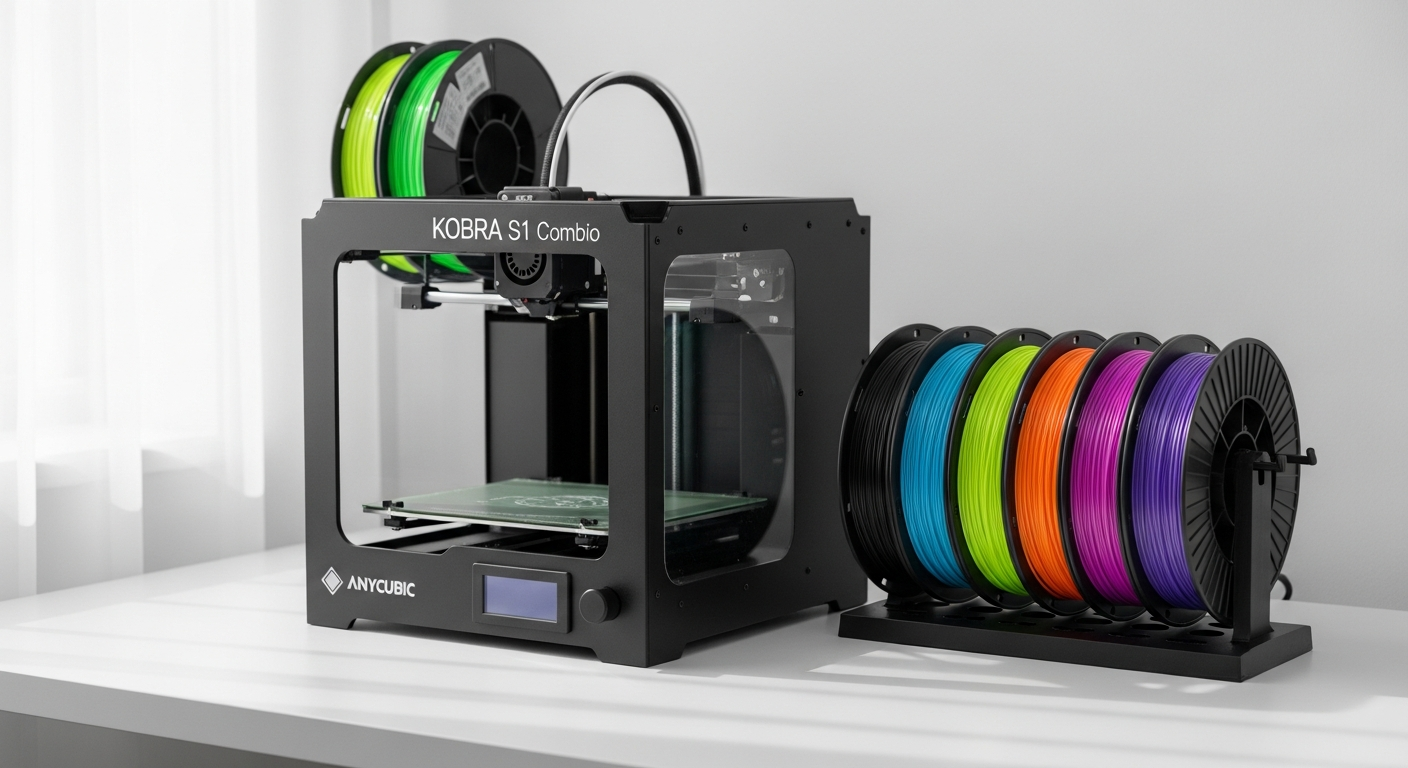
Unlock vibrant multi-color 3D printing without breaking the bank. Discover how the Anycubic Kobra S1 Combo delivers 4-8 color capability, 600mm/s speed, and precision engineering for creators and makers in 2026.
Multi-color 3D printing used to belong exclusively to industrial manufacturers with five-figure budgets and sprawling production floors. That gatekeeping is over. Today, individual creators and small business owners are shattering that barrier—and the Anycubic Kobra S1 Combo is the machine making it possible.
The Anycubic Kobra S1 Combo has earned its best-selling status within the FDM printer category for solid reasons. It combines ultra-fast print speeds reaching up to 600mm/s, millimeter-level precision, and a genuinely game-changing ability to print in up to four colors simultaneously—expandable to eight colors with an additional unit. This isn’t incremental improvement; it’s a fundamental shift in what’s available at the consumer level.
Discover the Anycubic Kobra S1 Combo and unlock your multi-color printing potential today.
This guide breaks down everything you need to know about the Kobra S1 Combo. You’ll discover exactly why creative professionals have gravitated toward this machine, understand its multi-color printing system in detail, examine real-world applications that showcase what’s actually possible, and learn the practical considerations you need to evaluate before making your investment.
The Multi-Color Printing Revolution: Why This Changes Everything
Four-Color Simultaneous Printing Capability
The Kobra S1 Combo handles multiple filament colors in a single print job without stopping or pausing between color changes. Four separate nozzles work in coordination, each feeding a different colored filament. This simultaneous approach eliminates the time-consuming, error-prone process of manually swapping filaments mid-print. Designers can create gradient effects, color-blocked designs, and intricate pattern work in one continuous session.
Expandable to Eight Colors
The modular design is where things get really interesting. Start with four colors, then scale to eight with an additional unit. This isn’t a locked-in limitation—you’re buying into a system that grows with your needs. A jewelry maker might start with the base unit, then add the second module once their business justifies the investment.
Vibrant, Complex Designs Unlock New Possibilities
Multi-color capability opens doors that single-color printing keeps firmly shut. Gradient transitions between shades, realistic miniature painting details, intricate pattern work that would take hours to hand-paint—all emerge from the printer automatically. Gaming miniatures leap off the tabletop with painted-on detail. Jewelry pieces gain dimension and visual interest that commands higher prices.
Material Waste Considerations
External color units do generate more material waste than fully integrated systems. Purge towers—the structure printed to clear filament between colors—consume filament that doesn’t end up in your final part. This is the honest trade-off. However, the cost savings from purchasing at the $599 price point versus industrial alternatives more than compensate for this material consumption.
Color Precision and Consistency
The printer maintains color accuracy across multiple filament feeds through careful nozzle coordination and thermal management. Each extruder maintains consistent temperature and pressure, preventing color bleeding or inconsistent saturation. The result is crisp color transitions and reliable output across multiple print jobs.
Speed Meets Precision: Engineering the Perfect Balance
600mm/s Printing Velocity
Ultra-fast speeds dramatically compress production timelines. A print that takes four hours on a standard machine might finish in ninety minutes on the Kobra S1 Combo. For product developers iterating through multiple design variations or small businesses fulfilling custom orders, this speed advantage translates directly to competitive advantage. You’re not sacrificing quality to achieve these velocities—the engineering maintains print integrity even at maximum speed.
Millimeter-Level Accuracy
Precision engineering ensures intricate details print correctly and functional prototypes perform as designed. Mechanical parts that need to mesh together actually fit. Dental models for orthodontic planning maintain the accuracy that clinical applications demand. This level of precision at a sub-$600 price point was simply unimaginable five years ago.
Advanced Auto-Leveling System
Manual bed leveling is a notorious frustration point for 3D printer users. The Kobra S1 Combo eliminates this entirely through automated calibration technology. The printer probes the bed surface, detects variations, and compensates automatically. First-layer adhesion—the foundation of every successful print—becomes reliable rather than a source of anxiety.
High-Performance Extruder Design
The enhanced filament feeding system excels at handling both standard and flexible materials. TPU, nylon, and other challenging filaments feed reliably through the high-precision extruder. Consistent extrusion pressure means uniform wall thickness and predictable print quality regardless of material choice.
Speed Versus Quality Trade-Offs
The printer gives you the control to dial back speed when ultra-fine detail work demands it. Maximum velocity serves time-sensitive production work. Slower speeds with optimized settings deliver museum-quality results for display pieces or high-value prototypes. Most users find themselves adjusting print speed based on the specific project rather than locking in one setting permanently.
Filament Flexibility: What You Can Actually Print
PLA, PETG, ABS, and ASA Compatibility
The Kobra S1 Combo supports the full range of practical filament options. PLA works for displays and non-functional pieces. PETG offers greater durability for mechanical parts and outdoor applications. ABS provides high-temperature resistance for functional prototypes. ASA combines ABS durability with superior weathering resistance for products that face UV exposure. This material range means you’re not locked into one approach—each project uses the optimal material.
Flexible Material Handling
TPU and similar flexible filaments require careful extrusion control. The high-performance extruder manages these materials without the jamming and inconsistency that plague lesser machines. Product designers can print flexible gaskets, phone cases, and protective components alongside rigid structural parts.
Material Switching Workflow
Transitioning between filament types involves purging the previous material through the nozzles before starting your next print. The Kobra S1 Combo’s design makes this straightforward. Clear step-by-step guidance on the touchscreen walks you through the process. Most users complete a material switch in under ten minutes.
Specialty Filament Considerations
Carbon-filled composites, nylon blends, and other advanced materials work with proper settings adjustment. The robust extruder design handles the grit and wear that specialty materials introduce. Community forums and documentation provide settings profiles for less common filament types.
Cost-Effective Material Sourcing
Quality filament compatible with the Kobra S1 Combo is readily available from multiple suppliers. Competition keeps prices reasonable. Buying in bulk—particularly when you’ve identified materials that work well with your specific printer—reduces per-kilogram costs substantially.
Real-World Applications: From Hobby to Business
Personalized Jewelry Production
Jewelry makers transform vision into profit with this printer. Custom engagement ring displays, color-coordinated wedding party gifts, branded business cards with dimensional detail—all become production-viable. The multi-color capability means hand-painted effects can be automated, dramatically increasing production capacity without sacrificing customization.
Product Prototyping and Iteration
Designers rapidly test concepts with functional accuracy. An engineering team working on a mechanical assembly prints the same part in different materials to compare performance characteristics. What would require weeks of traditional manufacturing happens in hours.
Miniature Modeling and Collectibles
Gaming enthusiasts and tabletop hobbyists create painted miniatures that rival commission painters in visual impact. Collectible figurines gain market value through multicolored detail work. Display dioramas become feasible for individual creators with modest budgets.
Dental and Orthodontic Applications
Precision medical models for surgical planning, retainer bases, and orthodontic aligners benefit from the millimeter-level accuracy. The material compatibility means biocompatible filaments can be used when clinical applications demand it.
Small-Batch Manufacturing
Entrepreneurs scale from hobby to micro-production using this printer. Etsy sellers move from hand-painted inventory to 3D-printed products, dramatically increasing throughput. A maker with three Kobra S1 Combo units running overnight shifts can produce inventory volumes that previously required outsourced manufacturing.
Educational and STEM Programs
Schools and makerspaces leverage multi-color capability for student engagement. Instead of discussing 3D printing theory, students actually see vibrant finished projects emerge from the printer. The accessible price point means educational institutions can afford multiple units rather than sharing a single machine.
User Experience: The Touchscreen Interface and Setup
Intuitive Control Panel
The touchscreen navigation system guides both newcomers and experienced operators through every function. Menu structure follows logical groupings. Hardware settings, print management, and filament control are always accessible without digging through nested menus. The interface respects that different users have different expertise levels.
Auto-Leveling Simplification
Automated calibration reduces setup time from the hour-long frustration sessions many 3D printer owners experience to a single button press. The printer handles the complexity invisibly. You don’t need to understand the underlying mathematics—just confirm that the auto-leveling process completed, and you’re ready to print.
Firmware Updates and Connectivity
Anycubic releases improvements to the printer’s software, introducing new capabilities and performance refinements. Updates download through connectivity features, and installation happens through the touchscreen. Integration with design software means sliced files transfer smoothly from your computer to the printer.
Learning Curve Expectations
New users typically achieve acceptable quality prints within their first session and develop reliable multi-color printing competence within two weeks of regular use. The auto-leveling system and intuitive interface compress the typical 3D printer learning curve substantially. You’re not spending months troubleshooting basic functionality.
Community Support and Resources
Anycubic maintains documentation, tutorial videos, and a responsive customer support channel. The broader 3D printing community shares settings, design files optimized for this printer, and troubleshooting solutions across forums and social media groups. Help is genuinely available when you encounter questions.
Investment Analysis: Value Proposition at $599
Price Positioning in the Market
The Kobra S1 Combo typically sells around $599, occasionally discounted from a $749 original price. Single-color FDM printers in this category typically cost $300-$400. Industrial-grade multi-color systems start at $5,000 and climb rapidly. The Kobra S1 Combo’s pricing positions it as genuinely disruptive—delivering capabilities previously reserved for five-figure investments.
Feature-to-Cost Ratio
You’re acquiring simultaneous four-color printing, 600mm/s speed, millimeter precision, advanced auto-leveling, and a high-performance extruder system in one investment. Breaking this into component costs if purchased separately, you’d spend significantly more. The bundled package delivers exceptional value.
Sale Pricing and Promotional Opportunities
Watch for promotional periods where retailers discount the printer further below the standard $599 asking price. Seasonal sales, bundle offers with filament, and flash promotions occur regularly. Setting up alerts on major retailers helps you catch these opportunities.
Long-Term Ownership Costs
Factor in maintenance and replacement parts. The high-performance extruder eventually requires servicing—nozzle replacements occur periodically depending on filament types used. Filament costs depend on your print volume but typically range from $15-$25 per kilogram. A printer running eight hours daily might consume $10-$15 of filament per day. These costs are reasonable for a production tool but worth calculating against your specific use case.
ROI Potential for Small Businesses
For a jewelry maker printing custom orders, ROI calculations typically show the printer paying for itself within 2-4 months of steady business activity. A product developer might measure ROI through time savings and iteration speed rather than direct revenue. An educator calculates ROI through student engagement and learning outcomes. Each business model produces different financial results, but the opportunity for positive ROI is genuinely there at this price point.
Practical Limitations and Honest Trade-Offs
Build Volume Specifications
The Kobra S1 Combo’s build volume falls within the range of the broader Kobra series—comparable to the standard models rather than the extra-large S1 Max. This means most prints fit comfortably, but very large single pieces require clever slicing and assembly strategies. You won’t be printing full-size helmets in one piece, but almost everything else is viable.
External Color Unit Footprint
Adding the second color module for eight-color capability requires additional workspace. The dual-unit setup takes up roughly twice the floor space of a single printer. This isn’t a constraint for commercial makerspaces or dedicated home workshops, but someone working in tight quarters should plan accordingly.
Troubleshooting and Fine-Tuning Needs
Even user-friendly printers occasionally encounter issues. Nozzle clogs, uneven extrusion, or filament tangles happen periodically. These aren’t design failures—they’re normal aspects of 3D printing ownership. The Kobra S1 Combo minimizes these occurrences through thoughtful engineering, but occasional adjustment is realistic.
Material Waste in Multi-Color Systems
Purge towers and color transition waste account for 5-10% of your total filament consumption when doing multi-color prints. This is simply the cost of simultaneous color printing. Single-color systems eliminate this waste, so factor it into your material budgeting.
Nozzle Maintenance and Cleaning
Switching between material types—particularly when moving from flexible to rigid filaments or using specialty materials—requires cleaning the nozzle assembly. This process takes 5-15 minutes depending on material residue. Regular maintenance extends component lifespan and prevents print quality degradation.
Getting Started: Your First Print to Your First Success
Unboxing and Assembly Timeline
Most users report 30-45 minutes from unboxing to first power-on, then another 15-20 minutes for auto-leveling and firmware verification. The printer arrives substantially assembled with clear setup instructions. No exotic tools or technical expertise is required. By evening, you’re printing.
Essential Accessories and Upgrades
A set of precision cleaning tools—brushes, tweezers, and dental picks—helps with maintenance. A dedicated filament storage system keeps material dry and organized, particularly important if you’re working with multiple colors. A small parts organizer holds nozzles and replacement components. An extra bed surface gives you options when one needs cleaning. None of these are required, but each enhances the experience.
Software Workflow
Design files (STL format) move from your CAD software to slicing software that converts them into G-code. That code transmits to the printer either via USB or through network connectivity. The touchscreen shows print progress and allows real-time adjustments. The workflow is straightforward—intentionally designed to minimize friction between idea and output.
First Print Best Practices
Start with proven designs rather than jumping directly to complex custom work. Print at 50% speed for your first few jobs while observing how the machine operates. Use quality filament from manufacturers known to work well with Anycubic printers. These approaches dramatically increase success probability.
Progression Pathway
Begin with single-color prints using standard PLA to understand your printer’s behavior. Graduate to multi-color designs once you’re comfortable with the touchscreen and software workflow. Experiment with specialty materials as your confidence grows. This natural progression ensures you develop competence rather than becoming frustrated through overly ambitious early projects.
Making the Decision: Is This Printer Right for You?
Best Suited For
Jewelry designers, product developers, small business owners, and serious hobbyists derive immediate value from this printer. Educators in schools and makerspaces find it democratizes advanced technology access. Anyone who’s been outsourcing color work or settling for single-color compromises discovers real relief in bringing production in-house.
When to Consider Alternatives
If your projects consistently exceed the available build volume, the larger Kobra S1 Max makes sense. If budget constraints are absolute and multi-color capability isn’t essential, a single-color FDM printer at $300-$400 meets basic needs. If you require resin printing’s ultra-fine detail capabilities for dental or jewelry applications, a different printer class is appropriate.
Scaling Considerations
This is a powerful long-term production solution, not just a stepping stone. Many commercial operations run multiple Kobra S1 Combo units instead of upgrading to more expensive machines. The price-to-capability ratio makes it economical to scale horizontally—adding more printers rather than trading up.
Competitive Comparison
Competing multi-color FDM options at similar price points either sacrifice speed, precision, or ease of use. The Kobra S1 Combo’s combination of 600mm/s performance and accessible multi-color printing creates meaningful differentiation. Single-color printers in this range cost less but lock you into monochrome output.
Questions to Ask Yourself
Do your projects benefit from multiple colors? Would speed improvements directly impact your productivity or revenue? Can you accommodate the hardware footprint, or is space severely constrained? Would multi-color output command premium pricing in your market? Honest answers to these questions clarify whether this specific printer aligns with your actual needs.
Your Creative Future Starts Here
The Anycubic Kobra S1 Combo represents genuine democratization of multi-color 3D printing technology. You’re no longer forced to choose between affordability and capability—this machine delivers both. Whether you’re a jewelry designer tired of outsourcing color work, a product developer who needs rapid prototyping, or a maker exploring what’s possible with advanced technology, this printer removes barriers that once stood between vision and reality.
The combination of 600mm/s speed, millimeter precision, and simultaneous four-color printing creates possibilities that were simply unavailable at this price point just a few years ago. Yes, trade-offs exist—the external color unit requires space, and like any 3D printer, occasional fine-tuning happens. But these minor considerations fade when you’re holding your first multi-color print in your hands.
Your next creative breakthrough might be just one print away. The question isn’t whether multi-color 3D printing is accessible anymore—it clearly is. The question is whether you’re ready to claim the creative freedom this technology offers. If you’re serious about bringing vibrant, complex designs to life, the Kobra S1 Combo deserves a place on your shortlist.
Order your Anycubic Kobra S1 Combo now and transform your creative possibilities.