
Discover how to select the perfect 50cc motorcycle scooter cylinder kit for engine restoration and performance upgrades. Learn about materials, specifications, and why Labécanerie is the trusted source.
Your 50cc motorcycle feels sluggish and the engine won't turn over like it used to. A worn cylinder, damaged piston, or degraded compression can transform a reliable commuter into a frustrating paperweight. The 50cc cylinder kit sits at the heart of engine revival for these nimble machines.
Whether you're riding a vintage Beta RR 50, a Sherco, or a Rieju enduro bike, the cylinder kit—complete with piston, rings, gasket set, and circlips—handles the combustion process that powers your ride. Understanding what goes into selecting and installing the right kit separates riders who restore their machines from those who waste time and money on mismatched parts.
This guide walks you through everything you need to know about selecting, understanding, and installing a 50cc motorcycle scooter cylinder kit, from cast iron versus Nicasil-coated aluminum to navigating the price spectrum from €50 basic replacements to €200+ performance editions. Explore Labécanerie's extensive 50cc cylinder kit inventory today.
Why Your 50cc Engine Needs a Cylinder Kit Replacement
Engine wear patterns: How two-stroke and four-stroke 50cc engines degrade over time and mileage
Two-stroke and four-stroke 50cc engines operate at high RPM despite their modest displacement, which accelerates wear on internal components. The cylinder wall—the precision-bored interior where the piston travels—gradually develops microscopic scratches and scoring from repeated friction. In two-stroke engines, the constant flow of fuel and oil mixture intensifies this degradation. Four-stroke engines face similar challenges, though at a slightly slower pace due to their different combustion cycle. After thousands of kilometers, the cylinder bore loses its smooth surface finish, allowing compression to escape around the piston.
Loss of compression: Warning signs that your cylinder and piston are no longer sealing properly
A compression test reveals the truth immediately. Healthy 50cc engines typically show 8-12 bar of compression, depending on the model. When compression drops below 6 bar, the engine struggles to start, idles roughly, and produces noticeably less power. You might notice the kick-start requires extra force yet the engine turns over reluctantly. Black smoke from the exhaust signals incomplete combustion. Fuel consumption climbs despite reduced performance. These signs point to worn piston rings or a scarred cylinder wall preventing proper sealing during the compression stroke.
Performance decline: Why riders notice reduced throttle response and sluggish acceleration
Low compression directly translates to weak combustion. With less pressure building in the cylinder, ignition occurs less forcefully, creating a cascading performance loss. The throttle feels unresponsive—you roll it wide open but the bike accelerates slowly. Climbing hills becomes laborious. The snappy character that made 50cc bikes fun disappears. Riders often mistake this gradual decline for normal aging, but a worn cylinder kit is usually the culprit.
Decoding Cylinder Kit Components and Materials
The complete kit breakdown: Cylinder body, piston, piston rings, piston pin, circlips, and gasket set explained
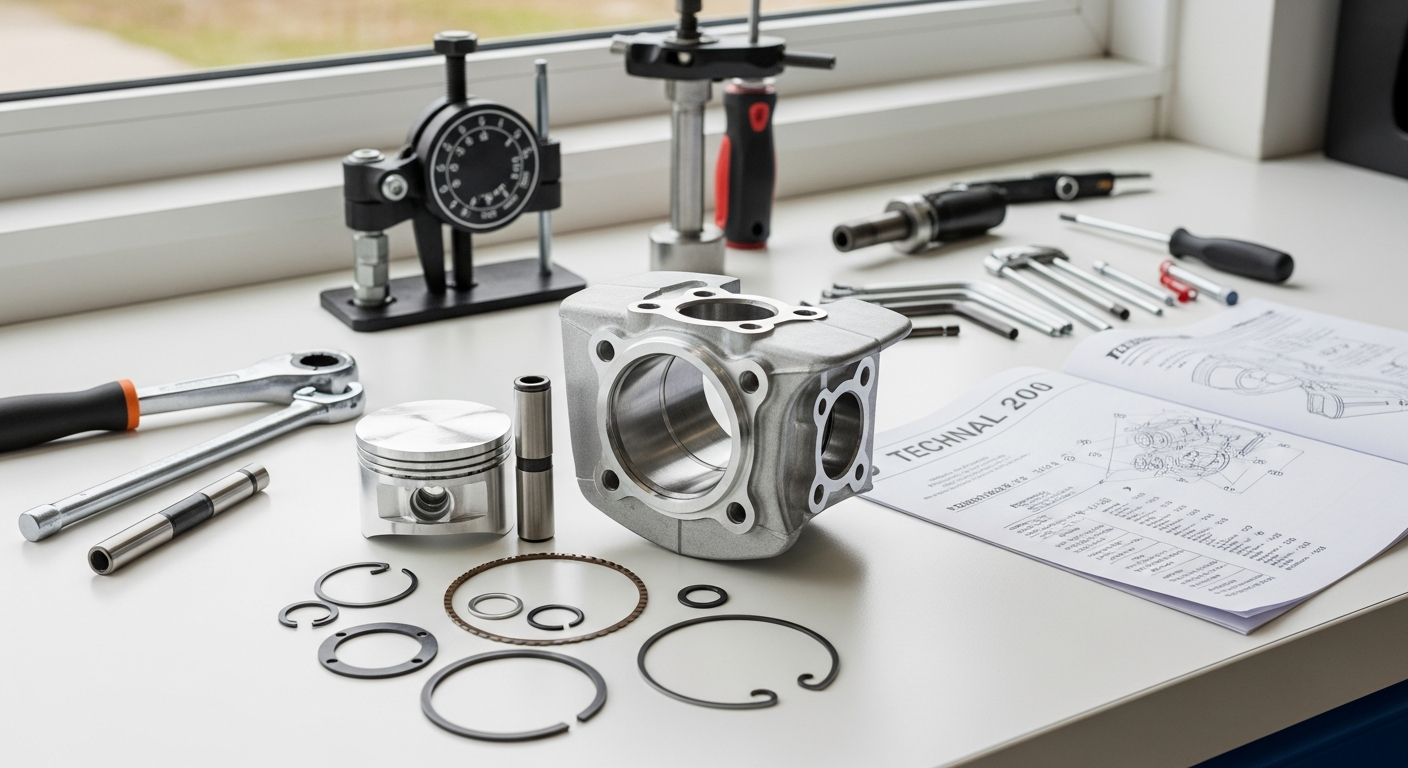
A complete 50cc cylinder kit includes several critical pieces working in concert. The cylinder body itself is the precision-bored aluminum or cast iron sleeve where combustion occurs. Inside, the piston—a lightweight plug-shaped component—moves up and down, compressing the fuel-air mixture and absorbing the explosion that follows. Piston rings (typically two or three per piston) seal the gap between the piston and cylinder wall, containing compression and preventing oil from burning in the combustion chamber. The piston pin connects the piston to the connecting rod, transmitting power to the crankshaft. Circlips—small wire clips—hold the piston pin in place. Finally, the gasket set includes seals for the cylinder head, base gasket, and other junction points, ensuring no compression leaks around component edges.
Cast iron vs. aluminum construction: Durability, heat dissipation, and performance trade-offs
Cast iron cylinders are heavier but exceptionally durable. They absorb and dissipate heat slowly, which can be an advantage in engines prone to overheating, though excess heat reduces power. Cast iron withstands repeated thermal cycling without cracking and tolerates imperfect piston rings better than aluminum. The trade-off: cast iron conducts heat less efficiently overall and adds weight that matters on lightweight 50cc bikes. Aluminum cylinders conduct heat far better, keeping the engine cooler and allowing higher compression ratios without detonation. They're lighter too. However, aluminum is softer and more prone to scoring if maintenance lapses. Aluminum cylinders require tighter tolerances and more careful installation.
Nicasil coating technology: Why premium kits use Nicasil-coated aluminum for superior performance
Nicasil—a nickel-silicon carbide composite—transforms aluminum's weakness into a strength. This hard, slippery coating protects the aluminum bore from wear while maintaining aluminum's excellent heat transfer. Premium 50cc cylinder kits employ Nicasil coating to deliver cast iron durability with aluminum performance advantages. The result: longer piston ring life, reduced friction, cooler operating temperatures, and more consistent power output. Nicasil-coated kits cost more upfront (€150–€200+) but justify the expense through extended service life and improved reliability.
Navigating the 50cc Cylinder Kit Price Spectrum
Budget-friendly replacements (€50–€80): Basic OEM-equivalent kits for standard restoration
Entry-level cylinder kits focus on restoring original engine function. These kits use cast iron or basic aluminum construction without premium coatings. Compression sealing matches factory specifications. Available from numerous manufacturers, budget kits work perfectly well for riders prioritizing cost over performance gains. They restore sluggish engines to their original vigor without modification. The downside: no power improvements beyond what a fresh engine produces, and slightly shorter service life compared to premium options.
Mid-range performance kits (€80–€150): Enhanced materials and slight power gains for enthusiasts
Mid-range options strike a balance. These kits often feature Nicasil-coated aluminum or premium cast iron with tighter tolerances. Some include slightly higher compression ratios, adding 10–15% power compared to stock engines. Piston rings and gasket materials improve sealing consistency. Enthusiasts targeting modest performance boosts without extreme tuning choose this tier. Installation difficulty remains reasonable, and the power gains are genuine and noticeable on the road.
Premium and tuning kits (€150–€200+): High-spec options for serious performance upgrades
Serious tuners purchase premium kits featuring full Nicasil coating, racing-spec pistons, and elevated compression ratios. These kits can yield 20–30% power increases in experienced hands. High-octane fuel becomes necessary to prevent detonation. Installation demands precision and technical skill. Reliability depends entirely on proper tuning and maintenance afterward. Premium kits represent the ceiling for 50cc power gains within legal displacement limits.
Matching Your Cylinder Kit to Your Specific Motorcycle Model
Compatibility challenges: Why a kit for a Beta RR 50 won't fit a Sherco or Rieju without verification
The 50cc label disguises significant engineering differences. A Beta RR 50 cylinder differs from a Sherco or Rieju in bore diameter, stroke length, cylinder port timing, and mounting bolt configuration. Bore sizes typically cluster around 40mm, but deviations exist. Stroke lengths vary, affecting piston pin location and connecting rod geometry. Mounting lugs don't align universally. Installing an incompatible kit results in improper sealing, misaligned ports preventing proper scavenging, or physically impossible assembly. Compatibility mistakes waste money and time.
Labécanerie's catalog advantage: How their extensive inventory solves the needle in a haystack problem
Labécanerie specializes in 50cc and vintage enduro motorcycle parts, maintaining an "unbeatable catalogue" spanning multiple manufacturers and model variations. Their decades of expertise mean they know which kits fit which machines. Rather than hunting through countless online listings hoping for compatibility, riders access a curated inventory verified for accuracy. This specialization eliminates guesswork. Labécanerie's reputation as an "absolute reference" for these parts stems directly from this deep model-specific knowledge.
Model-specific variations: Engine displacement, stroke type, and mounting configurations that differ across brands
Beta RR 50, Sherco, and Rieju represent distinct engineering philosophies. Some use aggressive port timing for performance; others prioritize predictability. Two-stroke engines require different cylinder architecture than four-stroke variants. Cooling passage locations vary. Intake manifold connections differ. Spark plug hole positioning matters. Carburettor flange sizes and shapes affect cylinder port entrance shape. These variations make model-specific matching essential. Purchasing a kit without verifying exact compatibility invites disaster.
Installation Realities and Technical Expertise Required
DIY feasibility: Honest assessment of whether a home mechanic can handle cylinder kit installation
Experienced home mechanics with proper tools can successfully install 50cc cylinder kits. The job demands patience and mechanical aptitude rather than exotic skills. Beginners should expect 4–6 hours of careful work. The process involves removing the cylinder head, extracting the old cylinder, cleaning the crankcase mating surface meticulously, installing new gaskets, positioning the new cylinder, and reassembling with correct torque specifications. One mistake—cross-threading a bolt, misaligning the cylinder, damaging a new gasket—cascades into larger problems. Professional installation eliminates risk but costs €80–€150 in labor.
Essential tools: What you'll need beyond the kit itself (honing tools, torque wrench, gasket scraper, etc.)
The cylinder kit alone doesn't include everything installation requires. A torque wrench ensures correct bolt tension—critical for preventing leaks and seizure. A gasket scraper removes old gasket material without gouging aluminum. A honing tool (or fine emery cloth) lightly conditions the new cylinder bore, improving piston ring sealing. A piston ring compressor simplifies piston installation. A gasket cutter prevents waste. Socket sets and screwdrivers specific to your bike's hardware matter. If you lack these tools, purchasing or renting them adds €50–€100 to the project cost, shifting the economic calculation toward professional service.
Step-by-step complexity: Removing the old cylinder, preparing the crankcase, and installing new components
Start by draining the fuel and oil, then remove the carburetor and intake manifold. Unbolt the cylinder head, extracting bolts in a crisscross pattern to prevent warping. The cylinder head lifts away, exposing the cylinder. Remove cylinder base bolts holding the old cylinder to the crankcase. Carefully extract the cylinder—piston rings can catch on the cylinder lip if you're careless. With the cylinder removed, inspect the crankcase mating surface for damage. Use a gasket scraper and degreaser to remove all old gasket material down to bare metal. Any debris left behind compromises the seal. Install the new base gasket and cylinder head gasket, positioning them correctly. Lightly hone the new cylinder bore with fine emery cloth to condition it. Install piston rings carefully—they're fragile and can snap. Position the piston pin circlips precisely. Lower the new cylinder slowly, ensuring the piston enters smoothly without catching. Check that the cylinder aligns with mounting provisions. Install base bolts using a torque wrench in a crisscross pattern, tightening progressively to prevent uneven seating. Reassemble the head, carburetor, and intake manifold. Refill with fresh oil and fuel. Allow gaskets time to set before running the engine hard.
Performance Gains and Real-World Expectations
Compression restoration: How a new cylinder kit returns lost power in worn engines
A worn engine delivering 5 bar of compression feels perpetually weak. Installing a fresh cylinder kit restores compression to 9–11 bar, immediately transforming the bike's character. The throttle response sharpens noticeably. Low-end torque improves, making acceleration from standstill snappier. Hill-climbing power returns. The engine idles more steadily without the hunting and missing of a weak-compression machine. These gains reflect mechanical efficiency, not magic. Better sealing during the compression stroke allows the fuel-air mixture to ignite more completely, producing more usable power.
Horsepower increases: Realistic gains from standard vs. performance-oriented kits
Standard cylinder kits restore a worn engine to original power output—typically 3–5 horsepower for 50cc bikes, depending on model. Performance-oriented kits can add 10–15% above stock (0.5–1 horsepower gain for many machines). Extreme tuning kits might reach 20–30% increases, though these demand high-octane fuel and careful jetting to prevent detonation. Real-world riders notice the mid-range improvements most acutely. The extra horsepower means less struggle during acceleration and climbing, making the bike feel more eager and responsive.
Throttle response improvement: Why a fresh cylinder feels snappier than a tired engine
A worn cylinder's poor compression and slack piston-to-bore clearance create compression leak-down—combustion pressure escapes past the piston rings before the expansion stroke begins. This delay dims the sharp power delivery that makes 50cc bikes fun. A tight new cylinder with fresh rings seals pressure instantly, creating immediate, direct power response. Twist the throttle and the engine reacts instantly rather than hesitantly. This snappiness defines the personality difference between a tired machine and a properly restored one.
Why Labécanerie Stands Out for 50cc Cylinder Kit Sourcing
Historical expertise: Decades of specialization in 50cc and vintage enduro motorcycle parts
Labécanerie's roots run deep in the 50cc and enduro motorcycle community, particularly in France where these bikes remain popular with young riders and urban commuters. This specialization isn't recent—it's baked into the company's "historical DNA." That historical focus means accumulated knowledge spanning decades: which kits work with which models, which manufacturers produce reliable components, which combinations deliver genuine value. Expertise built over years of direct customer interaction beats algorithm-based recommendations every time.
Unbeatable inventory: Access to rare components unavailable through mainstream retailers
Labécanerie's catalog includes "technical parts not found elsewhere." Mainstream motorcycle retailers focus on popular large-displacement bikes, treating 50cc components as niche products warranting minimal shelf space. Labécanerie inverts this priority, stocking extensive selections across multiple manufacturers and model variations. Need a cylinder kit for a 10-year-old Rieju? Labécanerie likely has options. Mainstream retailers might offer nothing. This inventory depth solves the real problem riders face: finding the right part for their specific bike.
24-hour dispatch capability: Real stock availability and rapid shipping for in-stock items
Labécanerie maintains real inventory, not drop-shipped orders. This means in-stock items ship within 24 hours. No waiting weeks for overseas sourcing. No surprise delays when ordered stock never materializes. For riders needing to get their bikes back on the road, this speed matters profoundly. Weekend mechanics can order Friday morning and install Saturday. Professional shops maintain customer satisfaction through fast parts sourcing.
Making Your Final Decision: Checklist and Next Steps
Assess your engine condition: Compression testing and visual inspection before committing to replacement
Before purchasing a cylinder kit, verify that low compression actually stems from cylinder wear rather than other issues. A compression test takes minutes with a simple gauge, costing €20–€30 at most shops. Manual kick-start bikes reveal compression through kick resistance—a worn engine kicks over lightly while a good one requires effort. Visual inspection of the exhaust for black smoke signals poor combustion. If compression tests acceptable but power is weak, the problem might be carburetor tuning, ignition timing, or transmission wear rather than the cylinder. Accurate diagnosis prevents wasted spending.
Define your goals: Are you restoring function or pursuing performance enhancement?
Budget kits suit riders wanting their bikes reliable again without modification. Performance kits appeal to enthusiasts seeking responsiveness. Extreme tuning kits demand expertise and higher ongoing maintenance. Clarity about your actual goals prevents overspending. A rider simply wanting their 50cc commuter reliable wastes money on a premium tuning kit yielding extra power they'll never use. Conversely, performance enthusiasts underwhelm themselves with budget options delivering minimal gains.
Budget allocation: Balancing kit cost, installation fees, and potential tool purchases
Total 50cc cylinder kit installation cost ranges from €50 (budget kit, DIY) to €300+ (premium kit plus professional installation). Factor in tool rentals if needed. Some riders prefer paying €150 labor to a professional rather than risking €200 mistakes. Others enjoy the learning experience and tool investment. Honest assessment of your mechanical confidence and available time prevents regrettable decisions. Start your 50cc cylinder kit selection with Labécanerie's expert guidance now.
Moving Forward With Confidence
Selecting a 50cc motorcycle scooter cylinder kit isn't just about buying a part—it's about breathing new life into a machine you depend on. The choice between cast iron durability and Nicasil-coated aluminum performance, between basic restoration and aggressive tuning, ultimately reflects your riding ambitions and mechanical comfort level. What separates successful cylinder kit installations from frustrating failures is preparation: knowing your engine's exact specifications, understanding what each component does, and recognizing when professional expertise matters more than DIY savings.
Labécanerie's unmatched catalog and reputation have cemented their position as the reference for these critical parts. When you're ready to restore compression, boost performance, or simply keep your motorcycle running reliably, their combination of inventory depth, technical knowledge, and rapid fulfillment removes the guesswork. Your next ride awaits. Discover the perfect 50cc cylinder kit for your motorcycle at Labécanerie today.